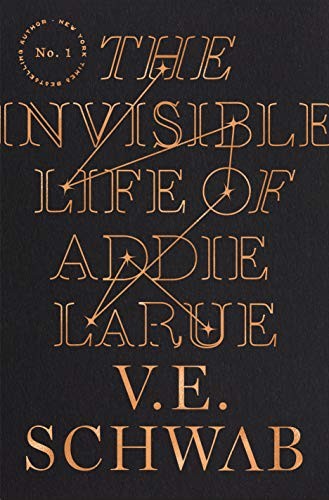
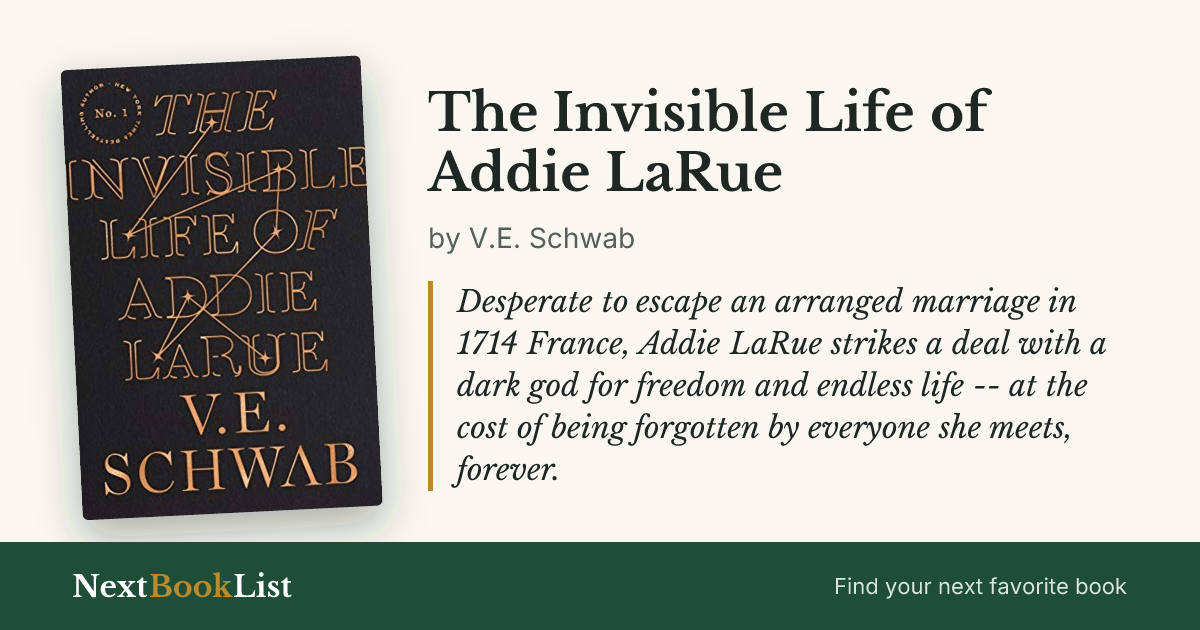
The Invisible Life of Addie LaRue
by V.E. Schwab · 2020
Desperate to escape an arranged marriage in 1714 France, Addie LaRue strikes a deal with a dark god for freedom and endless life -- at the cost of being forgotten by everyone she meets, forever.
Worth reading? A genuinely original take on the deal-with-the-devil premise, more meditation on memory and art than plot-driven fantasy.
| Author | V.E. Schwab |
|---|---|
| Published | 2020 |
| Publisher | Tor Books |
| Category | Fiction |
| Favorite quote | “Three words, large enough to tip the world. I remember you.” |
The Verdict
The premise is the strongest thing here – instead of the usual deal-with-the-devil story about mortality, Schwab makes the curse about being forgotten, which turns unlimited time and freedom into something genuinely melancholy rather than wish-fulfillment. Addie’s centuries as an anonymous muse to history’s artists is more compelling than it has any right to be.
Luc’s presence across the centuries is the book’s best structural choice – he never settles into simple villainy, which keeps the emotional core of the novel uncomfortable in a way that feels earned rather than manipulative.
Skip it if you need forward plot momentum to stay engaged – long stretches are meditative and structurally looping rather than driving toward a clear external goal. Read it if you want a genuinely original literary fantasy about what it costs to live without ever being remembered.
you want a genre-blending literary fantasy about memory, art, and mortality, told across three centuries, with a slow-burn romance that only becomes possible once someone can finally remember her
you want a plot-driven, fast-paced fantasy -- this is a meditative, structurally looping novel more interested in ideas about legacy and being forgotten than in traditional plot momentum
Book Summary
Addie LaRue prays for freedom on her wedding night in 1714 rural France and gets it from Luc, a dark god who grants her endless life and freedom from any obligation -- with the catch that she is instantly forgotten by everyone she meets the moment they're out of her sight, unable to leave a single mark or trace of having existed. The novel alternates between Addie navigating three centuries of complete anonymity, and a present-day storyline in 2014 New York, where she meets Henry, a bookstore clerk who is somehow the first person in 300 years to remember her.
Schwab uses Addie's curse to ask a genuinely interesting question: what would you actually do with unlimited time and freedom if none of it could ever accumulate into a legacy, a relationship, or even a memory anyone else holds onto? Addie's centuries of quiet survival -- becoming an anonymous muse to painters, mingling anonymously with history's margins -- become the book's real substance, more than the present-day romance that eventually gives the story its forward momentum.
Luc himself becomes a recurring, complicated presence across the centuries, less a straightforward villain than something between a captor and the only being who does remember her, which gives their relationship a genuinely uncomfortable, magnetic charge.
Top 8 Lessons from The Invisible Life of Addie LaRue
- Addie's deal grants her everything she asked for (freedom, endless life) while stripping the one thing she didn't think to protect against -- the ability to be remembered, which the book treats as the actual core of what makes a life meaningful.
- Unlimited time without the ability to build anything lasting is framed as its own kind of prison, not a wish come true, which reframes the classic deal-with-the-devil premise around legacy rather than mortality.
- Being forgotten by everyone she meets forces Addie to find identity entirely from within herself, since no relationship, achievement, or possession can ever accumulate to define her from the outside.
- Luc's relationship to Addie complicates the obvious villain framing -- across three centuries he's simultaneously her captor, her one constant companion, and arguably the only being who does remember her, which the book leans into rather than resolves cleanly.
- Art and creative influence become Addie's workaround to her curse -- she can't be remembered directly, but she can leave fingerprints on the work of painters and artists who do get remembered.
- Henry's ability to remember Addie is treated as its own kind of curse rather than a simple miracle, which keeps the central romance from being a straightforward wish-fulfillment fix to Addie's problem.
- The book argues that leaving a mark on the world doesn't require fame or permanence in the traditional sense -- Addie's quiet influence across centuries counts, even if she can never claim credit for it.
- Three centuries of forced anonymity are shown as genuinely lonely rather than romantically tragic, and the novel doesn't rush Addie's arc toward easy resolution just because a present-day love interest has arrived.
Top 4 Quotes from The Invisible Life of Addie LaRue
"If a person cannot leave a mark, do they exist?"
V.E. Schwab, The Invisible Life of Addie LaRue
"Three words, large enough to tip the world. I remember you."
V.E. Schwab, The Invisible Life of Addie LaRue
"They will not remember you, of course. But ideas are so much wilder than memories, so much faster to take root."
V.E. Schwab, The Invisible Life of Addie LaRue
"Grief is really just love, with nowhere to go."
V.E. Schwab, The Invisible Life of Addie LaRue
Frequently Asked Questions
Is The Invisible Life of Addie LaRue worth reading?
Yes, if you want a literary, idea-driven fantasy about memory and legacy rather than a fast-paced plot -- the premise is genuinely original and the prose carries it well.
Is The Invisible Life of Addie LaRue a romance novel?
It has a significant romance thread, but it's structured more as a literary fantasy spanning three centuries, with the present-day romance as one part of a larger story.
Is there a sequel to The Invisible Life of Addie LaRue?
As of this writing, it's a standalone novel, though V.E. Schwab has discussed the possibility of returning to the world.
Is The Invisible Life of Addie LaRue slow-paced?
Yes -- it moves meditatively between centuries and is more interested in ideas about memory and art than traditional plot momentum, especially in its middle stretch.
Ready to read it?
Get The Invisible Life of Addie LaRue on Amazon