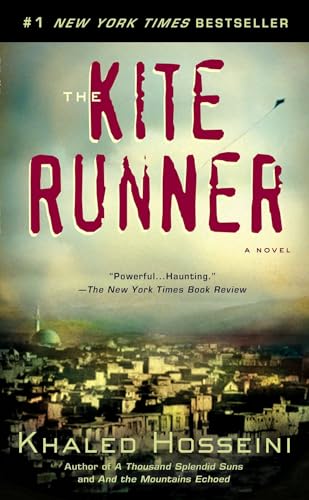
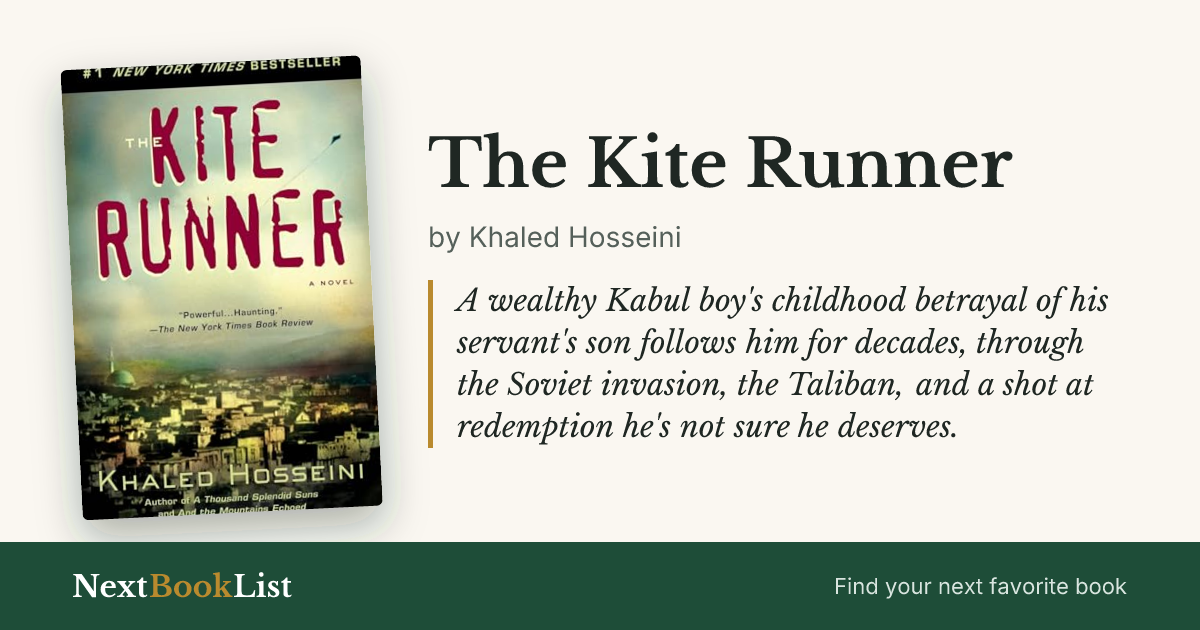
The Kite Runner
by Khaled Hosseini · 2003
A wealthy Kabul boy's childhood betrayal of his servant's son follows him for decades, through the Soviet invasion, the Taliban, and a shot at redemption he's not sure he deserves.
Worth reading? The Kite Runner earns its reputation as a gateway novel about Afghanistan for Western readers -- it's readable, emotionally direct, and doesn't flinch from Amir's cowardice the way a lot of guilt narratives soften their narrator. Where it loses points is the plotting mechanics in the second half, which lean on coincidence to force Amir's redemption into shape.
| Author | Khaled Hosseini |
|---|---|
| Published | 2003 |
| Publisher | Riverhead Books |
| Category | Fiction |
| Favorite quote | “For you, a thousand times over.” |
The Verdict
Hosseini’s real skill here is making Amir’s cowardice feel specific instead of generic – you understand exactly why a scared kid froze in that alley, and the book doesn’t let you off the hook for understanding it, either. That’s harder to pull off than it sounds.
Where the book strains is the return-to-Kabul section, which needs Amir’s old nemesis to still be running things decades later, in exactly the right place, for the plot to close its loop. It’s the kind of coincidence that works fine emotionally in the moment and less well once you stop and think about it.
Read it if you want a fast, emotionally direct novel about guilt and Afghanistan’s recent history that doesn’t require prior context to follow. Skip it if contrived plot mechanics in service of a big emotional payoff bother you more than they move you.
you want a novel that treats guilt as a plot engine, not a mood, and you're willing to sit with a narrator who did something genuinely unforgivable as a kid and spends the rest of the book proving it
you're allergic to redemption arcs that require a fairly contrived third-act coincidence to close the loop -- the book's back half asks you to accept some heavy plotting to get its ending
Book Summary
Amir, a privileged Pashtun boy in 1970s Kabul, watches his Hazara servant's son Hassan get assaulted and does nothing to stop it -- then spends the rest of his life trying to outrun the shame, first by driving Hassan away, later by fleeing to America with his father after the Soviet invasion.
Hosseini uses Amir and Hassan's friendship, and the class and ethnic gap between them (Pashtun over Hazara, master's son over servant's son), to dramatize a hierarchy most Western readers wouldn't otherwise see inside Afghan society before the wars flattened it.
The novel's back half sends adult Amir back to Taliban-controlled Kabul to rescue Hassan's orphaned son, turning personal guilt into a literal rescue mission -- a structural choice that makes the book's themes explicit but also stretches credibility.
Kite fighting, the tournament where Amir's betrayal of Hassan originally happens, becomes the book's central symbol: a moment of triumph and complicity that Amir can never fully separate from what he let happen right after it.
Top 9 Lessons from The Kite Runner
- The novel treats childhood cowardice as something that compounds with silence -- Amir's real crime isn't just failing to help Hassan, it's the years of concealment and small cruelties afterward that follow from covering it up.
- Class and ethnicity in the book aren't background color -- the Pashtun-Hazara divide structures every interaction between Amir and Hassan, even their genuine affection for each other.
- Baba, Amir's father, is written as a man whose own moral compromises (revealed late in the book) explain why he's so hard on Amir for lacking courage -- guilt in this book is generational.
- Emigration doesn't resolve Amir's guilt, it just relocates it -- his life in America is comfortable but the unresolved debt to Hassan follows him across an ocean.
- The book uses Afghanistan's political collapse (monarchy to Soviet invasion to Taliban rule) as a backdrop that makes Amir's personal redemption quest literally more dangerous each time he considers it.
- Redemption in the novel is framed as something that has to be paid for in action, not felt -- Amir's guilt only starts to lift once he does something at real physical risk to himself.
- Kite fighting, the arena where Amir's betrayal happens, works as the book's central symbol -- a moment of pure childhood triumph that becomes permanently tangled with the worst thing he's ever done.
- Hassan's loyalty to Amir never wavers even after the assault, and it's that loyalty, not just the assault itself, that makes Amir's betrayal land as hard as it does.
- The book's back half turns Amir's abstract guilt into a literal, physical rescue mission in Taliban-controlled Kabul, a structural choice that clarifies the theme even as it asks readers to accept some contrived plotting to get there.
Top 5 Quotes from The Kite Runner
"I became what I am today at the age of twelve, on a frigid overcast day in the winter of 1975."
Khaled Hosseini, The Kite Runner
"For you, a thousand times over."
Khaled Hosseini, The Kite Runner
"There is a way to be good again."
Khaled Hosseini, The Kite Runner
"It may be unfair, but what happens in a few days, sometimes even a single day, can change the course of a whole lifetime."
Khaled Hosseini, The Kite Runner
"Children aren't coloring books. You don't get to fill them with your favorite colors."
Khaled Hosseini, The Kite Runner
Frequently Asked Questions
Is The Kite Runner worth reading?
Yes, especially as an accessible entry point into modern Afghan history -- just go in knowing the second half leans on some convenient plotting to land its ending.
What is The Kite Runner about?
A Kabul boy's childhood betrayal of his best friend, and his decades-later attempt to make amends against the backdrop of Afghanistan's Soviet invasion and Taliban takeover.
Is The Kite Runner based on a true story?
No, it's fiction, though Hosseini draws on his own Afghan childhood and emigration for the setting and cultural details.
Is The Kite Runner appropriate for teens?
It contains a graphic assault scene and depictions of war violence, so it's better suited to older teens and adults.
Should I read The Kite Runner before A Thousand Splendid Suns?
They're not connected, so order doesn't matter, but The Kite Runner is the more commonly recommended starting point since it was published first.
Ready to read it?
Get The Kite Runner on Amazon