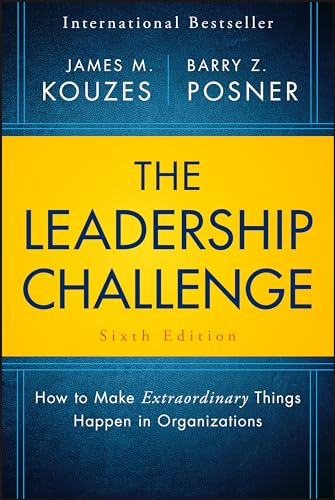
The Leadership Challenge
by James Kouzes & Barry Posner · 1987
The research-backed leadership framework built from thousands of case studies, distilled into five practices any leader can learn.
Worth reading? The Leadership Challenge is built different from most leadership books: instead of one executive's memoir dressed up as a framework, Kouzes and Posner surveyed and studied thousands of leaders to extract five practices that show up repeatedly in cases of genuinely effective leadership. It's more academically grounded than Primal Leadership, though also drier -- if you want the emotional-intelligence angle on leadership specifically, pair this with Primal Leadership rather than choosing one over the other.
| Author | James Kouzes & Barry Posner |
|---|---|
| Published | 1987 |
| Category | Self-Improvement & Psychology |
| Favorite quote | “Leadership is not about personality; it's about behavior.” |
The Verdict
Kouzes and Posner’s five practices have become close to an industry standard in corporate leadership development, and the research base behind them is genuinely more rigorous than most books in the genre. It’s dense reading, best used as a reference framework you return to rather than a single straight-through read.
you want an evidence-based, practice-driven leadership model rather than a single leader's personal war stories
you want a fast, casual read, this is research-dense and repeats its five-practice framework across many case studies, which can feel exhaustive
Book Summary
Leadership, per Kouzes and Posner's research, isn't a fixed trait some people have and others don't -- it's a set of learnable practices that show up consistently across effective leaders regardless of industry or personality: modeling the way (leading by example), inspiring a shared vision, challenging the process (taking smart risks), enabling others to act (building trust and collaboration), and encouraging the heart (recognizing contributions).
The book is also notable for treating leadership as fundamentally relational rather than positional -- it's not about the title or authority you hold, it's about the credibility you build with the people choosing to follow you, and credibility is earned through consistent action over time, not declared through a job title.
Top 7 Lessons from The Leadership Challenge
- Model the way: your own visible behavior sets the standard more than any policy you announce.
- Inspire a shared vision that others can see themselves in, not just one you personally find compelling.
- Challenge the process by seeking out small, smart experiments rather than either blind conformity or reckless risk.
- Enable others to act by building trust and collaboration, not by hoarding control.
- Encourage the heart -- recognize individual contributions specifically and consistently, not generically.
- Leadership credibility is earned through consistent action over time, not granted by title or position.
- Leadership is a set of learnable practices, not a fixed personality trait you either have or lack.
Top 3 Quotes from The Leadership Challenge
"Leadership is not about personality; it's about behavior."
James Kouzes & Barry Posner, The Leadership Challenge
"The best leaders are the best learners."
James Kouzes & Barry Posner, The Leadership Challenge
"Credibility is the foundation of leadership."
James Kouzes & Barry Posner, The Leadership Challenge
Frequently Asked Questions
Is The Leadership Challenge worth reading?
Yes, especially if you want research-backed leadership principles rather than one executive's personal anecdotes. The five practices framework is widely used in corporate leadership training for a reason.
What are the five practices in The Leadership Challenge?
Model the way, inspire a shared vision, challenge the process, enable others to act, and encourage the heart -- five behaviors Kouzes and Posner found consistently among effective leaders across their research.
Is The Leadership Challenge based on research?
Yes -- it's built on decades of surveys and case studies of leaders across industries, which distinguishes it from leadership books based on a single executive's personal experience.
How is this different from Primal Leadership?
The Leadership Challenge is a broader, practice-based framework built from wide research. Primal Leadership focuses specifically on emotional intelligence as the driver of leadership effectiveness.
Ready to read it?
Get The Leadership Challenge on Amazon