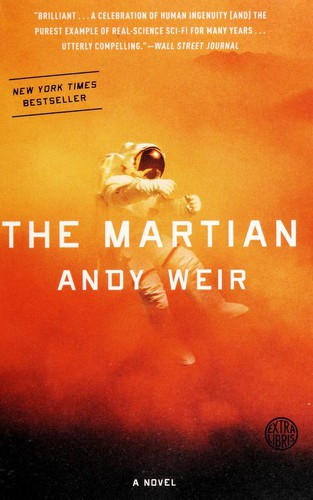
The Martian
by Andy Weir · 2014
An astronaut stranded alone on Mars after his crew leaves him for dead has to science his way through food, water, and communication problems with nothing but duct tape, chemistry, and stubborn optimism.
Worth reading? The Martian works because Weir treats survival as a series of solvable engineering problems and shows his work -- the math and chemistry are specific enough to feel real, and Mark Watney's constant deadpan humor keeps a potentially bleak premise propulsive instead of grim.
| Author | Andy Weir |
|---|---|
| Published | 2014 |
| Publisher | Crown Publishing Group |
| Category | Fiction |
| Favorite quote | “I'm gonna have to science the shit out of this.” |
The Verdict
Weir’s background as a software engineer shows in the best way: every problem Watney faces gets solved with actual numbers, actual chemistry, actual constraints. That specificity is what makes the survival story feel earned instead of hand-waved.
The humor is doing real structural work, not just comic relief – Watney’s sarcasm keeps a story about slow, methodical near-death from becoming exhausting to read for 350 pages. Whether that voice works for you probably determines whether the whole book works for you.
The NASA chapters add institutional stakes but are less compelling than the Mars sections, mostly because bureaucratic tension can’t compete with “will this man’s oxygen run out.”
Read it if you want hard science fiction that shows its work and keeps its tone light despite the stakes. Skip it if you want literary prose or deep psychological interiority instead of problem-solving momentum.
you want hard science fiction where the tension comes from real engineering and chemistry problem-solving, narrated by a wisecracking protagonist who refuses to be grim about his own survival odds
you want lyrical prose or deep interiority -- Weir's style is functional and joke-heavy, built for momentum and problem-solving, not literary voice
Book Summary
Astronaut Mark Watney is presumed dead and left behind on Mars when a dust storm forces his crew to abort their mission early. He survives, and the bulk of the book is a step-by-step account of him solving one existential problem after another -- growing food in Martian soil using his own waste as fertilizer, rationing water, jury-rigging communication with NASA -- using nothing but the equipment already on the base and his training as a botanist and mechanical engineer.
Weir's real subject is competence under pressure: every crisis in the book gets solved through specific, plausible science rather than convenient plot devices, and the book shows its work in enough technical detail that readers with engineering backgrounds have fact-checked it and found it mostly holds up. The tension comes less from suspense about whether Watney will die and more from the mechanics of exactly how he solves each new problem.
The book alternates Watney's first-person log entries (funny, profane, defiantly upbeat) with third-person chapters following NASA's efforts to bring him home, which lets Weir build institutional and political tension (public relations, budget fights, risk calculus) alongside the survival story on Mars.
Top 8 Lessons from The Martian
- Watney survives by treating his situation as a series of discrete, solvable engineering problems rather than a single overwhelming crisis -- the book models breaking an impossible situation into smaller ones.
- He grows potatoes in Martian soil by fertilizing it with his own waste and creating water through a hydrogen-oxygen combustion process, using only equipment already on the Mars habitat.
- The book insists on showing its scientific work -- the math for rationing supplies, the chemistry for producing water, the physics of the rover modifications are all worked through on the page, not glossed over.
- Watney's constant humor and sarcasm in his log entries function as a coping mechanism that also keeps the reader from experiencing his isolation as purely bleak.
- NASA's institutional response -- public relations concerns, budget constraints, competing risk assessments -- shows that rescuing one astronaut is as much a political and logistical problem as a technical one.
- The international cooperation subplot, where the China National Space Administration contributes a rocket to the rescue effort, reflects the book's interest in problem-solving that transcends institutional rivalry.
- Every setback in the story (an airlock breach, a dust storm, a failed supply launch) forces Watney to revise his plan rather than simply endure, reinforcing the book's theme that survival is active, not passive.
- The ending's high-risk rendezvous plan, involving Watney essentially becoming a human projectile to reach the rescue ship, is presented with the same rigorous problem-solving logic as the rest of the book.
Top 3 Quotes from The Martian
"I'm gonna have to science the shit out of this."
Andy Weir, The Martian
"Mars will come to fear my botany powers."
Andy Weir, The Martian
"I don't want to come off as arrogant here, but I'm the best botanist on the planet."
Andy Weir, The Martian
Frequently Asked Questions
Is The Martian worth reading?
Yes -- it's a propulsive, technically grounded survival story with a genuinely funny narrator, and the science holds up well for a general audience.
What is The Martian about?
Astronaut Mark Watney is stranded alone on Mars after his crew presumes him dead in a dust storm, and the book follows his engineering and chemistry-based survival while NASA works to rescue him.
Is The Martian scientifically accurate?
Mostly, yes -- Andy Weir researched the science extensively, and much of the survival chemistry and engineering has held up to expert fact-checking, with some simplifications for pacing.
Do you need a science background to enjoy The Martian?
No -- Weir explains the science through Watney's log entries in accessible terms, so no technical background is required.
Is the movie faithful to the book?
The 2015 film starring Matt Damon follows the book's plot closely, cutting some of the more granular technical detail for pacing.
Ready to read it?
Get The Martian on Amazon