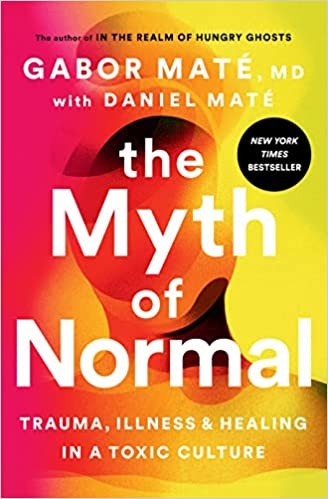
The Myth of Normal
by Gabor Maté · 2022
A physician's case that your chronic illness or anxiety might not be a personal failing -- it might be the culture you grew up in showing up in your body.
Worth reading? The Myth of Normal is the heaviest, longest book in this genre on the site, and that's by design -- Gabor Maté is a physician making a medically grounded argument, not a coach handing you a framework. His claim is that a culture built on disconnection, stress, and suppressed emotion produces the chronic illness and mental health struggles we treat as purely individual or biological. It's convincing and often uncomfortable, but it's not a quick fix book, and if you're looking for a five-step plan you'll be frustrated by how long it takes to get to any prescription. Read it if you want the 'why' behind your symptoms explained properly; skip it if you just want the 'what to do.'
| Full Title | The Myth of Normal: Trauma, Illness, and Healing in a Toxic Culture |
|---|---|
| Author | Gabor Maté |
| Published | 2022 |
| Category | Self-Improvement & Psychology |
| Favorite quote | “Trauma is not what happens to you. It's what happens inside you as a result of what happened to you.” |
The Verdict
Gabor Maté is a physician, and The Myth of Normal reads like one wrote it – long, evidence-heavy, and more interested in explaining the mechanism than handing you a five-step plan. His argument is that a lot of what we call individual illness or anxiety is actually the predictable output of unprocessed trauma running into a culture built on disconnection and chronic stress.
It’s a heavier read than most books in this list, both in length and tone. If you want the reasoning behind your symptoms laid out properly, it delivers. If you just want something to do this week, this isn’t that book.
you're dealing with chronic illness, anxiety, or a pattern that hasn't responded to willpower alone, and you're willing to read something dense and medically grounded to understand why
you want a quick, actionable self-help book -- this is a long, heavy read that argues before it prescribes, closer to a thesis than a workbook
Book Summary
Chronic illness and mental health conditions are frequently downstream of unprocessed childhood trauma and chronic stress, not purely genetic or random biological bad luck. Maté draws on decades of clinical experience to argue mind and body are far more connected than mainstream medicine treats them.
Modern culture is 'toxic' in a specific sense: it rewards disconnection from our own needs and emotions, prioritizes productivity over authentic connection, and normalizes chronic stress as just how life is, which erodes health over time.
Authenticity and attachment are basic human needs, and when a child has to choose between the two (suppressing their true self to stay attached to a caregiver), authenticity usually loses -- and that suppression can resurface decades later as illness or anxiety.
Healing requires addressing the emotional and social root causes, not just managing symptoms. Maté is critical of a medical system that treats the body in isolation from a person's life history and environment.
Top 8 Lessons from The Myth of Normal
- Chronic stress and suppressed emotion can manifest as physical illness, not just psychological distress.
- Ask 'what happened to you' instead of 'what's wrong with you' when trying to understand a symptom or pattern.
- Children often suppress their authentic needs to preserve attachment to caregivers, and that costs them later.
- Modern culture normalizes chronic stress as normal life, which quietly erodes long-term health.
- Treating a symptom without addressing its root emotional cause tends to produce recurrence, not healing.
- Reconnecting with your own needs and boundaries is often a precondition for physical healing, not a side benefit.
- The mind-body split in mainstream medicine underestimates how much emotional history shapes physical health.
- Compassionate self-inquiry into your own history is a legitimate part of treating chronic conditions.
Top 1 Quotes from The Myth of Normal
"Trauma is not what happens to you. It's what happens inside you as a result of what happened to you."
Gabor Maté, The Myth of Normal
Frequently Asked Questions
Is The Myth of Normal worth reading?
Yes, if you want a medically grounded explanation of how trauma and culture connect to chronic illness. It's a dense, long read, not a quick fix, so go in expecting depth over speed.
What is the main idea of The Myth of Normal?
Chronic illness and mental health struggles are often downstream of unprocessed trauma and a disconnected, high-stress culture, not just individual biology or willpower.
Is The Myth of Normal a self-help book?
It's closer to a medically grounded argument than a typical self-help workbook. It explains root causes in depth before offering direction, and it's a heavier, longer read than most books in this genre.
Who should read The Myth of Normal?
Readers dealing with chronic illness, anxiety, or unexplained patterns who want to understand the deeper 'why.' Skip it if you want a fast, actionable plan rather than a long explanatory case.
Ready to read it?
Get The Myth of Normal on Amazon