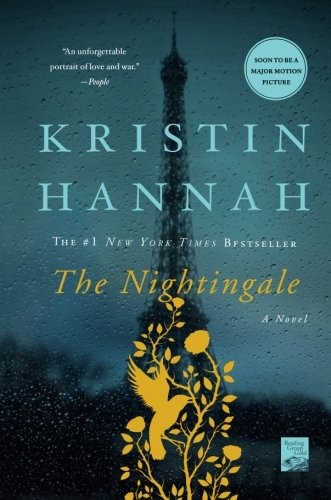
The Nightingale
by Kristin Hannah · 2015
Two French sisters take wildly different paths through Nazi-occupied France, one running an escape network for downed Allied airmen, the other surviving by staying quiet and compliant -- and the book argues both were forms of resistance.
Worth reading? The Nightingale is unabashedly a tearjerker, and it earns most of its emotional beats through solid research into the real French resistance networks (particularly the real-life 'Comet Line' escape routes that inspired Isabelle's story) even where the prose itself leans melodramatic. Vianne and Isabelle's contrasting paths, quiet survival versus active defiance, give the book its most interesting argument: that staying alive under occupation was its own kind of resistance, not just passive endurance.
| Author | Kristin Hannah |
|---|---|
| Published | 2015 |
| Publisher | St. Martin's Press |
| Category | Fiction |
| Favorite quote | “In love we find out who we want to be. In war we find out who we are.” |
The Verdict
The Comet Line-inspired escape network gives Isabelle’s half of the book real stakes and specificity, Hannah clearly did the research on how these routes actually operated, and that grounding keeps the more thriller-paced sections from feeling invented out of thin air.
Vianne’s storyline is the more interesting half, even though it’s the quieter one. Hannah is making a real argument here, that staying alive and protecting a child under occupation took its own kind of nerve, one the genre usually undersells next to more active heroics. The book’s willingness to sit in that discomfort, rather than resolve it neatly, is its best quality.
Read it if you want emotionally direct WWII fiction centered on women’s experience of occupation. Skip it if you’d rather your historical fiction stay restrained – this one goes for the tears on purpose, repeatedly.
you want emotionally direct WWII historical fiction centered entirely on women's experience of occupation, and you don't mind a novel that leans hard into melodrama to hit its emotional beats
you want restraint -- Hannah goes for maximum emotional impact at nearly every turn, and readers who prefer understated prose may find the sentimentality heavy-handed
Book Summary
Vianne and Isabelle Rossignol, sisters estranged by very different temperaments, are separated when Nazi Germany occupies France, Vianne staying in her village to protect her daughter while housing a German officer, Isabelle joining the resistance and eventually helping guide downed Allied airmen across the Pyrenees to safety.
Hannah draws directly on the real history of resistance escape networks (loosely inspired by the Comet Line) to give Isabelle's storyline concrete stakes, while Vianne's storyline focuses on the quieter, more morally compromised experience of surviving occupation without joining active resistance.
The novel's central argument is that Vianne's survival-focused choices, including sheltering a Jewish friend's children and enduring forced billeting of a German officer, constitute a form of courage the war-story genre doesn't usually credit as equal to Isabelle's more overtly heroic underground work.
A late-book reveal about Vianne's wartime actions (kept from her own children for decades) reframes the entire novel as being about the private, unspoken cost women paid during occupation, cost that history and even their own families often failed to fully register or honor.
Top 9 Lessons from The Nightingale
- The novel argues that resistance during occupation took multiple forms, and that Vianne's survival-focused choices deserve as much narrative weight as Isabelle's active underground work, a deliberate rebalancing of how WWII stories usually assign heroism.
- Isabelle's work with a resistance escape network is grounded in real history (inspired by actual wartime escape lines), giving the book's more overtly thriller-like sections real historical texture.
- The sisters' fraught relationship before the war, rooted in childhood abandonment by their father, is used to explain why they diverge so sharply in how they respond to occupation, temperament shaped by history, not random plot assignment.
- Vianne's decision to shelter a Jewish friend's children at enormous personal risk is presented without a triumphant framing, the novel keeps the moral cost and constant fear front and center rather than letting it read as simple heroism.
- The novel's late-book frame, an elderly survivor looking back decades later, is used to argue that many women's wartime sacrifices went unrecorded and unrecognized by history and even by their own families.
- Hannah uses the contrast between the sisters to challenge a common war-narrative assumption that only active combatants or saboteurs count as resisting, quiet endurance under threat is framed as its own form of defiance.
- Vianne being forced to house a German officer in her own home dramatizes how occupation collapsed the line between victim and collaborator long before anyone consciously chose a side.
- The late reveal of what Vianne actually did during the war, kept hidden from her own children for decades, reframes the whole novel as being about costs that even the people closest to her never fully knew about.
- Hannah writes toward maximum emotional impact by design, not restraint -- the book earns most of its bigger swings through the historical research underneath them, even where the prose itself leans melodramatic.
Top 1 Quotes from The Nightingale
"In love we find out who we want to be. In war we find out who we are."
Kristin Hannah, The Nightingale
Frequently Asked Questions
Is The Nightingale worth reading?
Yes, especially if you want women-centered WWII historical fiction -- just go in expecting a genuinely emotional, sometimes melodramatic read rather than a restrained one.
What is The Nightingale about?
Two French sisters navigate Nazi-occupied France through very different paths, one joining an active resistance escape network, the other surviving through quieter, morally complicated endurance.
Is The Nightingale based on a true story?
It's fiction, but Isabelle's resistance work draws inspiration from real wartime escape networks that guided downed airmen out of occupied France.
Is The Nightingale sad?
Yes, it's an intentionally emotional book that doesn't soften the costs of occupation, including violence, loss, and moral compromise.
Is there a movie version of The Nightingale?
A film adaptation has been in development, though as of this writing it hasn't been released -- don't confuse it with the unrelated 2018 Australian film of the same name.
Ready to read it?
Get The Nightingale on Amazon