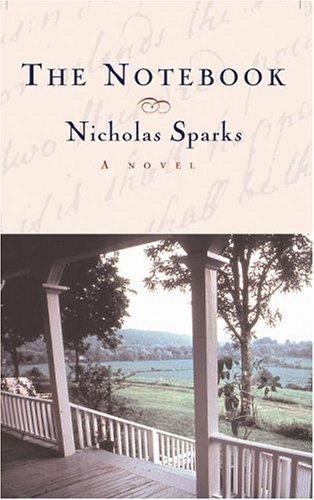
The Notebook
by Nicholas Sparks · 1996
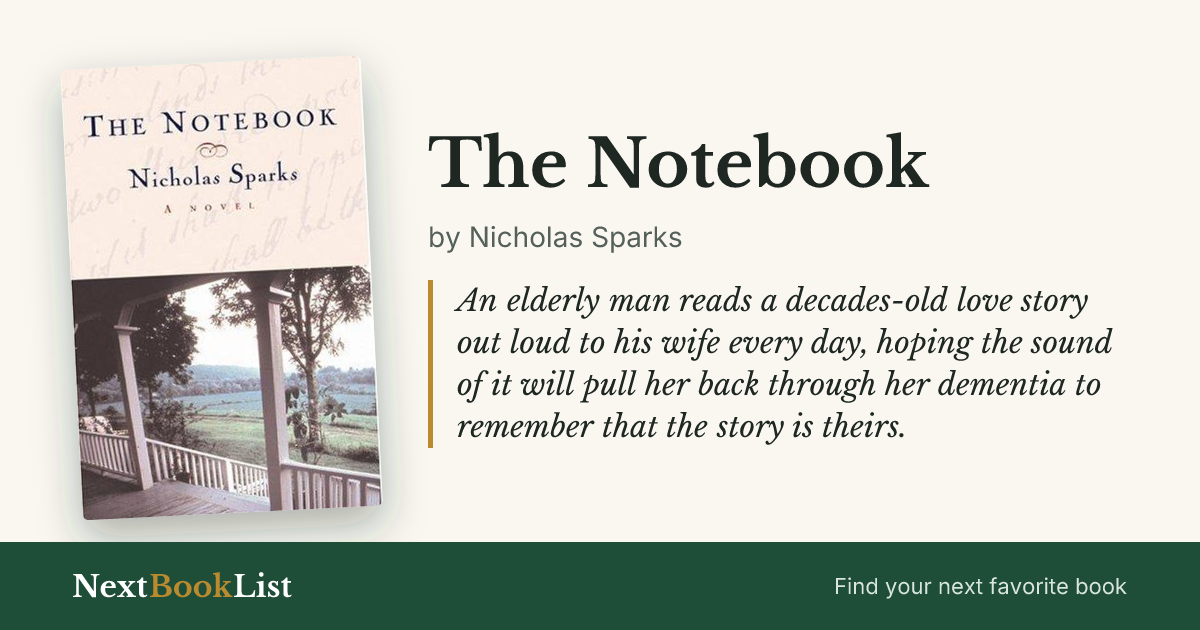
An elderly man reads a decades-old love story out loud to his wife every day, hoping the sound of it will pull her back through her dementia to remember that the story is theirs.
Worth reading? The Notebook is the book that set Nicholas Sparks's entire template, and it's also his best execution of it. The nursing-home frame, where an old man reads their story to a wife who can't remember it, does more emotional work than the young-love flashback could carry on its own.
| Author | Nicholas Sparks |
|---|---|
| Published | 1996 |
| Publisher | Warner Books |
| Category | Fiction |
| Favorite quote | “You are, and always have been, my dream.” |
The Verdict
The frame is the whole book. Strip out the present-day storyline and you’ve got a fairly generic star-crossed-teen-romance plot; keep it, and the reveal that Noah and Allie are both the young couple and the old couple gives the entire novel its actual force.
Sparks’s prose is plain by design, and here that plainness works in the book’s favor – it doesn’t get in the way of the reveal or oversell the sentiment before it’s earned.
It also set a formula Sparks would repeat, with steadily diminishing returns, across a dozen later books. If you’ve read several of them, you’ll recognize where this one is doing it first and best.
Read it if you want the original, strongest version of the Sparks formula. Skip it if you’ve already read enough of his later books that the structure feels used up.
you want a short, emotionally direct romance built around a genuinely strong framing device -- the present-day nursing home storyline gives the young-love flashback real weight it wouldn't have alone
you find Sparks's prose sentimental to the point of manipulation, or you've read enough of his later books that the formula (this one basically invented it) feels familiar rather than fresh
Book Summary
Noah and Allie fall in love as teenagers one summer in 1940s North Carolina, are separated by her family's disapproval and the war, and spend years apart before reuniting -- the flashback plot is a fairly standard star-crossed-lovers arc, told simply and without much complication.
The novel's real engine is the frame around that story: in the present day, an elderly Noah reads the story aloud daily to his wife, now in a nursing home with advanced dementia, in the hope that hearing it will occasionally bring her back to herself, even briefly.
Sparks lets the reveal that the young couple and the old couple are the same two people land with real force, and the book's actual subject turns out to be less about young love than about what it means to keep loving someone who can no longer remember loving you back.
Top 9 Lessons from The Notebook
- The nursing-home frame is doing more work than the young-love flashback -- it's the part of the book that earns genuine emotional weight rather than relying on sentiment alone.
- Sparks keeps the young-love plot deliberately simple and archetypal, which lets the present-day frame carry the book's actual complexity.
- The novel treats memory loss and caregiving with more specificity than its reputation as pure romance suggests.
- This book set the template (small-town setting, thwarted young love, a twist reveal) that most of Sparks's later novels would repeat with diminishing returns.
- The prose is plain and unadorned by design -- Sparks isn't going for literary complexity, he's going for direct emotional accessibility.
- The novel's ending resists an easy, fully redemptive resolution to the dementia plot, which is more honest than the format usually allows itself to be.
- The reveal that the star-crossed young couple and the elderly nursing-home couple are the same two people is timed to land with maximum force, and the whole book is built to earn that one moment.
- At barely 200 pages, this is Sparks working in his tightest form -- the shorter length keeps the sentiment from sprawling the way his later, longer novels sometimes do.
- The novel is loosely rooted in Sparks's own family history (inspired by his wife's grandparents), which may be part of why the nursing-home sections feel more specific than the generic young-love plot around them.
Top 3 Quotes from The Notebook
"I am nothing special; of this I am sure. I am a common man with common thoughts, and I've led a common life. There are no monuments dedicated to me and my name will soon be forgotten, but I've loved another with all my heart and soul, and to me, this has always been enough."
Nicholas Sparks, The Notebook
"The best love is the kind that awakens the soul and makes us reach for more, that plants a fire in our hearts and brings peace to our minds. That's what I hope to give you forever."
Nicholas Sparks, The Notebook
"You are, and always have been, my dream."
Nicholas Sparks, The Notebook
Frequently Asked Questions
Is The Notebook worth reading?
Yes -- it's Sparks's best execution of his own formula, and the nursing-home frame gives it more genuine weight than most of his later books.
What is The Notebook about?
An elderly man reads a decades-old love story aloud to his wife, whose dementia has erased her memory of it, revealing that they are the same young couple from the story.
Is The Notebook based on a true story?
Loosely -- Sparks has said the elderly couple's relationship was inspired by his wife's grandparents.
Is The Notebook sad?
Yes, it deals directly with dementia and aging alongside the romance, and doesn't fully soften the ending.
How does the book compare to the 2004 film?
The film is largely faithful to the plot and is widely considered one of the stronger book-to-film adaptations of Sparks's work.
Ready to read it?
Get The Notebook on Amazon