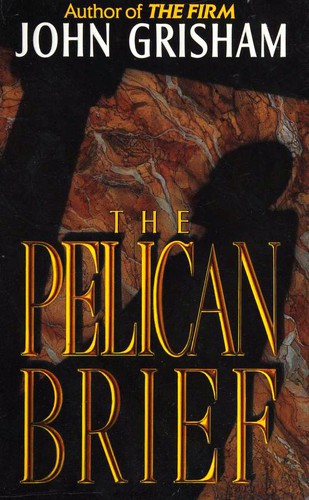
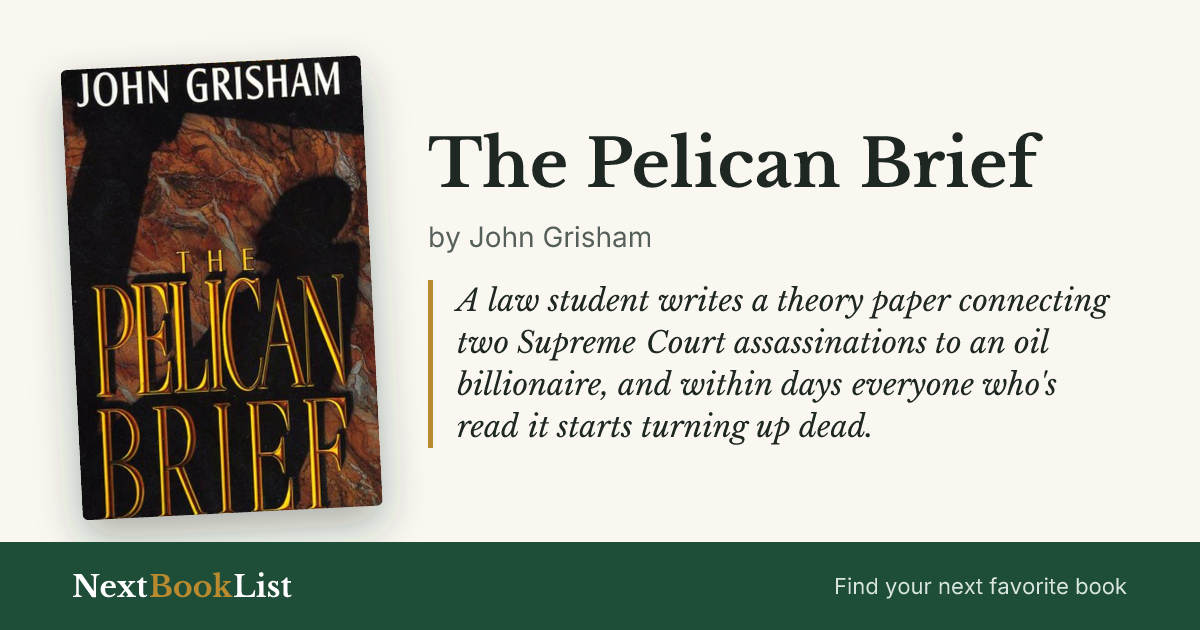
The Pelican Brief
by John Grisham · 1992
A law student writes a theory paper connecting two Supreme Court assassinations to an oil billionaire, and within days everyone who's read it starts turning up dead.
Worth reading? The Pelican Brief is Grisham leaning further into political conspiracy than legal procedure, and the premise (a law student's speculative memo turns out to be exactly right) is stronger than the execution. It's a fun, fast conspiracy thriller, but it asks you to accept a lot of narrow escapes.
| Author | John Grisham |
|---|---|
| Published | 1992 |
| Publisher | Doubleday |
| Category | Fiction |
The Verdict
The premise is the best part: a grad-school thought exercise turns out to be dead accurate, and the person who wrote it has no way to prove she didn’t mean to expose a real conspiracy. That setup earns a lot of goodwill early.
Where it wobbles is plausibility. Darby survives an improbable number of assassination attempts through a mix of luck and instinct, and by the book’s midpoint you’re reading more for momentum than for belief.
Grisham’s pairing of Darby with a reporter racing a print deadline gives the back half a different energy than The Firm’s legal maneuvering – it’s more newsroom thriller than courtroom drama.
Read it if you want a fast conspiracy plot with a smart premise. Skip it if you need your thrillers grounded in something closer to realistic risk.
you want a conspiracy thriller with a genuinely smart amateur-sleuth premise -- the hero survives on legal reasoning and caution, not combat skills
you want restrained, realistic pacing -- the body count and the speed at which Darby stays two steps ahead of professional killers strains credibility by the halfway point
Book Summary
Darby Shaw, a law student, writes a theoretical brief connecting the assassinations of two Supreme Court justices to a reclusive oil billionaire who stands to profit from the resulting court's rulings on an environmental case. She shares it with her professor as a thought exercise, not expecting anyone to take it seriously.
The brief turns out to be accurate, and once it reaches the wrong desks in Washington, Darby becomes a target for professional killers while the people meant to protect her -- the FBI, the White House -- are either compromised or too slow to act. The novel's tension comes from Darby having almost no one she can trust with what she knows.
Grisham pairs Darby with a Washington Post reporter to get the story into print before she's killed, turning the second half into a press-versus-power thriller as much as a legal one -- the courtroom takes a back seat to newsroom and surveillance tradecraft.
Top 11 Lessons from The Pelican Brief
- The plot's engine is that a correct theory, once it threatens powerful interests, becomes more dangerous to hold than a wrong one.
- Grisham uses institutional distrust as the core suspense mechanic -- Darby can't tell which parts of the government are hunting her and which might help.
- The novel pairs legal reasoning with investigative journalism as the two tools capable of taking down someone above the law, rather than relying on law enforcement.
- Darby's survival depends on constant movement and anonymity, which turns much of the book into a study of how hard it actually is to disappear.
- The book treats money and political access as functionally interchangeable -- the villain's oil wealth buys him direct influence over judicial appointments.
- Grisham keeps the romantic subplot minor relative to earlier thrillers of the genre, letting the conspiracy carry the book instead.
- Darby's mentor Thomas Callahan is killed in a car bombing early on, stripping away her one built-in support system and forcing the plot into her working almost entirely alone.
- The brief itself functions as a MacGuffin everyone wants to possess or destroy, which keeps the plot moving even when the physical danger stretches plausibility.
- FBI Director Voyles is written as neither fully trustworthy nor fully compromised, keeping Darby -- and the reader -- guessing about which parts of the government can actually help her.
- Grisham uses the newsroom's own internal caution -- editors demanding corroboration before running a story that could get someone killed -- as its own source of suspense, separate from the chase itself.
- The book resolves the conspiracy through publication and public exposure rather than a courtroom verdict, underlining that the press, not the legal system, is what actually stops the villain.
Frequently Asked Questions
Is The Pelican Brief worth reading?
Yes, as a fast conspiracy thriller -- just go in accepting that some of the escapes and coincidences ask for a lot of suspended disbelief.
What is The Pelican Brief about?
A law student's speculative legal memo turns out to correctly identify who's behind the assassination of two Supreme Court justices, making her a target for the people responsible.
Is The Pelican Brief a sequel to The Firm?
No, it's a standalone novel with different characters, published the year after The Firm.
How does The Pelican Brief compare to the movie?
The book gives more space to Darby's legal reasoning and the mechanics of the brief itself; the film compresses that in favor of the chase.
Is The Pelican Brief more political or more legal?
More political -- the courtroom takes a back seat to Washington power dynamics and investigative journalism for most of the book.
Ready to read it?
Get The Pelican Brief on Amazon