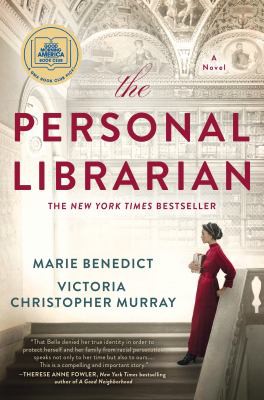
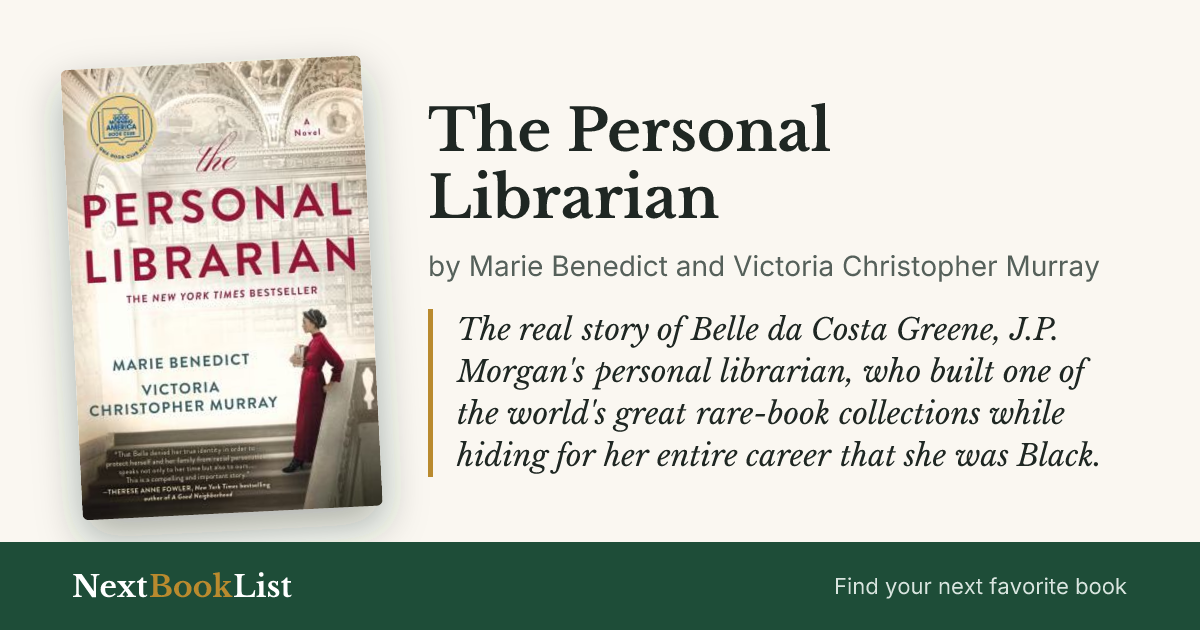
The Personal Librarian
by Marie Benedict and Victoria Christopher Murray · 2021
The real story of Belle da Costa Greene, J.P. Morgan's personal librarian, who built one of the world's great rare-book collections while hiding for her entire career that she was Black.
Worth reading? The Personal Librarian works because the true story underneath it is remarkable enough to survive workmanlike prose. Belle da Costa Greene passing as white to build the Morgan Library's rare book collection, negotiating with European dealers as the most powerful librarian in America, is a story that didn't need much embellishment, and the co-authors mostly get out of its way.
| Author | Marie Benedict and Victoria Christopher Murray |
|---|---|
| Published | 2021 |
| Publisher | Berkley |
| Category | Fiction |
The Verdict
The strongest scenes are the acquisition negotiations, where Belle talks European dealers into selling Morgan manuscripts they didn’t want to part with. She’s sharper than everyone in the room, and the book lets you feel that without over-explaining it.
Where it’s thinner is the prose itself. This isn’t a stylistically ambitious novel, and the emotional beats sometimes tell you what to feel instead of earning it. What holds the book together is that the underlying true story, an entire hidden identity sustained for decades at the top of a field that would have shut her out, doesn’t need much dressing up.
Read it if you want accessible historical fiction built on a true story that deserves to be better known. Skip it if you want prose as daring as its subject.
you want historical fiction built on a genuinely underexplored true story, with a protagonist whose competence and daring carry the book even when the prose plays it safe
you want literary risk-taking in the writing itself -- this is a solid, readable, fairly conventional historical novel, not a stylistic showcase
Book Summary
Belle Marion Greener, daughter of one of the first Black graduates of Harvard, reinvents herself as Belle da Costa Greene, adopts a fabricated Portuguese ancestry to explain her complexion, and becomes J.P. Morgan's personal librarian in 1905 -- a job that put her at the center of the international rare-book and manuscript trade.
The novel tracks the daily cost of passing: constant vigilance, distance from her own family, and the knowledge that one slip could end not just a career but a life she'd built entirely on a fabricated identity, all while she was outmaneuvering male dealers and collectors twice her age in acquiring priceless manuscripts for Morgan.
Benedict and Murray, a white author and a Black author, wrote the book together deliberately, and that collaboration shapes how the novel handles the psychological weight of Belle's double life -- it treats the passing not as a plot twist but as the sustained, exhausting labor it actually was.
Top 11 Lessons from The Personal Librarian
- Belle da Costa Greene passed as white for her entire public career, a choice the novel frames as survival within a Gilded Age America where a Black woman could not have held her position openly.
- The novel is precise about the rare book trade itself -- the auctions, forgeries, and negotiations Belle navigated to build the Morgan Library's collection are grounded in real acquisitions.
- Passing required Belle to invent a fictional Portuguese grandmother to explain her complexion, and maintaining that fiction meant real distance from her own family, who also had to pass to protect her secret.
- J.P. Morgan gave Belle unusual professional latitude and a public profile most women of any race didn't have in 1905, which the book treats as both opportunity and a trap that made discovery higher-stakes.
- The book underscores how much of Belle's power depended on performance -- of confidence, of expertise, of belonging in rooms built to exclude her twice over.
- The dual authorship (Benedict is white, Murray is Black) was a deliberate choice by the writers to handle the racial dimension of Belle's story with more than one perspective.
- The novel treats Belle's fashion and public persona -- her deliberately striking, expensive style -- as a calculated tool for commanding authority in rooms full of skeptical male dealers, not vanity.
- Belle's romantic relationships in the book are complicated by the same secret that defines her career -- any real intimacy risks the discovery that could end everything she's built.
- The novel shows Belle building the Morgan Library into a public-facing cultural institution, not just a private collection, which the book frames as her lasting legacy beyond Morgan's own name.
- Anti-Black and antisemitic prejudice among the dealers and collectors Belle negotiates with is depicted as an ordinary, constant backdrop she has to navigate rather than a single dramatic confrontation.
- The book contrasts Belle's public triumphs with the private toll of sustaining a fabricated identity for decades, refusing to present her success story as costless.
Frequently Asked Questions
Is The Personal Librarian worth reading?
Yes -- the true story of Belle da Costa Greene is compelling enough to carry a fairly conventional historical-fiction treatment.
Is The Personal Librarian based on a true story?
Yes -- Belle da Costa Greene was J.P. Morgan's real personal librarian, and she did pass as white with a fabricated Portuguese ancestry for her entire public career.
Who wrote The Personal Librarian?
Marie Benedict and Victoria Christopher Murray co-wrote the novel, a deliberate pairing of a white author and a Black author given the book's subject.
What is The Personal Librarian about?
It follows Belle da Costa Greene as she builds the Morgan Library's rare manuscript collection while concealing that she was Black to survive in Gilded Age New York.
Is The Personal Librarian a fast read?
Yes -- it's plot-forward historical fiction, closer to accessible than literary.
Ready to read it?
Get The Personal Librarian on Amazon