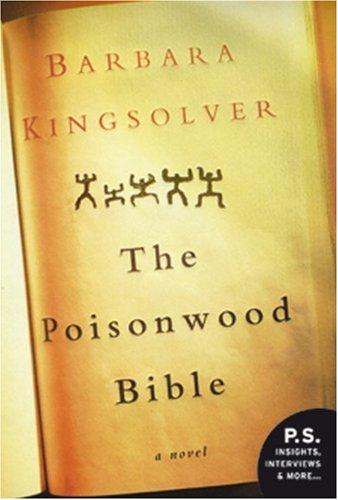
The Poisonwood Bible
by Barbara Kingsolver · 1998
A fundamentalist Baptist missionary drags his wife and four daughters to the Belgian Congo in 1959, and the country he refuses to understand ends up reshaping -- or destroying -- every one of them.
Worth reading? The Poisonwood Bible earns its scope by never letting the political history overwhelm the family drama, or the reverse. Nathan Price's refusal to adapt to the Congo -- planting a garden the wrong way, preaching in mistranslated words -- becomes a small, personal version of the larger colonial and Cold War arrogance the novel is really about.
| Author | Barbara Kingsolver |
|---|---|
| Published | 1998 |
| Publisher | Harper Perennial |
| Category | Fiction |
| Favorite quote | “Everything you're scared of is a story.” |
The Verdict
Kingsolver’s real achievement is refusing to make Nathan Price a cartoon. He’s never given a redemption scene, never softens, and the novel doesn’t need him to – his fixed certainty is the point, the same certainty that let a father drag his family into a place he never bothered to understand.
The five narrators are genuinely distinct voices, not just a structural trick – Adah’s wordplay-heavy interiority reads nothing like Rachel’s shallow self-absorption, and both read nothing like Leah’s slow political awakening. That range is what keeps 500-plus pages moving.
Read it if you want a family saga willing to hold a father accountable and tie personal arrogance to real political history. Skip it if you’re looking for Nathan to eventually see the light – he never does, and that’s deliberate.
you want a family saga that's also a serious reckoning with American and Belgian intervention in the Congo, told through five distinct, believable narrators
you want the father, Nathan Price, to get any real redemption arc -- Kingsolver keeps him a fixed, unmovable figure of certainty from start to finish, by design
Book Summary
Nathan Price, an unbending Baptist missionary, relocates his wife Orleanna and their four daughters to a village in the Belgian Congo in 1959, convinced he can convert the village to Christianity despite understanding almost nothing about the language, culture, or politics around him.
The novel is narrated in rotating chapters by Orleanna and each of the four daughters -- Rachel, Leah, Adah, and Ruth May -- giving five distinct perspectives on the same events and letting each character's fate diverge sharply based on how she responds to the country and the father who brought her there.
Kingsolver ties the family's unraveling directly to the Congo's own political unraveling, including the CIA-backed assassination of Prime Minister Patrice Lumumba, arguing that Nathan's small-scale arrogance and the American government's large-scale intervention are the same failure of listening at different scales.
Top 7 Lessons from The Poisonwood Bible
- Nathan Price's insistence on planting an American-style garden in Congolese soil, ignoring local knowledge, becomes a small, literal symbol of the larger colonial refusal to adapt to the place being 'helped.'
- The novel is narrated by five different women -- the mother and four daughters -- and their radically different responses to the same experience show how differently people can process the same trauma.
- Kingsolver ties the family's story directly to the real 1961 assassination of Congolese Prime Minister Patrice Lumumba, connecting Nathan's personal failure to a documented U.S. and Belgian intervention.
- Each daughter's adult fate -- Rachel's opportunism, Leah's activism, Adah's scientific detachment, Ruth May's fate in the village itself -- reads as a direct consequence of how she related to her father's certainty.
- The novel uses mistranslation as a recurring device -- Nathan's mangled Kikongo phrases mean something different, often something damaging, than what he intends -- to dramatize the danger of speaking without understanding.
- Orleanna's guilt as the mother who couldn't protect her children from her husband's choices runs through the entire novel as its emotional undertow.
- The book argues that individual certainty -- religious, political, or personal -- causes damage in direct proportion to how little the certain person is willing to listen.
Top 2 Quotes from The Poisonwood Bible
"Everything you're scared of is a story."
Barbara Kingsolver, The Poisonwood Bible
"The power is in the balance: we are our injuries, as much as we are our successes."
Barbara Kingsolver, The Poisonwood Bible
Frequently Asked Questions
Is The Poisonwood Bible worth reading?
Yes -- it's a rare novel that takes both a family drama and a specific, real political history seriously without letting either overwhelm the other.
What is The Poisonwood Bible about?
A Baptist missionary relocates his wife and four daughters to the Belgian Congo in 1959, and the novel follows their unraveling family alongside the Congo's own political upheaval, including the assassination of Prime Minister Patrice Lumumba.
Is The Poisonwood Bible based on a true story?
The family is fictional, but the novel is grounded in real Congo history, including the U.S. and Belgian-backed political events of the era.
How is The Poisonwood Bible narrated?
In rotating first-person chapters by the mother, Orleanna, and each of the four daughters, giving five distinct perspectives on the same events.
Did The Poisonwood Bible win any awards?
It was a finalist for the Pulitzer Prize and won several other honors, including the National Book Prize of South Africa's equivalent recognitions abroad, though it didn't win the Pulitzer itself.
Ready to read it?
Get The Poisonwood Bible on Amazon