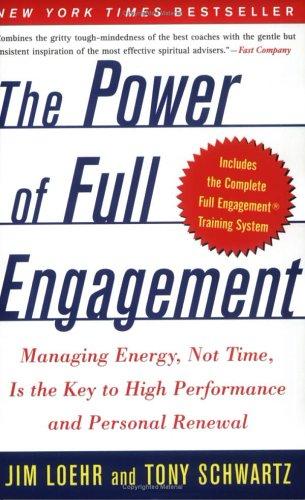
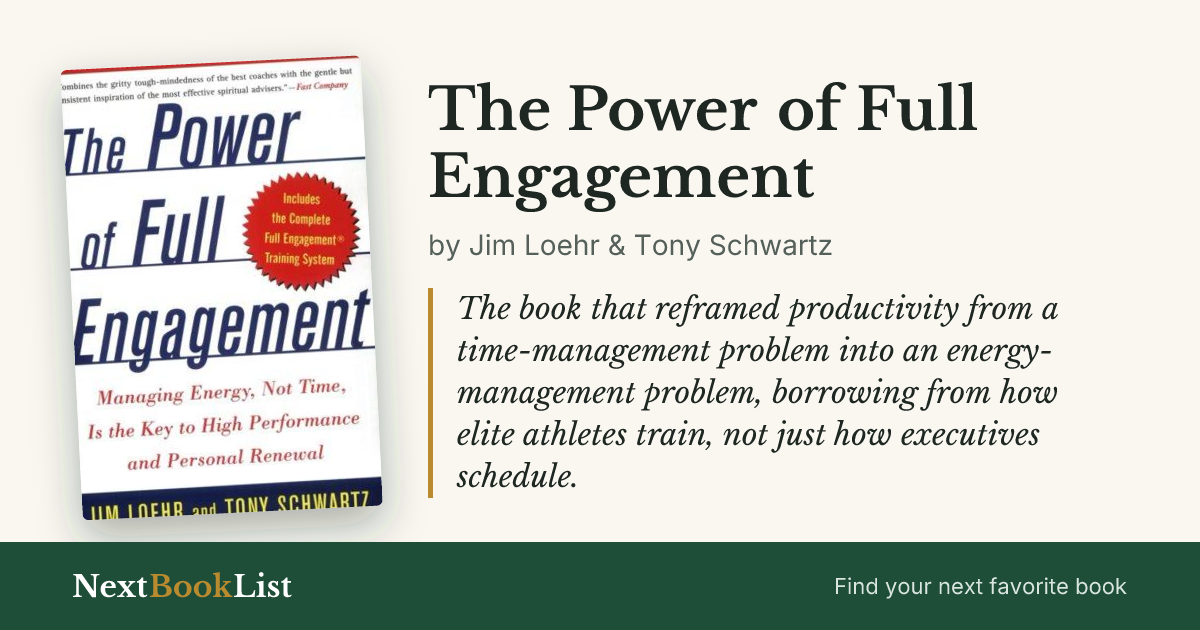
The Power of Full Engagement
by Jim Loehr & Tony Schwartz · 2003
The book that reframed productivity from a time-management problem into an energy-management problem, borrowing from how elite athletes train, not just how executives schedule.
Worth reading? The Power of Full Engagement's core reframe is simple and underused: time is a fixed resource you can't create more of, but energy is renewable if you manage it like athletes manage theirs, in cycles of stress and recovery rather than one long grind. Loehr and Schwartz apply sports psychology to knowledge work, and the oscillation principle (work in focused bursts, then genuinely recover, rather than pacing evenly through the day) is more actionable than most productivity advice that only addresses scheduling.
| Full Title | The Power of Full Engagement: Managing Energy, Not Time, Is the Key to High Performance and Personal Renewal |
|---|---|
| Author | Jim Loehr & Tony Schwartz |
| Published | 2003 |
| Category | Self-Improvement & Psychology |
| Favorite quote | “Energy, not time, is the fundamental currency of high performance.” |
The Verdict
Loehr and Schwartz’s background training Olympic and professional athletes shows in how directly they apply sports-recovery science to office work, and the 90-120-minute focus-then-recover cycle is one of the more testable, immediately usable ideas in the whole productivity genre. Pair it with a scheduling book if you need both halves of the problem solved.
you manage your calendar well but still run out of energy before you run out of tasks
you want a scheduling framework, this is about energy (physical, emotional, mental, spiritual), not calendar mechanics; pair it with First Things First if you want both
Book Summary
Performance depends on energy across four dimensions -- physical, emotional, mental, and spiritual -- not just time allocation, and energy, unlike time, can be expanded through the right rituals even though it's also finite in the short term. The authors borrow directly from elite sports training: athletes don't train at maximum intensity continuously, they oscillate between stress and recovery, and knowledge workers who skip the recovery half of that cycle burn out even while managing their calendars perfectly.
Positive rituals -- specific, deliberately built habits around sleep, movement, meals, and renewal breaks -- matter more than willpower for sustaining energy, because willpower itself is a depletable resource. The book argues you should design your days around energy renewal cycles (roughly 90-120 minutes of focused work followed by genuine recovery) rather than trying to power through eight hours on willpower alone.
Top 7 Lessons from The Power of Full Engagement
- Manage energy, not just time -- a full calendar doesn't guarantee you'll have the energy to execute it well.
- Oscillate between focused work and genuine recovery, rather than pacing evenly through the day.
- Build positive rituals around sleep, movement, and meals -- willpower alone depletes and can't sustain performance.
- Energy has four dimensions: physical, emotional, mental, and spiritual -- neglecting any one undermines the others.
- Work in roughly 90-120 minute focused sessions, then take a genuine recovery break, not just a shorter task switch.
- Recovery isn't optional or lazy -- it's the mechanism that makes the next period of high output possible.
- Define a sense of purpose (spiritual energy, in the book's framing) to sustain motivation through difficult stretches.
Top 5 Quotes from The Power of Full Engagement
"Energy, not time, is the fundamental currency of high performance."
Jim Loehr & Tony Schwartz, The Power of Full Engagement
"The number one problem is not sufficiently valuing renewal."
Jim Loehr & Tony Schwartz, The Power of Full Engagement
"We become fully engaged when we invest our full and best energy."
Jim Loehr & Tony Schwartz, The Power of Full Engagement
"Watching television is the mental and emotional equivalent of eating junk food."
Jim Loehr & Tony Schwartz, The Power of Full Engagement
"We grow the aspects of our lives that we feed -- with energy and engagement -- and choke off those we deprive of fuel. Your life is what you agree to attend to."
Jim Loehr & Tony Schwartz, The Power of Full Engagement
Frequently Asked Questions
Is The Power of Full Engagement worth reading?
Yes, especially if you manage your calendar well but still find yourself running out of energy before you run out of tasks. The energy-management reframe fills a real gap that time-management books don't address.
What is the main idea of The Power of Full Engagement?
Performance depends on managing energy across physical, emotional, mental, and spiritual dimensions, not just time -- and energy is renewable through deliberate cycles of stress and recovery, modeled on elite athletic training.
How is this different from First Things First?
First Things First is about prioritizing what goes on your calendar based on importance versus urgency. The Power of Full Engagement is about whether you have the energy to execute what's already on your calendar. The two are complementary, not competing.
What are the four types of energy in The Power of Full Engagement?
Physical, emotional, mental, and spiritual. The authors argue neglecting any one dimension undermines your capacity in the others, even if your calendar and to-do list are perfectly organized.
Ready to read it?
Get The Power of Full Engagement on Amazon