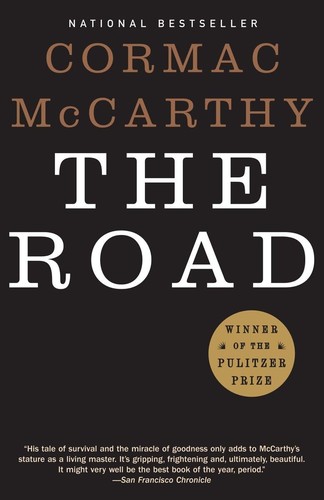
The Road
by Cormac McCarthy · 2006
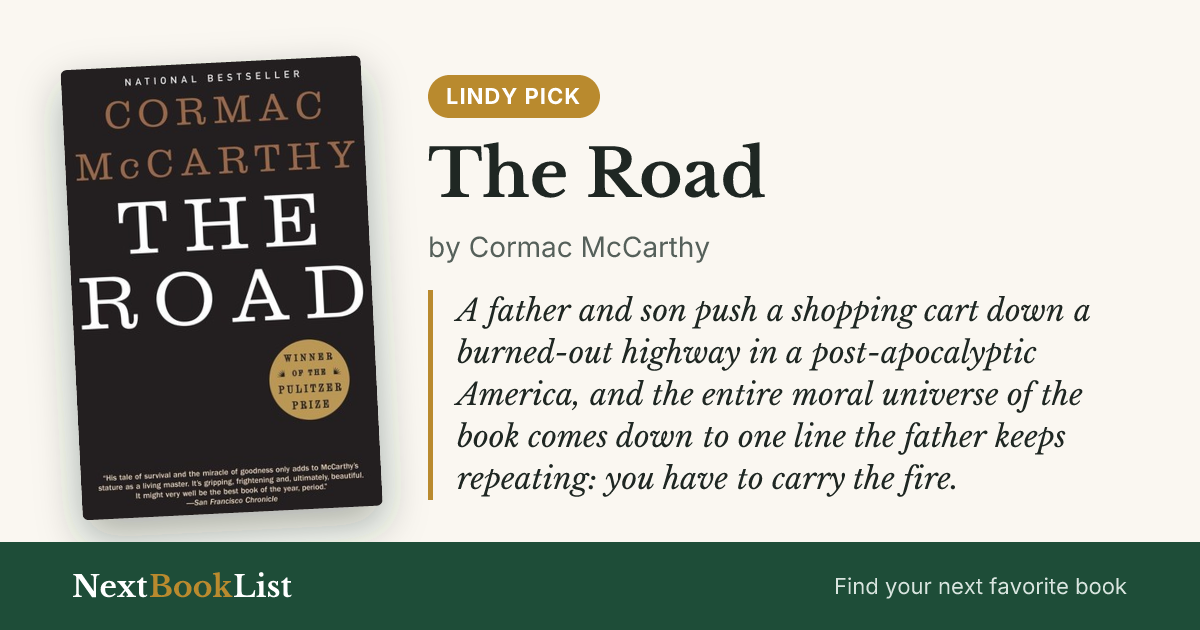
A father and son push a shopping cart down a burned-out highway in a post-apocalyptic America, and the entire moral universe of the book comes down to one line the father keeps repeating: you have to carry the fire.
Worth reading? The Road strips McCarthy's usual concerns, violence, survival, what people are capable of, down to their simplest possible form: a father trying to keep his son alive and, more importantly, keep him good in a world that's stopped rewarding goodness. It's shorter and more emotionally direct than his other major novels, which makes it the right McCarthy to start with. The prose is spare even by his standards, and the ending is one of the few genuinely hopeful notes in his whole body of work.
| Author | Cormac McCarthy |
|---|---|
| Published | 2006 |
| Publisher | Vintage International |
| Category | Fiction |
| Favorite quote | “You have to carry the fire.” |
The Verdict
The father’s mantra, “carrying the fire,” does a lot of work in a very short book, and it lands because McCarthy never over-explains it. It’s not a metaphor the characters unpack for you, it’s just something the father says to give his son a reason to keep being decent when decency has stopped being practical.
The prose is McCarthy’s sparest, short sentences, minimal punctuation, and it fits the setting: a world stripped down to almost nothing has a narrator stripped down to match.
Read it if you want McCarthy’s most human, most hopeful book, despite the setting being his bleakest. Skip it if you need your post-apocalyptic fiction to explain the apocalypse, this one has zero interest in that question.
you want McCarthy's most emotionally direct, most accessible novel -- brutal setting, but a real, uncomplicated love at its center
you want worldbuilding or explanation for what caused the apocalypse -- McCarthy never says, and the book has zero interest in answering that question
Book Summary
An unnamed father and son walk south through a devastated, ash-covered America years after an unexplained catastrophe has wiped out nearly all plant and animal life, scavenging for food and avoiding roving bands of cannibalistic survivors along the way.
The father's central project isn't just physical survival, it's moral survival: he repeatedly tells his son they're 'carrying the fire' and are 'the good guys,' trying to preserve some code of decency in a world where that code has almost no practical value left.
McCarthy deliberately withholds any explanation for the apocalypse, no war, no disaster is ever named, which forces the novel's focus entirely onto the father-son relationship rather than any speculative or political framing of how the world ended.
Top 7 Lessons from The Road
- McCarthy never explains the cause of the apocalypse, keeping the novel's focus entirely on the father and son's relationship rather than any broader explanation or worldbuilding.
- The father's repeated phrase, 'we're the good guys' and 'carrying the fire,' functions as the boy's entire moral education in a world with almost no other source of ethical guidance left.
- The novel's cannibalistic survivor groups represent the alternative the father is fighting against, not just death, but the total collapse of any moral code.
- The boy, born after the catastrophe, has no memory of the old world, making him, uniquely among the novel's characters, purely a product of the post-apocalyptic one.
- The father's terminal illness, coughing blood throughout the novel, creates constant urgency around what happens to the boy once his father can no longer protect him.
- Small acts of mercy, sharing food, refusing to kill when killing would be easier, are treated by the novel as more significant moral victories than any large-scale plot event.
- The ending, in which the boy is taken in by a family after his father's death, is one of the only genuinely hopeful conclusions in McCarthy's body of work.
Top 6 Quotes from The Road
"You have to carry the fire."
Cormac McCarthy, The Road
"Each the other's world entire."
Cormac McCarthy, The Road
"You forget what you want to remember, and you remember what you want to forget."
Cormac McCarthy, The Road
"He knew only that the child was his warrant. He said: If he is not the word of God God never spoke."
Cormac McCarthy, The Road
"Goodness will find the little boy. It always has. It will again."
Cormac McCarthy, The Road
"My job is to take care of you. I was appointed to do that by God. I will kill anyone who touches you. Do you understand?"
Cormac McCarthy, The Road
Frequently Asked Questions
Is The Road worth reading?
Yes -- it's McCarthy's most emotionally direct novel, and the father-son relationship at its center gives the bleak setting real, earned weight.
What is The Road about?
A father and son travel south through a devastated, ash-covered post-apocalyptic America, scavenging for food and avoiding cannibalistic survivors, while the father tries to keep his son both alive and morally decent.
What caused the apocalypse in The Road?
McCarthy never says. The cause is deliberately left unexplained so the novel can stay focused entirely on the father and son's relationship rather than any disaster backstory.
Is The Road a good McCarthy book to start with?
Yes, it's widely recommended as the most accessible entry point into his work, shorter and more emotionally direct than Blood Meridian or No Country for Old Men.
Did The Road win any awards?
Yes, it won the 2007 Pulitzer Prize for Fiction and was adapted into a 2009 film.
Ready to read it?
Get The Road on Amazon