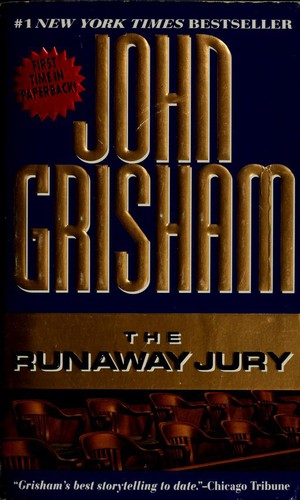
The Runaway Jury
by John Grisham · 1996
A juror with a hidden agenda and an outside partner secretly working the case turn a tobacco company's liability trial into a high-stakes game neither side of the courtroom sees coming.
Worth reading? The Runaway Jury works because it flips the usual courtroom thriller structure: instead of following the lawyers, Grisham centers a juror, Nicholas Easter, who's playing a long game neither the plaintiff's team nor the tobacco company's jury consultants can figure out. The mechanics of jury manipulation, both illegal and the legal-but-sleazy consulting kind, are the real subject.
| Author | John Grisham |
|---|---|
| Published | 1996 |
| Publisher | Doubleday |
| Category | Fiction |
The Verdict
Grisham’s smartest move here is putting the reader inside the manipulation instead of the courtroom argument. You spend more time watching Nicholas and Marlee run their long game than you spend on witness testimony, which makes this feel closer to a heist novel wearing a legal-thriller costume.
The late reveal of Nicholas and Marlee’s real motive recontextualizes everything that came before it. It doesn’t fully excuse the scheme, but it complicates the easy read of them as simple con artists working the system for money.
Read it if you want a legal thriller built around manipulation and information control rather than courtroom oratory. Skip it if you want procedural realism – this one prioritizes plotting over how trials actually work.
you want a legal thriller that's really a jury-manipulation heist story, with a tobacco industry villain and a protagonist playing both sides
you want realistic courtroom procedure -- the jury-tampering premise leans into thriller plotting over legal accuracy
Book Summary
Nicholas Easter gets seated on a jury in a lawsuit against a tobacco company over a smoker's death, and through his outside partner Marlee, begins quietly signaling to both the plaintiff's attorneys and the tobacco company's legal team that the jury's verdict can be influenced, for a price, setting up a bidding war neither side fully controls.
The novel runs two parallel systems of manipulation: Grisham shows the tobacco company's jury consultants using extensive research, surveillance, and psychological profiling to try to seat a favorable jury, a legal but ethically murky practice, alongside Nicholas and Marlee's outright illegal scheme to control the verdict directly.
The book uses the tobacco litigation backdrop to make a broader point about how much a "fair trial" is actually shaped by resources and manipulation on both the legal and illegal sides, before revealing Nicholas and Marlee's real motive, connected to a personal loss from smoking, which reframes their scheme as vigilante justice rather than simple corruption.
Top 10 Lessons from The Runaway Jury
- Jury consulting, the legal practice of researching and profiling potential jurors to seat a favorable panel, is shown as a powerful, well-funded tool that already skews trials before any testimony happens.
- Nicholas and Marlee's illegal manipulation scheme runs parallel to, and comments on, the tobacco company's legal-but-ethically-questionable jury consulting, blurring the line between the two.
- The tobacco company's institutional resources, extensive research budgets, private investigators, jury consultants, give it a structural advantage over an individual plaintiff long before the trial itself begins.
- Nicholas and Marlee's eventual revealed motive, a personal loss connected to smoking, reframes their manipulation as a response to systemic injustice rather than simple financial corruption, complicating a clean good-guy/bad-guy reading.
- The novel treats the idea of a truly 'fair' jury as already compromised by money and manipulation on the corporate side, which is part of what makes the protagonists' countermanipulation read as poetic justice rather than pure villainy.
- Information control, who knows what about the jurors, the case, and each other's schemes, drives the plot's tension more than courtroom argument does.
- Marlee and Nicholas's scheme requires patient, long-term planning executed under constant scrutiny -- the novel treats meticulous preparation, not improvisation, as the real skill behind pulling off deception at this scale.
- The book positions the tobacco company's institutional confidence, its assumption that money and process will win, as itself a vulnerability, since it makes them slower to suspect they're being played.
- Grisham uses the parallel bidding war between plaintiff's counsel and the defense to show that once a verdict is treated as something purchasable, both sides become equally compromised, not just the side willing to break the law outright.
- The novel's late pivot from 'clever con' to 'vigilante justice' asks the reader to weigh whether an illegal act aimed at a legal-but-unjust system deserves a different moral standard than ordinary corruption.
Frequently Asked Questions
Is The Runaway Jury worth reading?
Yes, for a legal thriller that centers a juror's manipulation scheme rather than the usual lawyer protagonist -- it's a different structure than most of Grisham's other courtroom novels.
Is The Runaway Jury realistic about how trials work?
Not entirely -- the jury-tampering premise is plotted for thriller tension rather than procedural accuracy, though the jury consulting industry it depicts is grounded in a real practice.
Was The Runaway Jury made into a movie?
Yes -- a 2003 film adaptation starred John Cusack, Gene Hackman, and Dustin Hoffman, though it changed the defendant from a tobacco company to a gun manufacturer.
Do I need to have read other Grisham novels first?
No -- it's a standalone novel and doesn't require familiarity with his other legal thrillers.
Ready to read it?
Get The Runaway Jury on Amazon