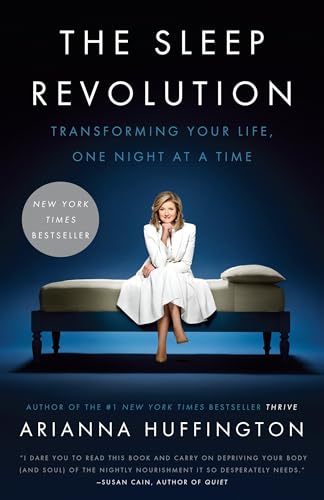
The Sleep Revolution
by Arianna Huffington · 2016
The Huffington Post founder collapsed from exhaustion and broke her cheekbone on her own desk, then wrote 400 pages making the case that sleep deprivation is a public health crisis we've all agreed to pretend is a productivity flex.
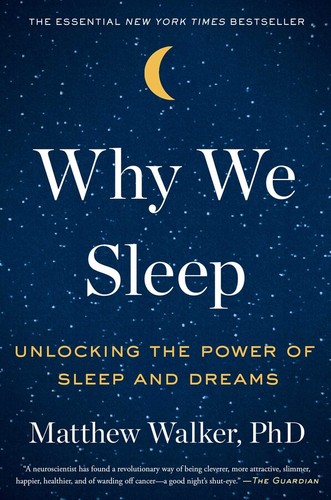
Worth reading? The Sleep Revolution is a better persuasion tool than a practical manual -- it'll convince you sleep deprivation is a crisis faster than Matthew Walker's Why We Sleep, but Walker's book has more hard science and better actionable detail once you're already convinced. Read this first if you're still telling yourself you'll sleep when you're dead.
| Full Title | The Sleep Revolution: Transforming Your Life, One Night at a Time |
|---|---|
| Author | Arianna Huffington |
| Published | 2016 |
| Publisher | Harmony Books |
| Category | Self-Improvement & Psychology |
| Favorite quote | “By helping us keep the world in perspective, sleep gives us a chance to refocus on the essence of who we are.” |
The Verdict
Huffington’s own collapse is doing a lot of the persuasive work here, and it works because it’s specific and embarrassing in a way most wellness books avoid. If you need the case made for why sleep matters before you’ll act on any tactics, start here; if you’re already convinced, skip straight to Matthew Walker’s Why We Sleep for the deeper science.
you want the cultural-history-plus-science case for sleep as non-negotiable, backed by research on everything from car accidents to cognitive decline, and you respond better to argument than to a pure how-to checklist
you already believe sleep matters and just want tactics -- this leans heavier on the why (history, science, culture, Huffington's own collapse story) than the how; pair it with a more tactical book if you want a step-by-step protocol
Book Summary
Huffington frames her own 2007 collapse from exhaustion, which ended with her breaking her cheekbone on her own desk, as the origin point for the book's argument: that sleep deprivation has been culturally rebranded as a badge of honor, especially inside high-achievement professional culture, when it's actually a measurable health and safety risk.
The book traces how electric light and 24-hour connectivity reshaped sleep norms, then connects chronic sleep loss to concrete downstream effects -- car accidents, weakened immune function, weight gain, and long-term cognitive decline. Huffington frames better sleep as part of her broader "third metric" idea, that success measured only by money and power is incomplete without wellbeing folded in.
Top 9 Lessons from The Sleep Revolution
- Huffington frames her own 2007 collapse from exhaustion, breaking her cheekbone on her desk, as the origin of her interest in sleep science.
- The book argues that sleep deprivation has been culturally rebranded as a badge of honor, especially in high-achievement professional culture.
- Chronic sleep loss is linked in the book to measurable risks including car accidents, weakened immune function, weight gain, and long-term cognitive decline.
- Huffington traces historical and cultural attitudes toward sleep, including how electric light and 24-hour connectivity reshaped sleep norms.
- The book pushes back on 'sleep when you're dead' hustle culture as not just unhealthy but counterproductive to the performance people are actually chasing.
- Screens and blue light before bed are presented as a major, underrated disruptor of sleep quality.
- Huffington recommends treating the bedroom as a sleep-only sanctuary, removing phones and work materials from it entirely.
- The book connects sleep to broader wellbeing, tying it into her 'third metric' framework of success beyond money and power.
- Corporate case studies, including companies experimenting with nap rooms and sleep policies, are used to argue that sleep investment pays off even in pure productivity terms.
Top 4 Quotes from The Sleep Revolution
"By helping us keep the world in perspective, sleep gives us a chance to refocus on the essence of who we are."
Arianna Huffington, The Sleep Revolution
"These two threads that run through our life -- one pulling us into the world to achieve and make things happen, the other pulling us back from the world to nourish and replenish ourselves -- can seem at odds, but in fact they reinforce each other."
Arianna Huffington, The Sleep Revolution
"When we shrink our whole reality down to pending projects, when our life becomes our endless to-do list, it's difficult to put them aside each night and let ourselves fall asleep."
Arianna Huffington, The Sleep Revolution
"Sleep is profoundly intertwined with virtually every aspect of brain health."
Arianna Huffington, The Sleep Revolution
Frequently Asked Questions
Is The Sleep Revolution worth reading?
Yes, if you need convincing that sleep deprivation is a real problem, not just an inconvenience -- it's a strong persuasion case, though lighter on step-by-step tactics.
Is The Sleep Revolution more science or more memoir?
It's a mix, anchored by Huffington's own exhaustion-driven collapse, but backed with real research on sleep's effects on health, safety, and cognition.
How is The Sleep Revolution different from Why We Sleep?
Why We Sleep by Matthew Walker has denser hard science and more actionable detail. The Sleep Revolution is broader and more persuasive on the cultural why, making it a good starting point before Walker's book.
Who should read The Sleep Revolution?
Anyone still operating on 'sleep when you're dead' logic. Skip it if you already prioritize sleep and just want tactics.
Ready to read it?
Get The Sleep Revolution on Amazon