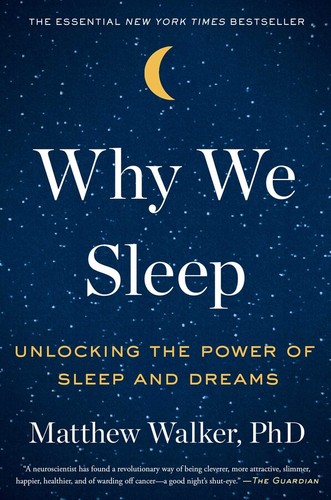
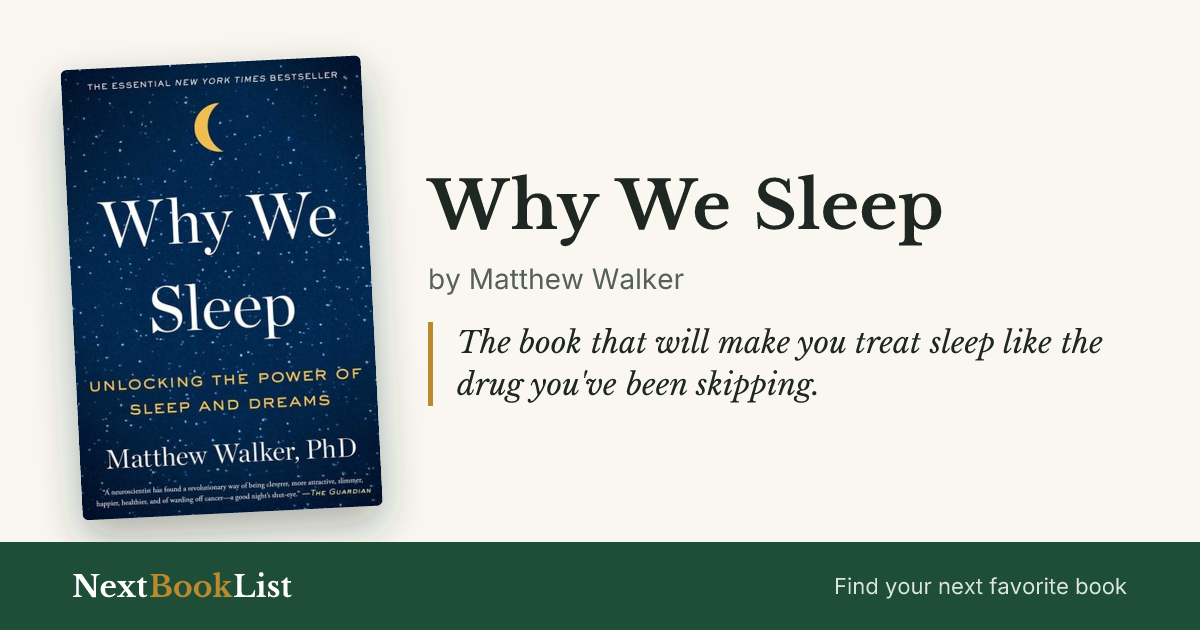
Why We Sleep
by Matthew Walker · 2017
The book that will make you treat sleep like the drug you've been skipping.
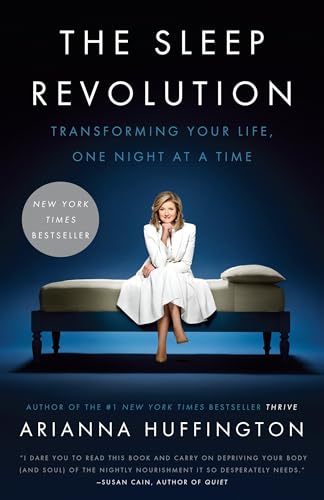
Worth reading? Why We Sleep is the science-first, no-nonsense case for sleep, and it beats a book like Arianna Huffington's The Sleep Revolution on rigor: Walker is a sleep researcher, not a journalist collecting anecdotes, and the studies here are specific and cited. If you need to actually understand the mechanism -- why sleep loss wrecks memory, immunity, and mood -- this is the one to read. Skip it if you already have good sleep habits and just want tactical tips; the book is heavier on "why this matters" than "here's your bedtime routine." If you want the lighter, more anecdotal, habit-tip version, that's closer to what Huffington's book offers -- but you'll walk away from Walker's book more genuinely convinced.
| Full Title | Why We Sleep: Unlocking the Power of Sleep and Dreams |
|---|---|
| Author | Matthew Walker |
| Published | 2017 |
| Publisher | Scribner |
| Category | Self-Improvement & Psychology |
| Favorite quote | “The shorter your sleep, the shorter your life.” |
The Verdict
Walker doesn’t need to oversell this one – the studies do the persuading. Once you understand what six hours a night actually does to your memory and immune system, “I’ll sleep when I’m dead” stops sounding like a flex.
you treat sleep as optional and wonder why your focus, mood, and health are off
you already protect 8 hours and practice good sleep hygiene -- you don't need convincing
Book Summary
Sleep is not downtime, it's active maintenance -- your brain clears metabolic waste, consolidates memory, and regulates emotion during sleep, and every one of these processes measurably degrades with even modest sleep restriction. Walker's research shows six hours a night, sustained, produces cognitive impairment comparable to legal intoxication.
Chronic sleep deprivation is linked to nearly every major health problem tracked by modern medicine: Alzheimer's, cancer, diabetes, obesity, poor cardiovascular health, and weakened immune function. This isn't correlation dressed up as causation -- Walker walks through the specific biological mechanisms (like reduced clearance of amyloid plaques in the brain) that connect short sleep to each outcome.
Modern life is actively hostile to sleep -- artificial light, caffeine, alcohol, irregular schedules, and a culture that treats "I'll sleep when I'm dead" as a badge of honor. Walker argues for treating consistent sleep and wake times, a cool dark room, and cutting late caffeine as non-negotiable infrastructure, not optional wellness extras.
Top 9 Lessons from Why We Sleep
- Six hours of sleep a night, sustained, impairs cognition comparably to being legally drunk.
- Sleep loss impairs memory consolidation -- you don't just feel tired, you actually learn and retain less.
- REM sleep processes emotional experiences, which is part of why sleep-deprived people are more reactive.
- Caffeine has a longer half-life than most people think -- afternoon coffee disrupts sleep you won't notice losing.
- Alcohol fragments sleep architecture even though it makes you fall asleep faster.
- A consistent sleep and wake time matters more than total hours alone.
- Naps can help, but they don't fully substitute for lost nighttime sleep.
- Blue light from screens suppresses melatonin and delays your body's wind-down signal.
- Chronic short sleep is linked to Alzheimer's, cancer, diabetes, and cardiovascular disease -- not just tiredness.
Top 5 Quotes from Why We Sleep
"Sleep is the single most effective thing we can do to reset our brain and body health each day."
Matthew Walker, Why We Sleep
"The shorter your sleep, the shorter your life."
Matthew Walker, Why We Sleep
"Routine is one of the most powerful sleep-aiding tools."
Matthew Walker, Why We Sleep
"No aspect of our biology is left untouched by sleep deprivation."
Matthew Walker, Why We Sleep
"Sleep, unfortunately, is not an optional lifestyle luxury."
Matthew Walker, Why We Sleep
Frequently Asked Questions
Is Why We Sleep worth reading?
Yes -- it's the most rigorously argued, research-backed case for prioritizing sleep available in a mainstream book. Skip it only if you're already convinced and just need a bedtime routine, not the science.
What is the main idea of Why We Sleep?
Sleep isn't passive downtime -- it's active maintenance for memory, immunity, and emotional regulation, and chronic short sleep is linked to nearly every major modern disease.
How long does it take to read Why We Sleep?
About 8 hours. It's 368 pages and denser with research citations than a typical self-improvement book.
Does Why We Sleep give practical tips, or is it mostly science?
It's mostly the science and the case for why sleep matters, with practical guidance (consistent schedule, cool dark room, cutting late caffeine) concentrated more toward the end.
Ready to read it?
Get Why We Sleep on Amazon