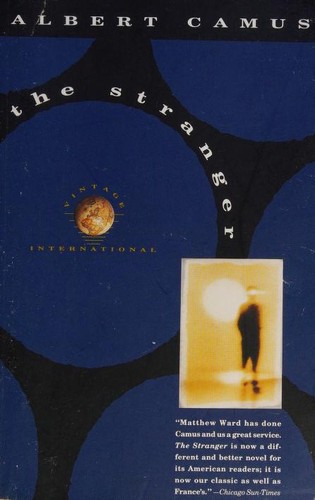
The Stranger
by Albert Camus · 1942
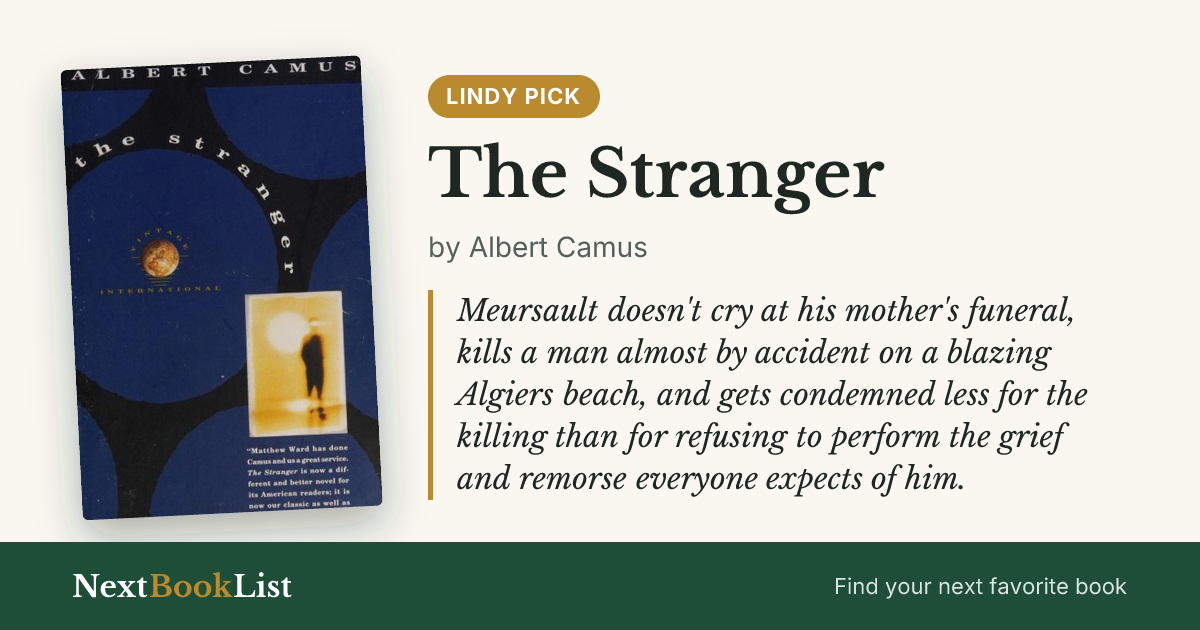
Meursault doesn't cry at his mother's funeral, kills a man almost by accident on a blazing Algiers beach, and gets condemned less for the killing than for refusing to perform the grief and remorse everyone expects of him.
Worth reading? The Stranger is short enough to read in an afternoon and stays with you for years, which is a rare combination. Camus's flat, affectless prose isn't a limitation, it's the argument: Meursault refuses to perform emotions he doesn't feel, and society punishes him for that honesty more than for the actual killing. It's the best 120-page argument for absurdism you'll find.
| Full Title | The Stranger |
|---|---|
| Author | Albert Camus |
| Published | 1942 |
| Publisher | Vintage International |
| Category | Fiction |
| Favorite quote | “In the depths of winter, I finally learned that within me there lay an invincible summer.” |
The Verdict
Read this one straight through in a single sitting if you can. The flat, clipped prose builds a kind of hypnotic momentum that gets lost if you put it down for a week between chapters.
Meursault’s detachment is going to frustrate you at first – you keep waiting for him to feel something the way a normal narrator would, and he never does. That frustration is the book working as intended. Camus wants you to notice how much of what we call “normal” emotional response is actually performance.
Skip the temptation to read it as a crime thriller. The murder happens almost by accident and barely gets discussed as a moral event; the real story is the trial, where society punishes Meursault for his honesty about his own indifference far more than for what he did on that beach.
you want the cleanest, shortest introduction to existentialist fiction, written in prose so flat and precise it becomes its own kind of style
you need a narrator you can emotionally connect with -- Meursault's detachment is the whole point, and it keeps you at arm's length the entire book
Book Summary
Meursault attends his mother's funeral without crying, starts a relationship with Marie the next day, and later shoots an Arab man on a beach in what reads less like premeditated murder than a kind of sun-blinded accident -- the novel's famous line is that he pulled the trigger "because of the sun."
The trial in part two isn't really about the killing -- it becomes a trial of Meursault's character, his failure to cry at his mother's funeral used as evidence of his moral monstrosity more aggressively than the actual crime. Camus is showing how society demands you perform expected emotions, and punishes authenticity that doesn't fit the script.
Camus's concept of "the absurd" -- the collision between humans' need for meaning and a universe that offers none -- runs underneath the whole novel. Meursault doesn't pretend life has inherent meaning, and his emotional flatness is really a kind of honesty the world can't tolerate.
The novel's ending, where Meursault finally embraces "the gentle indifference of the world" awaiting execution, is Camus's closest thing to a positive statement: peace comes not from finding meaning but from accepting there isn't any, and living fully anyway.
Top 7 Lessons from The Stranger
- Meursault's refusal to perform grief he doesn't feel gets him condemned as much as the actual killing -- the novel argues society polices authentic feeling as harshly as it does actual crime.
- The famous line 'because of the sun' as his stated reason for the murder captures Camus's idea that human action can be driven by absurd, non-rational forces rather than clean motive.
- 'The absurd' -- the gap between wanting life to have meaning and a universe that offers none -- is the philosophical engine of the book, though Camus dramatizes it rather than lecturing on it.
- The trial sequence shows how a legal system can convict a character rather than a crime, using Meursault's emotional flatness as proof of guilt.
- Meursault's flat affect isn't coldness so much as radical honesty -- he refuses to lie about feelings he doesn't have, even when lying would save his life.
- The ending's 'gentle indifference of the world' is Camus's version of peace: not meaning, but acceptance, arrived at only once Meursault stops resisting his own execution.
- The novel's spare, declarative prose style (short sentences, minimal metaphor) mirrors Meursault's own detachment -- form and content are doing the same work.
Top 5 Quotes from The Stranger
"In the depths of winter, I finally learned that within me there lay an invincible summer."
Albert Camus, The Stranger
"Mother died today. Or maybe yesterday; I can't be sure."
Albert Camus, The Stranger
"I opened myself to the gentle indifference of the world."
Albert Camus, The Stranger
"I may not have been sure about what really did interest me, but I was absolutely sure about what didn't."
Albert Camus, The Stranger
"Nobody, nobody had the right to cry over her."
Albert Camus, The Stranger
Frequently Asked Questions
Is The Stranger worth reading?
Yes -- it's short, direct, and the cleanest entry point into existentialist and absurdist fiction there is.
What is The Stranger about?
Meursault, a detached and emotionally flat man, kills a stranger on a beach and is condemned less for the killing than for his refusal to perform the grief society expects.
What does 'because of the sun' mean in The Stranger?
It's Meursault's stated reason for the shooting -- Camus uses it to show human action driven by absurd, non-rational forces rather than clean motive.
Is The Stranger the same as absurdism?
The Stranger dramatizes Camus's philosophy of the absurd -- the tension between humans' need for meaning and an indifferent universe -- but his essay The Myth of Sisyphus lays out the philosophy directly if you want the non-fiction companion.
How long does it take to read The Stranger?
At roughly 120 pages, most readers finish it in one or two sittings.
Ready to read it?
Get The Stranger on Amazon