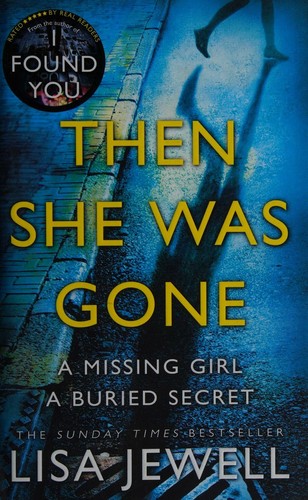
Then She Was Gone
by Lisa Jewell · 2017
Ten years after her fifteen-year-old daughter vanished without a trace, a mother falls for a man whose own young daughter looks eerily like the girl she lost.
Worth reading? Then She Was Gone earns its reputation as one of the stronger entries in the crowded missing-child-thriller genre because Jewell is more interested in grief than in shock. The mother's ten years of unresolved mourning are rendered with real specificity, and the eventual answer to what happened to her daughter is disturbing precisely because it's plausible rather than baroque.
| Author | Lisa Jewell |
|---|---|
| Published | 2017 |
| Publisher | Atria Books |
| Category | Fiction |
The Verdict
Jewell spends real time on Laurel’s frozen grief before the plot machinery kicks in, and that patience is what makes the eventual reveal land. You’ve sat with this mother’s numbness long enough that the answer to what happened feels like a gut punch, not a plot twist.
The pacing is deliberate almost to a fault in the middle stretch, and the subject matter (a missing child, patterns of control within a family) is heavier than a lot of what gets shelved next to it. This isn’t a book to hand someone looking for a breezy beach read.
Read it if you want a thriller that treats grief as seriously as its mystery. Skip it if you need faster pacing or want to avoid genuinely dark material involving a child.
you want a slow-burn thriller about grief and denial that earns its dread instead of rushing to shock you, with a mystery that's disturbing in a genuinely unsettling way rather than a cheap way
you want fast-paced action-thriller pacing -- this is a patient, character-driven build, and the darkest material (which involves a child) needs a content warning some readers will want going in
Book Summary
Laurel Mack's fifteen-year-old daughter Ella disappeared on her way to a study session a decade ago and was never found. The novel opens with Laurel still frozen in that loss, going through the motions of a life that stopped fully functioning the day Ella vanished.
When Laurel meets and falls for Floyd, a charming older man, his young daughter Poppy's resemblance to Ella at that age becomes impossible for Laurel (and the reader) to ignore, and the novel uses that resemblance to slowly, carefully pull the decade-old mystery back open.
The book alternates timelines and perspectives to build toward an answer that involves manipulation and control dynamics the novel takes seriously rather than sensationalizing, which is part of why it lands harder than a lot of comparable thrillers -- the horror is grounded in believable psychology, not a twist for its own sake.
Top 9 Lessons from Then She Was Gone
- The novel treats a parent's decade of unresolved grief as its emotional core, not just a setup for the mystery plot -- Laurel's numbness and denial are rendered with real specificity.
- A physical resemblance between two characters becomes the mechanism that reopens a cold case, which lets the book build dread gradually instead of relying on a sudden discovery.
- The eventual explanation involves patterns of manipulation and control within a family, and the book handles that material seriously rather than using it purely as a shock twist.
- Multiple timelines and shifting narrators let the reader piece together what Laurel herself couldn't see for ten years, which mirrors how denial works in real grief.
- The book's content is genuinely dark, involving a missing child and family manipulation, and it doesn't soften that darkness for commercial comfort -- some readers will want to know that going in.
- Laurel's new relationship with Floyd is written as genuinely appealing before the resemblance to Ella curdles it, so the reader shares her hope instead of immediately suspecting him.
- The novel gives real interiority to secondary characters -- Laurel's surviving children and ex-husband -- showing how one disappearance reshapes an entire family, not just the mother.
- Poppy, Floyd's young daughter, is written with enough specificity to read as a real child in danger, not just a plot device mirroring the missing Ella.
- The eventual reveal traces back to a slow, controlling dynamic that predates Ella's disappearance by years, so the 'twist' is really the surfacing of something that was always there.
Frequently Asked Questions
Is Then She Was Gone worth reading?
Yes -- it's a well-regarded, character-driven thriller that earns its darkness rather than relying on shock alone.
What is Then She Was Gone about?
A mother whose teenage daughter disappeared without a trace ten years earlier falls for a man whose young daughter closely resembles her missing girl.
Is Then She Was Gone disturbing?
Yes -- it deals with a missing child and manipulation within a family, and the content is genuinely heavy. Go in aware of that.
Is Then She Was Gone a slow-burn thriller?
Yes -- it prioritizes grief and character over fast-paced action, building tension gradually rather than through constant plot twists.
Does Then She Was Gone have a satisfying resolution?
Most readers find the answer to Ella's disappearance disturbing but earned, grounded in believable psychology rather than a shock twist.
Ready to read it?
Get Then She Was Gone on Amazon