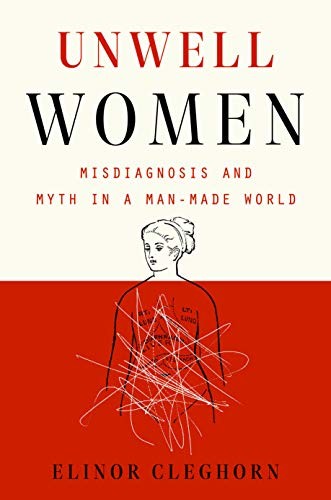
Unwell Women
by Elinor Cleghorn · 2021
A history of Western medicine told through centuries of women being disbelieved, misdiagnosed, and mythologized by the doctors treating them -- written by an author who lived it herself.
Worth reading? Unwell Women is a stronger history than most books in the women's-health-advocacy wave because Cleghorn is a trained historian, not just a patient-turned-writer -- she traces the medical mistreatment of women all the way back to the Greek concept of the 'wandering womb' and shows a continuous line to modern misdiagnosis of conditions like lupus and endometriosis. It pairs well with, but goes deeper than, more memoir-driven books like Maya Dusenbery's Doing Harm.
| Full Title | Unwell Women: Misdiagnosis and Myth in a Man-Made World |
|---|---|
| Author | Elinor Cleghorn |
| Published | 2021 |
| Publisher | Dutton |
| Category | Science & Nature |
| Favorite quote | “Women have been telling doctors that something is wrong with their bodies for centuries, and for centuries doctors have been telling them they are wrong.” |
The Verdict
What makes this land harder than a typical advocacy book is the interleaving – every historical horror story (leeching for hysteria, forced sterilizations, dismissed pain) sits right next to Cleghorn’s own decade of being told her lupus symptoms were “just anxiety.” The history isn’t ancient; it’s the same pattern still running. If you’ve ever been told your pain was in your head, this book will make you furious in a useful way.
you want the historical why behind modern medicine's gender gap (pain dismissal, autoimmune misdiagnosis, the medicalization of women's bodies) traced from ancient Greece to today
you want a purely practical, how-to-advocate-for-yourself guide -- this is a work of history and cultural criticism, not a patient handbook
Book Summary
Western medicine has, for most of its history, treated the female body as an inherently defective or hysterical deviation from a male "default," and this framing -- not just individual doctor bias -- shaped diagnostic categories, research priorities, and treatment for centuries.
Cleghorn interweaves her own decade-long ordeal being misdiagnosed with lupus (repeatedly told her symptoms were psychological or exaggerated) with historical case studies, showing that the same dismissive patterns from centuries ago persist in exam rooms today.
Conditions disproportionately affecting women -- endometriosis, autoimmune diseases, chronic pain syndromes -- remain understudied and underfunded partly because of this inherited assumption that women's reported pain is unreliable or emotionally driven rather than physiologically real.
Top 8 Lessons from Unwell Women
- The ancient 'wandering womb' theory treated female illness as the uterus literally displacing and disrupting the body, a root metaphor that echoes into modern dismissiveness.
- Hysteria as a diagnostic category was used for centuries to medicalize and silence women's physical and emotional complaints.
- Cleghorn's own decade of lupus misdiagnosis illustrates how 'it's probably stress' or 'it's probably anxiety' still functions as a default dismissal for women's pain.
- Clinical trials historically excluded women (partly over reproductive-risk concerns), leaving huge gaps in how medications and diseases present in female bodies.
- Racism compounds sexism in medical dismissal -- the book documents how Black women's pain has been disbelieved even more severely, rooted in historical medical racism.
- Diseases that predominantly affect women, like endometriosis, have historically received disproportionately less research funding relative to their prevalence and severity.
- The medicalization of normal female experiences (menstruation, menopause, childbirth) has often served to pathologize rather than support women.
- Patient self-advocacy and persistence, while necessary in the current system, is framed by Cleghorn as a symptom of institutional failure, not a solution to it.
Top 4 Quotes from Unwell Women
"Women have been telling doctors that something is wrong with their bodies for centuries, and for centuries doctors have been telling them they are wrong."
Elinor Cleghorn, Unwell Women
"To paraphrase the great Maya Angelou: when a woman tells you she is in pain, believe her the first time."
Elinor Cleghorn, Unwell Women
"Women are more likely to be offered minor tranquillisers and antidepressants than analgesic pain medication. Women are less likely to be referred for further diagnostic investigations than men. And women's pain is much more likely to be seen as having an emotional or psychological cause, rather than a bodily or biological one."
Elinor Cleghorn, Unwell Women
"For centuries, medicine has claimed that women are defined by their bodies and biology. But we have never been respected as reliable narrators of what happens to our bodies."
Elinor Cleghorn, Unwell Women
Frequently Asked Questions
Is Unwell Women worth reading?
Yes, especially if you want the historical roots of modern medicine's gender gap explained by a trained historian rather than just a memoir of one person's diagnosis journey.
Is Unwell Women a memoir or a history book?
Both -- it interweaves Cleghorn's own decade-long lupus misdiagnosis with a broader history of how Western medicine has treated women's bodies since antiquity.
How is Unwell Women different from other women's health books?
It goes further back and deeper into history than most contemporary women's-health-advocacy books, tracing the 'wandering womb' theory and centuries of hysteria diagnoses to modern dismissiveness.
Who should read Unwell Women?
Anyone who's been dismissed by a doctor, works in healthcare, or wants to understand why women's pain is still routinely under-investigated.
Ready to read it?
Get Unwell Women on Amazon