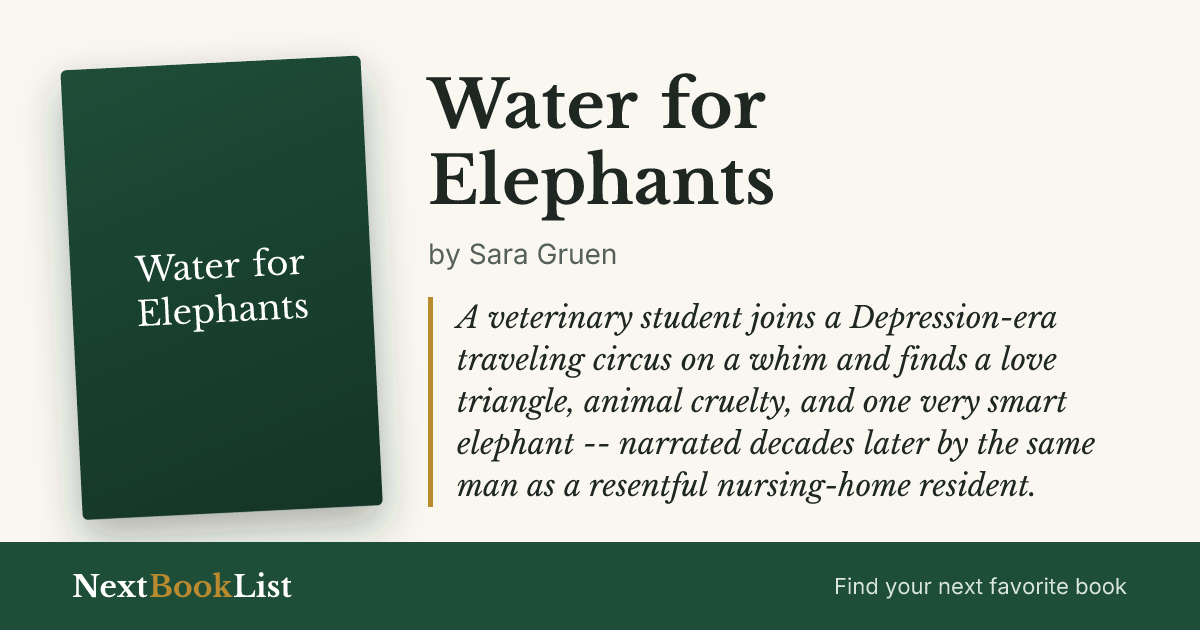
Water for Elephants
by Sara Gruen · 2006
A veterinary student joins a Depression-era traveling circus on a whim and finds a love triangle, animal cruelty, and one very smart elephant -- narrated decades later by the same man as a resentful nursing-home resident.
Worth reading? Water for Elephants is a solid, well-researched historical romance elevated by its circus setting and dragged down slightly by how predictable the central love triangle is. Gruen clearly did the homework on Depression-era traveling circuses, animal training practices, and the caste system between circus workers and performers, and that texture is what makes the book memorable more than the plot does.
| Author | Sara Gruen |
|---|---|
| Published | 2006 |
| Publisher | Algonquin Books |
| Category | Fiction |
| Favorite quote | “Age is a terrible thief. Just when you're getting the hang of life, it knocks your legs out from under you and stoops your back. It makes you ache and muddies your head and silently spreads cancer throughout your spouse.” |
The Verdict
The circus research is what elevates this above a standard-issue period romance. Gruen clearly dug into how these outfits actually operated, the labor abuses, the animal treatment, the strict social ladder between performers and roustabouts, and that specificity gives the book a texture a lot of historical fiction doesn’t bother earning.
The love triangle itself is the least interesting part. August’s villainy is telegraphed early and never really complicates itself, and Jacob and Marlena’s connection follows a fairly standard forbidden-romance beat sheet. Rosie the elephant, honestly, is the better character.
Read it if you want well-researched Depression-era circus history wrapped around a serviceable romance. Skip it if graphic animal cruelty content is something you’d rather avoid.
you want historical fiction with real circus-industry texture (the Depression-era traveling circus is meticulously researched) wrapped around a fairly conventional forbidden-love plot
you're sensitive to depictions of animal abuse -- the novel doesn't shy away from how badly circus animals were treated, and it's a recurring, sometimes graphic thread
Book Summary
Jacob Jankowski, orphaned days before his final veterinary exams, jumps a train that turns out to belong to the Benzini Brothers circus, and talks his way into a job as the show's veterinarian during the Depression.
The novel splits its time between young Jacob's circus life, where he falls for Marlena, the star performer married to the circus's abusive, possibly mentally ill animal trainer August, and elderly Jacob narrating from a nursing home decades later, resentful of being infantilized by staff and family who don't know his history.
Gruen uses Rosie the elephant, purchased as a supposedly untrainable, "stupid" animal, as both a plot device and a thematic center: Rosie turns out to understand Polish commands and becomes the emotional and narrative key to the book's climax, tying animal intelligence and animal abuse together as a single argument.
The novel is heavily researched from real circus history and Depression-era labor conditions, workers thrown from moving trains ("redlighting") when a circus went bankrupt, strict hierarchies between circus performers and roustabouts, which gives the more conventional romance plot a grounded, specific backdrop.
Top 9 Lessons from Water for Elephants
- The novel treats Depression-era traveling circuses as a genuine subculture with its own caste system, performers above laborers, both above the animals, and uses that hierarchy to explain why abuse went unchecked for so long.
- August's abuse of Rosie and of Marlena is framed as connected, not parallel -- the same capacity for cruelty and control shows up in how he treats an animal and how he treats his wife.
- Rosie's intelligence, hidden until Jacob discovers she responds to Polish, not English, commands, is used to argue that perceived 'stupidity' in an abused animal is often just miscommunication, not a real deficit.
- Elderly Jacob's nursing-home narration contributes a quieter theme: how much of a person's real history gets erased once they're old and dependent on others' care and assumptions.
- The 'redlighting' practice, throwing workers off moving trains during bankruptcy to avoid paying them, is used to show how disposable labor was treated even outside the animal-cruelty plotline.
- The love triangle between Jacob, Marlena, and August ultimately takes a back seat structurally to the Rosie plotline, which is where the novel's climax and its sharpest moral stakes actually live.
- Jacob's decision to jump a moving train and beg for work is framed as the only move left to someone who just lost his family and his future in the same week, not as youthful daring.
- The circus's day-to-day logistics -- loading trains, striking tents, moving towns overnight -- are rendered in granular procedural detail that grounds the novel's more melodramatic beats in something concrete.
- Uncle Al, the circus's owner, is written as proof of how thin the line was between legitimate show business and outright exploitation of workers and performers during the Depression.
Top 5 Quotes from Water for Elephants
"Age is a terrible thief. Just when you're getting the hang of life, it knocks your legs out from under you and stoops your back. It makes you ache and muddies your head and silently spreads cancer throughout your spouse."
Sara Gruen, Water for Elephants
"With a secret like that, at some point the secret itself becomes irrelevant. The fact that you kept it does not."
Sara Gruen, Water for Elephants
"When two people are meant to be together, they will be together. It's fate."
Sara Gruen, Water for Elephants
"Even as your body betrays you, your mind denies it."
Sara Gruen, Water for Elephants
"Why the hell shouldn't I run away with the circus?"
Sara Gruen, Water for Elephants
Frequently Asked Questions
Is Water for Elephants worth reading?
Yes, mainly for the circus history and Rosie's storyline -- the central romance is more conventional but the setting carries the book.
What is Water for Elephants about?
A veterinary student who joins a Depression-era traveling circus, falls for a performer trapped in an abusive marriage, and uncovers the intelligence of an elephant named Rosie.
Does Water for Elephants depict animal cruelty?
Yes, directly and repeatedly -- it's a central thread of the plot, so readers sensitive to that content should be aware going in.
Is Water for Elephants historically accurate?
Gruen researched real Depression-era circus practices extensively, and much of the operational detail (labor conditions, animal treatment, circus hierarchy) reflects documented history.
Is there a movie version of Water for Elephants?
Yes, a 2011 film adaptation starring Reese Witherspoon and Robert Pattinson.
Ready to read it?
Get Water for Elephants on Amazon