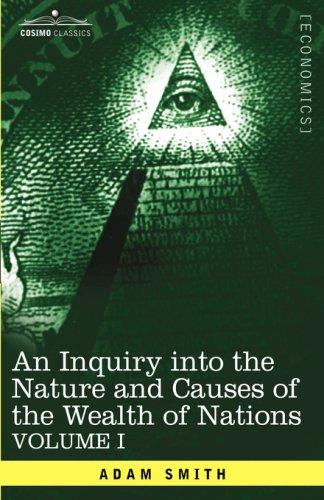
The Wealth of Nations
by Adam Smith · 1776
The 1776 book that invented economics as a discipline and explained, in plain prose, why free exchange makes everyone richer.
Worth reading? Every economist, central banker, and talking head since 1776 is either building on this book or arguing with it. That's the strongest Lindy signal there is: 250 years later, the debate is still conducted on Smith's terms. You don't need to read all 1,000 pages. The famous parts, the pin factory, the invisible hand, the butcher and baker, the warning about merchants conspiring, are enough to make you the smartest person in most rooms about why markets work and where they rot. Read it as the source code. Modern business and investing books are all footnotes and rebuttals to Smith. If you want the original, here it is, and it's still in print because it's still right about more than it's wrong about.
| Full Title | An Inquiry into the Nature and Causes of the Wealth of Nations |
|---|---|
| Author | Adam Smith |
| Published | 1776 |
| Publisher | Cosimo Classics |
| Category | Business & Money |
| Favorite quote | “It is not from the benevolence of the butcher, the brewer, or the baker, that we expect our dinner, but from their regard to their own interest.” |
The Verdict
Smith’s 1776 inquiry invented economics as a field and is still the book every economist argues with or builds on. Two and a half centuries later, the debate runs on his terms.
Read it if you argue about markets, taxes, or trade and want to know what the people you're arguing with are actually supposed to know.
Skip it if you want a quick read. It's 1,000+ pages of 18th-century prose and you'll get 90% of the value from five famous ideas.
Book Summary
Smith's engine is the division of labor: a pin factory where each worker does one tiny step produces vastly more than the same people each making whole pins. Specialization is the root of wealth.
His most quoted mechanism is the invisible hand, people pursuing their own interest in a competitive market end up serving others better than they would if they tried to serve others on purpose.
He was suspicious of both monopoly and merchants lobbying government for favors. 'People of the same trade seldom meet together, even for merriment and diversion, but the conversation ends in a conspiracy against the public.' That line is 250 years old and still describes every industry dinner.
Top 10 Lessons from The Wealth of Nations
- Division of labor is the engine of wealth. Specialize, and a group of ordinary people out-produces a group of generalists by orders of magnitude.
- Self-interest, channeled by competition, serves others better than deliberate charity does. That's the invisible hand.
- Watch out for people in the same trade meeting privately. Smith said their conversation ends in a conspiracy against the public. Still true.
- Free trade makes both sides richer. Tariffs protect a few producers by taxing everyone else.
- Price is set by supply and demand, not by the moral worth of the work. Scarcity, not effort, sets the price.
- Markets need rules and trust. Smith was not a 'greed is good' theorist; he assumed honest, law-abiding participants.
- Mercantilism, hoarding gold, is a dead end. A nation's wealth is its output and its people, not its pile of metal.
- Education and infrastructure are legitimate state roles; Smith wanted a limited but real government, not an absent one.
- The butcher, brewer, and baker feed you from self-interest, not benevolence. Build systems that align interest with outcome.
- Wealth compounds across generations through saved capital reinvested in better methods.
Top 5 Quotes from The Wealth of Nations
"It is not from the benevolence of the butcher, the brewer, or the baker, that we expect our dinner, but from their regard to their own interest."
Adam Smith, The Wealth of Nations
"People of the same trade seldom meet together, even for merriment and diversion, but the conversation ends in a conspiracy against the public, or in some contrivance to raise prices."
Adam Smith, The Wealth of Nations
"Man is an animal that makes bargains: no other animal does this - no dog exchanges bones with another."
Adam Smith, The Wealth of Nations
"Consumption is the sole end and purpose of all production; and the interest of the producer ought to be attended to, only so far as it may be necessary for promoting that of the consumer."
Adam Smith, The Wealth of Nations
"Every man, as long as he does not violate the laws of justice, is left perfectly free to pursue his own interest his own way."
Adam Smith, The Wealth of Nations
Frequently Asked Questions
Did Adam Smith invent capitalism?
Not exactly, but he wrote the first systematic explanation of how market economies work, which is why he's called the father of economics. He described capitalism more than he invented it.
Is the 'invisible hand' a real quote?
Yes, and it's narrower than people think. Smith used it a few times to mean self-interest in a competitive market unintentionally benefits society. He did not mean 'greed solves everything,' which is a later distortion.
Do I have to read the whole thing?
No. Read an abridged edition or the famous chapters. The full text is dense 18th-century prose, and the core ideas are a small fraction of the page count.
Ready to read it?
Get The Wealth of Nations on Amazon