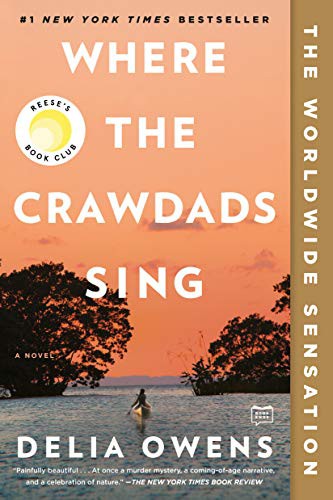
Where the Crawdads Sing
by Delia Owens · 2018
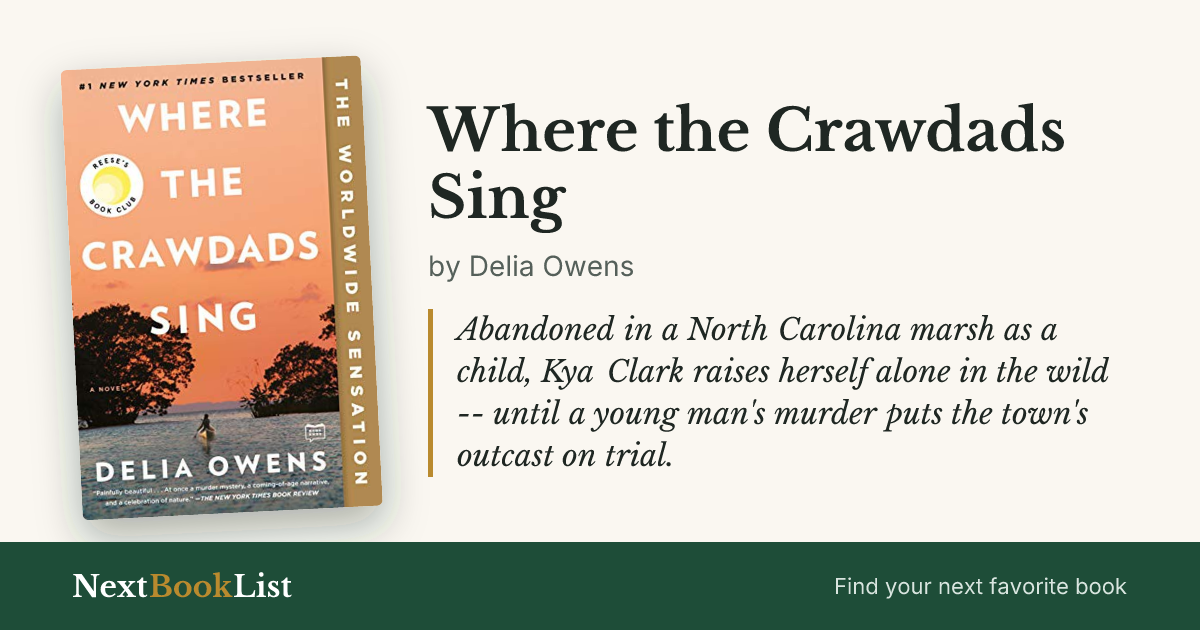
Abandoned in a North Carolina marsh as a child, Kya Clark raises herself alone in the wild -- until a young man's murder puts the town's outcast on trial.
Worth reading? A slow-burn nature novel with a murder trial bolted on -- read it for Kya and the marsh, not for pace.
| Author | Delia Owens |
|---|---|
| Published | 2018 |
| Publisher | G.P. Putnam's Sons |
| Category | Fiction |
| Favorite quote | “Autumn leaves don't fall; they fly.” |
The Verdict
The marsh writing is the reason this book became what it became – Owens spent decades as a field zoologist before she wrote fiction, and it shows in every page about tide pools, shorebirds, and the cold logic of who survives out there. That’s the real appeal, more than the murder plot.
Where it loses people is pace. The first half is essentially a survival memoir with courtroom scenes teased in flash-forwards; if you came for a fast-moving thriller, the back half’s trial will feel like it arrived a hundred pages too late. If you came for Kya and the marsh, the trial ends up being the least interesting part of the book, competently plotted but clearly secondary to the character study.
Skip it if you want your small-town mystery to move like a thriller from page one – try The Guest List instead. Read it if you want a slow, well-observed portrait of isolation that happens to have a murder in it, not the other way around.
you want a slow-building mystery wrapped around a survival story, with nature writing good enough to justify the pace, and you don't mind a courtroom drama that shows up late and moves fast
you want the mystery to drive from page one -- the murder trial doesn't take over the book until well past the halfway mark, and the first half is closer to a coming-of-age nature memoir than a thriller
Book Summary
Kya Clark is abandoned by her family one by one in the marshlands of the North Carolina coast, left to raise herself from around age seven with almost no contact with the town that calls her "Marsh Girl." The novel splits its time between her childhood -- learning to survive off the marsh, taught to read by a kind local boy -- and a murder investigation years later, after the town's golden-boy quarterback turns up dead near her shack.
The trick is that Owens, a wildlife scientist by training, treats the marsh itself as a character with its own logic: predation, adaptation, the cold arithmetic of who survives. Kya's isolation isn't just sad backstory, it's the thing the whole plot hinges on -- she's shaped by rules that have nothing to do with the town's rules, and the murder trial becomes as much about whether a jury can judge someone raised entirely outside their world.
What makes it work past the premise is that Owens never asks you to feel sorry for Kya so much as understand her on the marsh's own terms -- self-sufficiency built out of abandonment, not virtue.
Top 8 Lessons from Where the Crawdads Sing
- Abandonment doesn't have to break a person -- it can also force a self-reliance that no stable childhood would have taught, though the book never pretends that trade is a fair one.
- Kya's isolation from the town isn't a personality quirk, it's a survival strategy she built after every person who was supposed to stay, left.
- The marsh operates on rules of adaptation and predation that have nothing to do with human morality, and Owens uses that as a lens for how the town ultimately judges Kya.
- Being an outsider in a small community isn't just lonely, it makes you a convenient villain the moment something goes wrong, whether you did it or not.
- Literacy and language become Kya's bridge back to the human world, but only on her terms, through someone patient enough to earn her trust first.
- Love that requires you to disappear or be less than you are isn't safety, and the men in Kya's life are sorted almost entirely by whether they can hold both her and the marsh.
- A courtroom is a bad tool for understanding a person raised entirely outside its assumptions -- the trial's real tension is whether the jury can even ask the right questions.
- Nature doesn't offer redemption or punishment, only consequence, and the book's ending only works if you accept that framework instead of a strictly moral one.
Top 4 Quotes from Where the Crawdads Sing
"Autumn leaves don't fall; they fly."
Delia Owens, Where the Crawdads Sing
"Sometimes she heard night-sounds she didn't know or jumped from lightning too close, but whenever she stumbled, it was the land who caught her."
Delia Owens, Where the Crawdads Sing
"There is a time for daring and a time for caution, and a wise man understands which is called for."
Delia Owens, Where the Crawdads Sing
"Isolation had turned into something bigger than herself, and it beckoned her."
Delia Owens, Where the Crawdads Sing
Frequently Asked Questions
Is Where the Crawdads Sing worth reading?
Yes, if you're patient with pacing -- it's less a thriller than a coming-of-age novel with a murder trial grafted onto the back half, and the marsh setting does most of the heavy lifting.
Is Where the Crawdads Sing based on a true story?
No. It's a work of fiction, though author Delia Owens drew on her own decades as a wildlife scientist living in remote parts of Africa for the marsh's ecological detail.
Is there a movie based on Where the Crawdads Sing?
Yes, a 2022 film adaptation was produced by Reese Witherspoon's Hello Sunshine, starring Daisy Edgar-Jones as Kya.
Does Where the Crawdads Sing have trigger warnings?
Yes -- child abandonment, domestic abuse, and a murder trial with graphic testimony all feature. It's not a light read despite the nature-writing tone.
Ready to read it?
Get Where the Crawdads Sing on Amazon