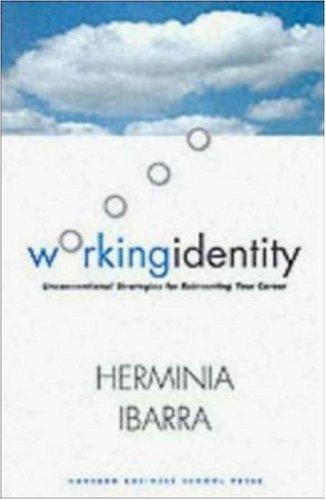
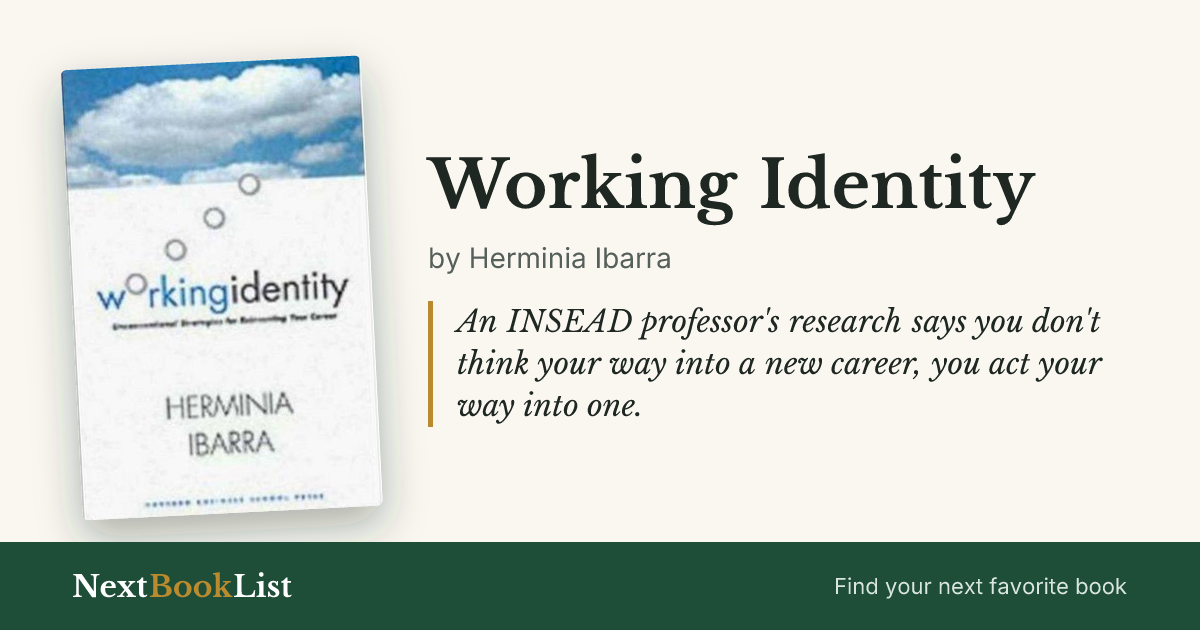
Working Identity
by Herminia Ibarra · 2003
An INSEAD professor's research says you don't think your way into a new career, you act your way into one.
Worth reading? Ibarra's central claim inverts the conventional wisdom directly: you don't discover your one true self through reflection and then go find matching work, you construct a new professional identity through action, small experiments, new networks, then let the sense of self catch up afterward. It's research-backed (real case studies of career changers), not motivational filler. Skip it if you want a workbook with exercises; this is closer to a research narrative with a framework embedded in it.
| Full Title | Working Identity: Unconventional Strategies for Reinventing Your Career |
|---|---|
| Author | Herminia Ibarra |
| Published | 2003 |
| Publisher | Harvard Business School Press |
| Category | Self-Improvement & Psychology |
| Favorite quote | “Self-creation is a lifelong journey. Only by our actions do we learn who we want to become, how best to travel, and what else will need to change to ease the way.” |
The Verdict
Ibarra’s research contradicts the advice most career changers hear first: figure out who you are, then find work that matches. Her case studies of real professionals mid-transition found the reverse order actually works, they acted first through small experiments and let a clearer sense of identity emerge from what the action revealed, not from more reflection.
The three practices, experimenting with new activities, shifting into new networks, and reworking your own narrative, hold up because they’re drawn from real transitions, not built as a motivational framework first and illustrated after the fact.
Skip it if you want a workbook with exercises to fill in; this reads more like a research narrative with the framework embedded in the stories. Pair it with Designing Your Life if you want the process laid out step by step alongside Ibarra’s underlying psychology.
you're mid-career, considering a real change, and keep waiting to 'figure it out' before you move
you want a step-by-step workbook (Designing Your Life is the more exercise-driven version of similar advice)
Book Summary
Conventional career-change advice says: know yourself first, then find matching work. Ibarra's research on real career changers found the opposite order works better, act first through small experiments, then let a clearer sense of identity emerge from what you actually did and how it felt.
Three practices drive successful reinvention: experimenting with new professional activities before fully committing, shifting into new networks of people who reflect the person you're becoming, and making sense of the transition through the stories you tell yourself and others along the way.
Career changers usually carry several possible selves at once during a transition, and the discomfort of that ambiguity is normal, not a sign the change is wrong. Ibarra argues you resolve it through testing, not through more analysis.
Top 9 Lessons from Working Identity
- Act your way into a new identity; don't wait to fully know yourself before you start experimenting.
- Run small, low-stakes experiments (a side project, a course, a temporary role) before committing to a full career pivot.
- Shift your network deliberately toward people already doing the work you're considering; identity follows relationships, not just reflection.
- Expect to hold several possible future selves at once during a transition; the ambiguity is normal, not a red flag.
- The stories you tell about your transition (to yourself and others) actively shape how the change unfolds, not just describe it.
- A crisis of meaning in your current role is often the real trigger for change, more than the job's external circumstances.
- Reinvention is rarely a single decisive leap; it's a series of small, testable steps that compound.
- Waiting for total clarity before acting usually delays the change indefinitely; clarity tends to arrive after action, not before it.
- Mentors and role models from your target field matter more during a transition than career counselors or personality tests.
Top 5 Quotes from Working Identity
"When we follow our passions, we also risk escalating our emotional commitment to a new course of action before we have evidence that it will be doable."
Herminia Ibarra, Working Identity
"Shifting connections refers to the practice of finding people who can help us see and grow into our new selves, people we admire, would like to emulate, and with whom we want to spend time. All reinventions require social support."
Herminia Ibarra, Working Identity
"When we see change as requiring 'big, bold strokes,' we amplify our fear of it; we overcome this fear by putting one foot in front of the other, in a series of safer steps."
Herminia Ibarra, Working Identity
"Becoming our own person, breaking free from our 'ought selves'—the identity molded by important people in our lives—is at the heart of the transition process."
Herminia Ibarra, Working Identity
"Self-creation is a lifelong journey. Only by our actions do we learn who we want to become, how best to travel, and what else will need to change to ease the way."
Herminia Ibarra, Working Identity
Frequently Asked Questions
Is Working Identity worth reading?
Yes, if you're mid-career and seriously considering a change but keep waiting to 'figure it out' first. Ibarra's research says that order is backwards, act first, let identity catch up. Skip it if you want a structured workbook instead of a research narrative.
What is the main idea of Working Identity?
Career reinvention happens through action first, small experiments, new networks, new narratives, not through introspection followed by a single decisive leap.
Who should read Working Identity?
Mid-career professionals seriously considering a change who are stuck waiting for clarity before they act.
Working Identity or Designing Your Life, which should I read first?
Read Working Identity for the research and the psychological reframe on why waiting for clarity backfires. Read Designing Your Life for the more structured, exercise-driven process to actually run the experiments.
Ready to read it?
Get Working Identity on Amazon