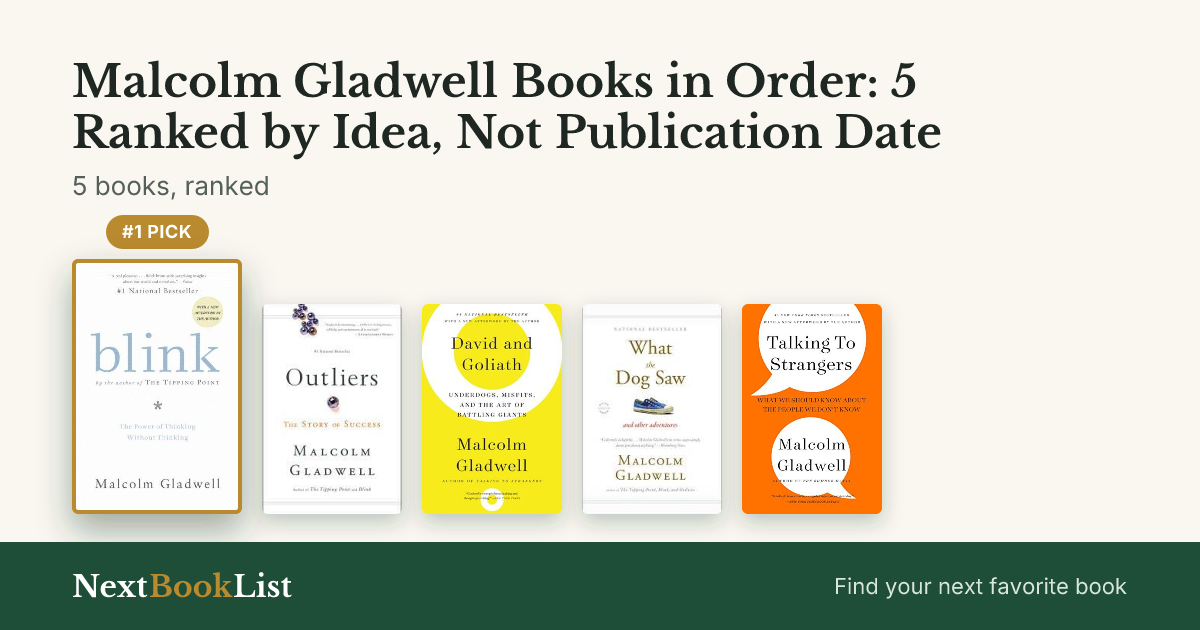
Malcolm Gladwell Books in Order: 5 Ranked by Idea, Not Publication Date

Updated July 16, 2026 · 5 books

Malcolm Gladwell Books in Order: 5 Ranked by Idea, Not Publication Date: ranked list of 5 books

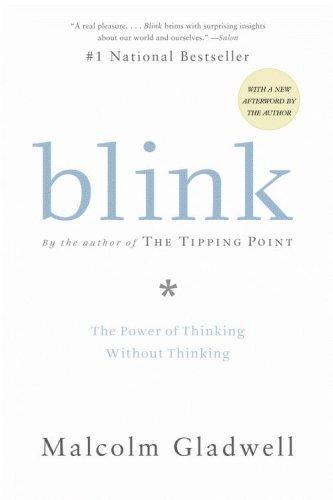
Gladwell’s pattern is the same in every book: take one counterintuitive claim, prove it with a run of vivid, unrelated-seeming stories, then land a soft synthesis. That makes reading order less about chronology and more about which idea you want first. Blink (snap judgment happens faster and more accurately than we admit) and Outliers (success is mostly circumstance, not just talent) are the two everyone already half-knows through cultural osmosis, so they’re the strongest starting points.

David and Goliath takes the same formula and points it at disadvantage - the idea that some obstacles make people stronger rather than weaker. Talking to Strangers is the most self-aware entry, partly walking back the confidence Blink built by showing how often humans misread people they don’t know. Reading Talking to Strangers after Blink actually works better than reading it first - it lands as a correction, not a contradiction. What the Dog Saw, a collection of his New Yorker pieces, doesn’t carry a single big idea the way the others do, so it fits best as something you dip into between the full-length books rather than a dedicated start or finish.

Be honest with yourself about the formula fatigue. Critics have called out that by the fourth or fifth Gladwell book, the shape is predictable - a surprising claim, three or four anecdotes, a tidy close - and the storytelling starts doing more work than the evidence. If you’ve read Blink and Outliers and already feel like you’ve got Gladwell’s method, that’s a legitimate place to stop. You’re not missing a different argument in the later books, just more of the same one applied to new material.

Quick Comparison

#BookBest for
1BlinkMalcolm Gladwellyou make fast, high-stakes calls (hiring, triage, negotiation) and want to know when to trust your first readAmazon
2OutliersMalcolm Gladwellanyone who assumes talent alone explains achievement and wants the real, evidence-based storyAmazon
3David and GoliathMalcolm Gladwellanyone weighing whether David and Goliath belongs on their business and money shelfAmazon
4What the dog saw and other adventure storiesMalcolm Gladwellanyone weighing whether What the dog saw and other adventure stories belongs on their business and money shelfAmazon
5Talking to StrangersMalcolm Gladwellanyone weighing whether Talking to Strangers belongs on their self-improvement and psychology shelfAmazon

The Books

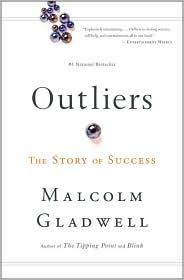
Outliers by Malcolm Gladwell book cover

2. Outliers

Malcolm Gladwell · 2008

The book that reframed success as a product of timing, culture, and 10,000 hours, not just individual genius.

Gladwell’s Outliers is the most readable case for why success is situational: born at the right time, given 10,000 hours of practice, and supported by a culture that pushes you. It’s weaker on causation than it pretends, but as a myth-buster about the lone genius it’s unmatched. Skip it if you want step-by-step strategy, this is a lens, not a playbook.

Read it if: anyone who assumes talent alone explains achievement and wants the real, evidence-based story

Skip it if: you've already absorbed the 10,000-hour rule and just want a business tactic

Full verdict: Outliers →

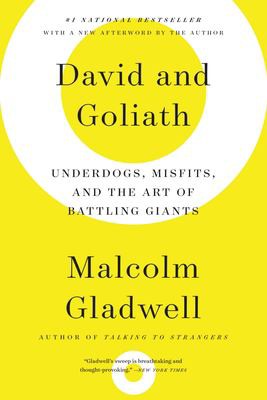
David and Goliath by Malcolm Gladwell book cover

3. David and Goliath

Malcolm Gladwell · 2013

Malcolm Gladwell's take on business, the honest verdict is below.

Gladwell’s case that underdogs win by breaking the rules, and that advantages often come with hidden costs. Read it for the twisty stories. Skip it if you want a tight argument, like his others, it’s vignette-driven and easy to over-generalize.

Read it if: anyone weighing whether David and Goliath belongs on their business and money shelf

Skip it if: you want a different angle than Malcolm Gladwell's

Full verdict: David and Goliath →

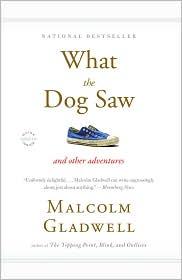
What the dog saw and other adventure stories by Malcolm Gladwell book cover

4. What the dog saw and other adventure stories

Malcolm Gladwell · 2009

Malcolm Gladwell's take on business, the honest verdict is below.

Gladwell’s essay collection is his most readable work, short, curious, and low on the forced ‘big idea’ of his later books. Read it for pleasure and odd facts; skip it if you want one tight thesis, because it’s a grab bag.

Read it if: anyone weighing whether What the dog saw and other adventure stories belongs on their business and money shelf

Skip it if: you want a different angle than Malcolm Gladwell's

Full verdict: What the dog saw and other adventure stories →

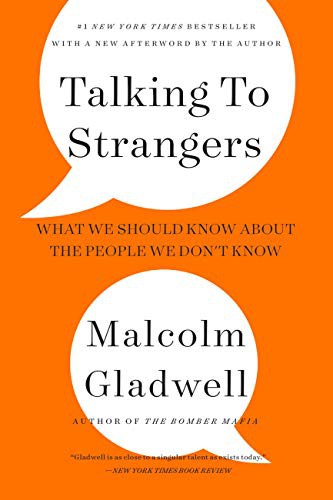
Talking to Strangers by Malcolm Gladwell book cover

5. Talking to Strangers

Malcolm Gladwell · 2019

Malcolm Gladwell's take on self-improvement, the honest verdict is below.

Gladwell on why we misread people we don’t know, hung on high-profile cases. Provocative and readable; skip if his story-first, argument-loose style frustrates you, because critics fairly note he cherry-picks.

Read it if: anyone weighing whether Talking to Strangers belongs on their self-improvement and psychology shelf

Skip it if: you want a different angle than Malcolm Gladwell's

Full verdict: Talking to Strangers →

Frequently Asked Questions

What order should I read Malcolm Gladwell books in?

Blink and Outliers first - they're his two most influential ideas (snap judgment, and the hidden role of circumstance in success) and the ones everyone actually references. David and Goliath and Talking to Strangers can follow in either order. What the Dog Saw, a magazine-essay collection, works well as a palate cleanser between the full-length books rather than a start or finish.

What is Malcolm Gladwell's most famous book?

Outliers, mainly for the "10,000 hours" idea, though the book's real argument is broader - that success depends heavily on timing, culture, and circumstance most people never see. Blink is a close second for "thin-slicing" and snap judgment.

Do Gladwell's books get repetitive?

Somewhat. The formula - counterintuitive claim, a run of vivid stories, a soft synthesis - is consistent across all five, and critics have pointed out the pattern gets thinner by book four or five. If you've read Blink and Outliers and feel like you have the idea, it's fair to stop there.

Is What the Dog Saw worth reading?

It's a collection of his New Yorker essays, so it's lower commitment and more varied than his full-length books. Good if you want Gladwell in smaller doses, skippable if you'd rather stick to his standalone arguments.

Which Gladwell book should I read last, or skip?

Talking to Strangers is the most useful to read last - it's partly a correction of overconfidence in reading people, which lands better once you've seen Blink's case for snap judgment. If you're pressed for time, What the Dog Saw is the easiest to skip since it's essays rather than one sustained argument.

Keep Reading