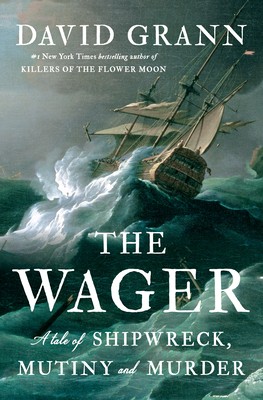
The Wager
by David Grann · 2023
A British warship wrecks off Patagonia in 1741, and the survivors' competing accounts of what happened next become their own kind of mutiny.
Worth reading? The Wager is Grann working in the same register as Killers of the Flower Moon -- meticulous research turned into a genuine page-turner -- applied to 18th-century naval history instead of 20th-century crime. It beats most survival narratives because it doesn't resolve into a clean hero's story; the competing, self-serving accounts are the actual subject. Read The Terror by Dan Simmons afterward if you want the same wrecked-ship-in-the-cold setup as fiction.
| Full Title | The Wager: A Tale of Shipwreck, Mutiny and Murder |
|---|---|
| Author | David Grann |
| Published | 2023 |
| Publisher | Doubleday |
| Category | History |
| Favorite quote | “Empires preserve their power with the stories that they tell, but just as critical are the stories they don't—the dark silences they impose, the pages they tear out.” |
The Verdict
Grann’s real subject isn’t the shipwreck – it’s what happens to truth once everyone who survived has a reason to lie about it. The court-martial doesn’t resolve the mystery so much as show you how institutions decide which lies are useful to believe.
It moves like a thriller for a book built almost entirely from 280-year-old court records and ship logs, which is the same trick that made Killers of the Flower Moon work. If you liked that one, this is an easy next pick.
you want true survival history with a genuine mystery at its center -- not just what happened, but whose account of it you should believe
you want a tidy, single-narrator adventure story -- the whole point here is that no single account can be fully trusted
Book Summary
The HMS Wager was part of a British naval squadron sent to raid Spanish treasure ships in the 1740s, and it wrecked off the coast of Patagonia. The survivors split into factions -- one loyal to the captain, one following the gunner-turned-mutineer John Bulkeley -- and descended into starvation, mutiny, and murder as they tried to get home. Multiple groups of survivors eventually made it back to England years apart, each publishing a self-serving and conflicting account of what had happened. The Admiralty's court-martial, Grann shows, cared less about establishing the truth than about protecting the reputation of the Royal Navy, which shaped whose version of events was allowed to stand. Grann frames the whole story as a study in how people construct self-justifying narratives under extreme survival pressure, and how empire depends on ordinary people's willingness to serve a system that treats them as expendable -- including the Indigenous Kawesqar people who helped the stranded sailors survive, a debt British accounts largely erased.
Top 10 Lessons from The Wager
- The HMS Wager wrecked off Patagonia in the 1740s while part of a British squadron raiding Spanish treasure ships.
- Survivors split into rival factions -- one loyal to the captain, one following the mutinous gunner John Bulkeley.
- Starvation and desperation dissolved rank and social order faster than almost anything else on the island.
- Multiple survivor groups reached England years apart, each with a self-serving, conflicting account of events.
- The Admiralty's court-martial prioritized protecting the Royal Navy's reputation over establishing the truth.
- Indigenous Kawesqar people helped the stranded sailors survive, a debt British accounts largely minimized or erased.
- Grann frames the competing survivor narratives as a study in how people construct self-justifying stories under extreme pressure.
- The book argues empire depends on ordinary people's willingness to serve a system willing to treat them as expendable.
- Officers' published memoirs were shaped as much by fear of prosecution as by any desire to inform the public.
- Grann treats the unreliability of every account, including the official ones, as the real subject of the book.
Top 4 Quotes from The Wager
"We all impose some coherence—some meaning—on the chaotic events of our existence. We rummage through the raw images of our memories, selecting, burnishing, erasing. We emerge as the heroes of our stories, allowing us to live with what we have done—or haven't done."
David Grann, The Wager
"Empires preserve their power with the stories that they tell, but just as critical are the stories they don't—the dark silences they impose, the pages they tear out."
David Grann, The Wager
"It is precisely such unthinking complicity that allows empires to endure. Indeed, these imperial structures require it: thousands and thousands of ordinary people, innocent or not, serving—and even sacrificing themselves for—a system many of them rarely question."
David Grann, The Wager
"Yet they were compelled onward by that mysterious narcotic: hope."
David Grann, The Wager
Frequently Asked Questions
Is The Wager worth reading?
Yes -- it's Grann's meticulous research applied to a genuinely gripping survival story, and the competing, self-serving survivor accounts give it a mystery most true survival narratives don't have.
What is The Wager about?
The 1741 wreck of the British warship HMS Wager off Patagonia, the mutiny and starvation that followed, and the conflicting accounts survivors gave years later when they finally made it back to England.
Is The Wager a true story?
Yes. It's narrative nonfiction built from ship logs, court-martial records, and survivor memoirs, which is also why the book spends so much time on how unreliable those sources are.
Who should read The Wager?
Fans of Grann's Killers of the Flower Moon, naval history readers, and anyone who likes a true story where the biggest mystery is which narrator to believe.
Ready to read it?
Get The Wager on Amazon