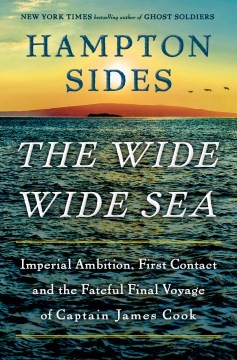
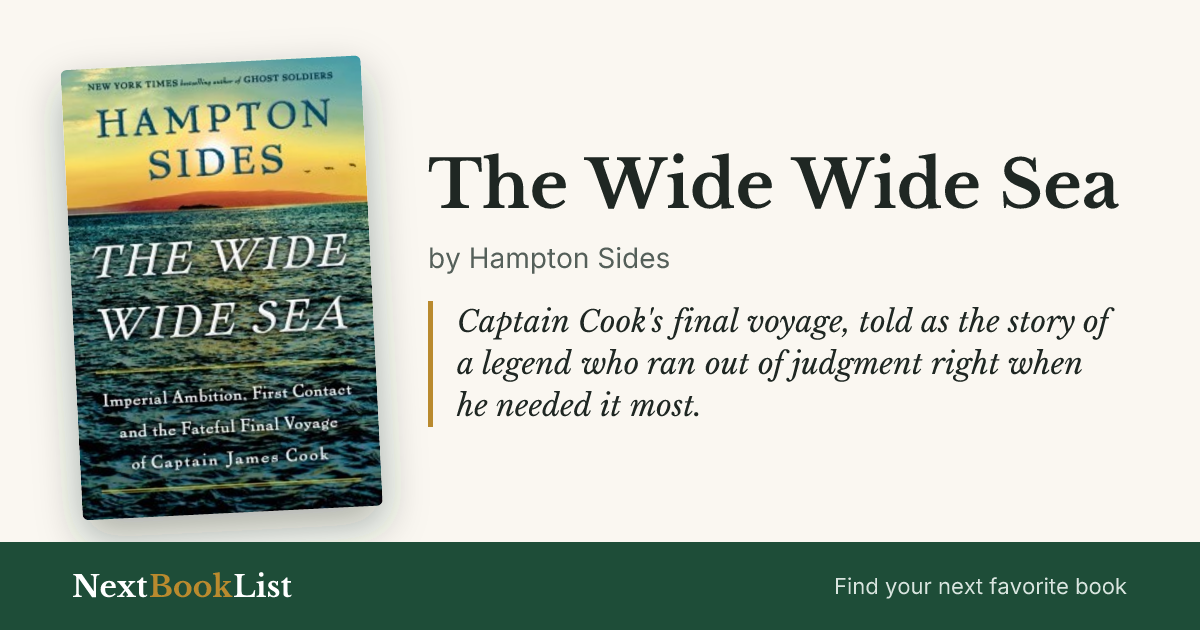
The Wide Wide Sea
by Hampton Sides · 2024
Captain Cook's final voyage, told as the story of a legend who ran out of judgment right when he needed it most.
Worth reading? The Wide Wide Sea is the best Cook biography for readers who already know the outline (three voyages, killed in Hawaii) and want the fuller, messier version. Sides doesn't excuse Cook's role in empire, but he doesn't flatten him into a villain either. If you liked Sides's In the Kingdom of Ice, this is the same narrative-history muscle applied to a more morally complicated subject.
| Full Title | The Wide Wide Sea: Imperial Ambition, First Contact and the Fateful Final Voyage of Captain James Cook |
|---|---|
| Author | Hampton Sides |
| Published | 2024 |
| Publisher | Doubleday |
| Category | History |
| Favorite quote | “There was a charisma bound up in the discretion of his command style—in what he didn't say, what he didn't do, how he didn't react. He believed in minimal exertion of energy or explanation.” |
The Verdict
Sides’s real subject isn’t the Northwest Passage – it’s the gap between the disciplined, low-casualty Cook of the first two voyages and the impatient, erratic Cook who got himself killed on the third. That gap is more interesting than another straight “great explorer” narrative would have been.
It helps that Sides doesn’t let the reader off easy on the imperial violence underneath the adventure. This isn’t a book that asks you to root uncomplicatedly for Cook, and it’s better for it.
you want a narrative history of exploration that doesn't flinch from the imperial violence underneath the adventure
you want a straightforward hero's-journey account of Cook -- Sides is deliberately complicating the myth, not polishing it
Book Summary
Cook's third and final voyage set out to find the Northwest Passage and return a Tahitian named Omai to his home island -- but the book's real interest is in how a man famous for minimal-loss, highly disciplined voyages became uncharacteristically erratic near the end of his life, culminating in his death at Kealakekua Bay, Hawaii. Sides uses the voyage's first-contact encounters in Alaska, the Pacific Northwest, and Hawaii to reexamine Cook not as a simple hero of discovery but as an instrument, sometimes reluctant, of empire -- drawing on Indigenous oral histories alongside ship logs to complicate the standard account. The book traces how Cook's own legend outpaced the man, and how his crew's treatment of Indigenous peoples, including kidnappings and retaliatory violence over the voyage, set the stage for the fatal miscalculation that killed him.
Top 10 Lessons from The Wide Wide Sea
- Cook's third voyage aimed to find the Northwest Passage and return the Tahitian Omai to his home island.
- Cook was famous for minimal-loss voyages and strict discipline, which makes his erratic judgment on the final voyage stand out.
- Sides reexamines Cook as an instrument of empire, not a pure hero of discovery, without simply recasting him as a villain.
- First-contact encounters in Alaska, the Pacific Northwest, and Hawaii are shown as complex, often violent negotiations rather than simple 'discovery.'
- The crew's kidnappings and retaliatory violence against Indigenous peoples on the voyage foreshadow Cook's death.
- Cook was killed at Kealakekua Bay, Hawaii, in a skirmish that began over a stolen ship's boat.
- Sides draws on Indigenous oral histories and modern scholarship, not just European ship logs, to widen the account.
- Omai's return to Tahiti loaded with Western goods and customs becomes its own cautionary tale about the costs of contact.
- The book suggests Cook's declining health and judgment near the voyage's end help explain his fatal error in Hawaii.
- Cook's own legend, built over two earlier successful voyages, outpaced the increasingly erratic man leading the third.
Top 3 Quotes from The Wide Wide Sea
"There was a charisma bound up in the discretion of his command style—in what he didn't say, what he didn't do, how he didn't react. He believed in minimal exertion of energy or explanation."
Hampton Sides, The Wide Wide Sea
"On the unknown coast of America, the ships ran on foggy nights under full sail, and the captain slept peacefully all the while. In the moment of greatest danger, he was at once the most merry, the most serene, and the most steady."
Hampton Sides, The Wide Wide Sea
"form a morally complicated tale that has left a lot for modern sensibilities to unravel and critique"
Hampton Sides, The Wide Wide Sea
Frequently Asked Questions
Is The Wide Wide Sea worth reading?
Yes, if you want a narrative history of Cook's final voyage that takes the imperial violence seriously instead of treating it as a footnote to the adventure story.
What is The Wide Wide Sea about?
Captain James Cook's third and final Pacific voyage, his increasingly erratic judgment near its end, and his death in Hawaii, told alongside the perspectives of the Indigenous peoples he encountered.
Is The Wide Wide Sea sympathetic to Cook?
It's neither a hagiography nor a takedown. Sides presents Cook as a genuinely skilled commander whose judgment failed him at the worst possible moment, within a system of empire he served.
Who should read The Wide Wide Sea?
Readers of narrative history and exploration who want the fuller, more complicated version of a story they may only know in outline.
Ready to read it?
Get The Wide Wide Sea on Amazon