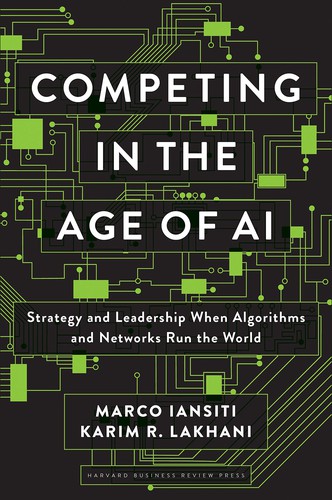
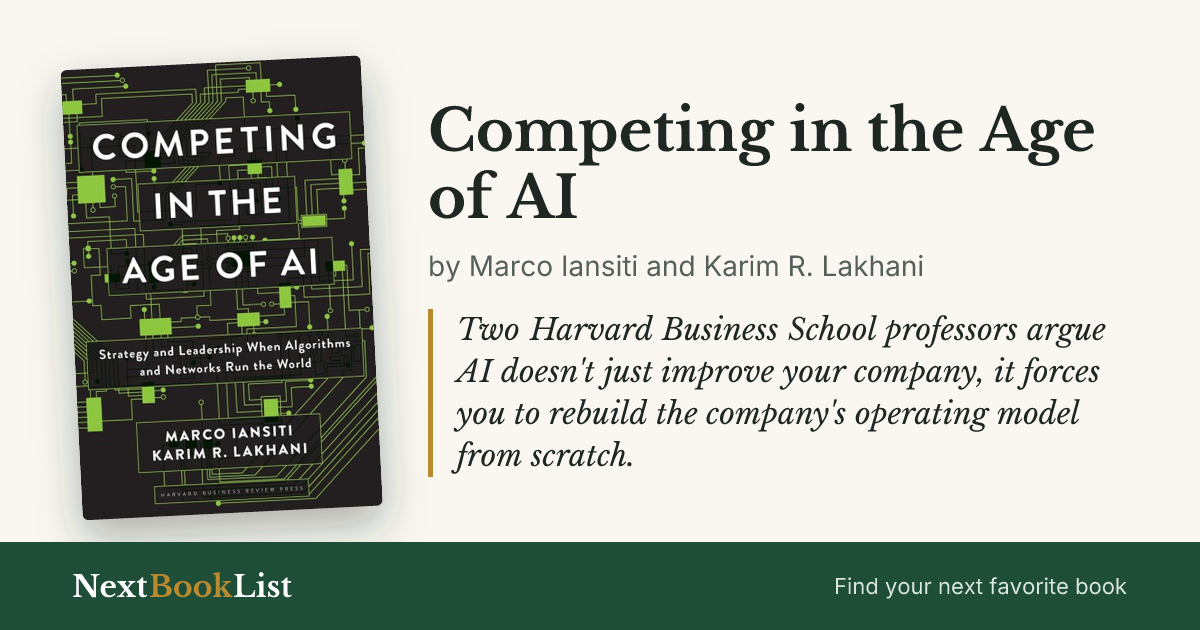
Competing in the Age of AI
by Marco Iansiti and Karim R. Lakhani · 2020
Two Harvard Business School professors argue AI doesn't just improve your company, it forces you to rebuild the company's operating model from scratch.
Worth reading? Iansiti and Lakhani's case study spine, Ant Financial, Netflix, Microsoft, Amazon, argues the companies winning with AI didn't bolt it onto an existing org chart, they rebuilt decision-making, scaling economics, and boundaries between industries around it. Their 'firm as algorithm' framing (decisions increasingly made by data pipelines, not committees) is the sharpest strategy idea in the book. Read it if you're deciding how deep an AI rebuild your organization actually needs. Skip it if you're an individual contributor looking for personal productivity tips.
| Full Title | Competing in the Age of AI: Strategy and Leadership When Algorithms and Networks Run the World |
|---|---|
| Author | Marco Iansiti and Karim R. Lakhani |
| Published | 2020 |
| Category | Business & Money |
The Verdict
This is the strategy-level book on the AI shelf, less about what AI can do and more about what it does to how a company has to be built to use it well. The Netflix and Ant Financial case studies alone are worth the read if you’re the one deciding org structure, not just using the tools.
executives and operators deciding how deeply to rebuild around AI-driven decision-making
you want tactics for individual AI use, not organizational strategy
Book Summary
The authors' central claim: firms built around traditional, human-decision-heavy processes hit a scaling ceiling that AI-native firms don't. Companies like Netflix or Ant Financial scale not by adding more people to make more decisions, but by building data and algorithmic pipelines that make decisions at near-zero marginal cost, which changes both their growth economics and their competitive boundaries with adjacent industries.
They argue most incumbent companies underestimate how much organizational, not just technical, change this requires: new decision rights, new skills, and a willingness to let algorithms own decisions previously reserved for managers. Bolting an AI team onto an unchanged org chart, in their case studies, consistently underperforms firms that rebuilt around it.
Top 7 Lessons from Competing in the Age of AI
- Firms that scale via algorithms, not headcount, hit different growth economics than traditional firms.
- The 'firm as algorithm' shift changes decision rights, not just tooling.
- Bolting an AI team onto an unchanged org chart underperforms a genuine structural rebuild.
- AI-native companies increasingly compete across traditional industry boundaries, not within them.
- Data pipelines that make decisions at near-zero marginal cost change what 'scaling' even means.
- Leadership's job shifts from making decisions to deciding which decisions algorithms should own.
- Most AI transformation failures are organizational, not technical.
Frequently Asked Questions
Is Competing in the Age of AI worth reading?
Yes, if you're an executive or operator deciding how deep an AI-driven organizational rebuild actually needs to go. It's strategy-level, not tactics-level.
What is the main idea of Competing in the Age of AI?
Winning AI-era companies rebuild their decision-making and scaling economics around algorithms rather than bolting AI onto an unchanged organization.
Who should read Competing in the Age of AI?
Executives, strategists, and operators making structural decisions about how deeply to rebuild their company around AI.
Ready to read it?
Get Competing in the Age of AI on Amazon