Best AI Books: 13 Ranked, From Daily Use to Existential Risk

Updated July 20, 2026 · 13 books

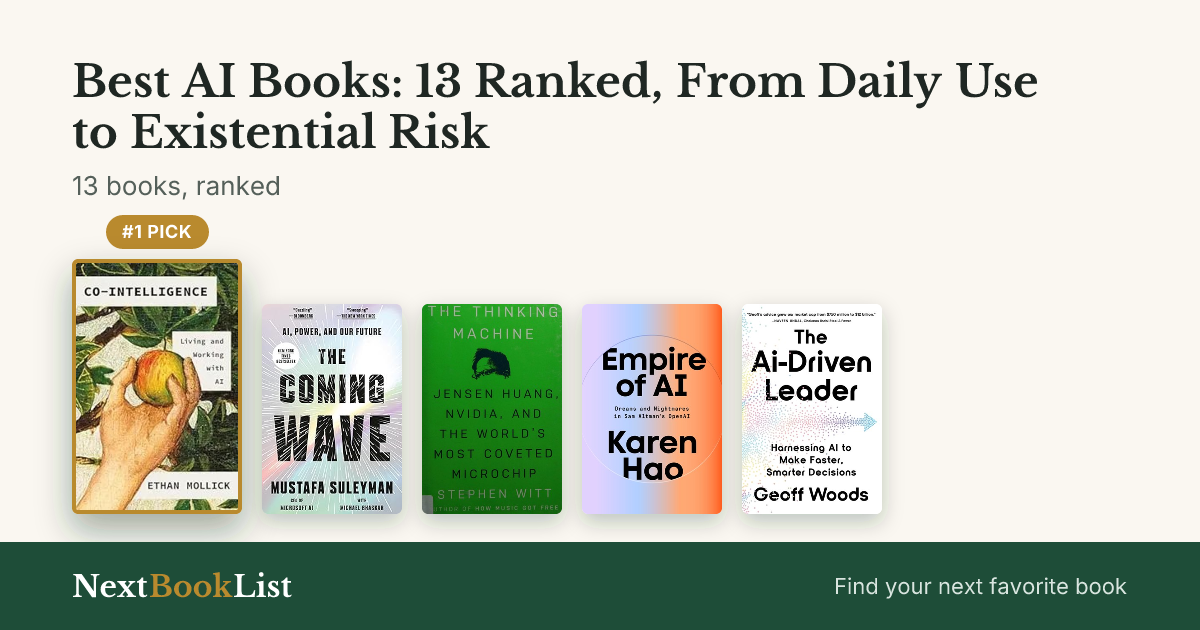
Best AI Books: 13 Ranked, From Daily Use to Existential Risk: ranked list of 13 books

Start with Co-Intelligence if you touch AI tools daily and want to get noticeably better at using them by this afternoon, it’s the most immediately practical book on this list. If you want the stakes before the tactics, start with The Coming Wave instead, Mustafa Suleyman’s insider argument for why AI and synthetic biology are about to break the nation-state’s grip on power.

The middle of the list covers AI’s business and organizational side: Thinking Machine and Empire of AI for the founder and corporate stories behind Nvidia and OpenAI, Competing in the Age of AI and Power and Prediction for the strategy of rebuilding a business around algorithms rather than bolting AI onto an unchanged org chart, and AI 2041 for the most concrete, scenario-driven look at how this plays out across the next two decades.

The back half is the risk and philosophy shelf, and it’s worth reading in order of intensity: Life 3.0 first for the balanced, scenario-mapped view, Superintelligence next for the rigorous academic foundation under every later safety argument, then If Anyone Builds It, Everyone Dies for the sharpest, least hedged case that current methods can’t safely build superhuman AI at all. Our Final Invention closes the historical loop, showing how clearly some researchers saw this coming years before ChatGPT made it a dinner-table topic.

One skeptic’s warning to close on: AI Snake Oil is the corrective every reader of this list needs eventually. Generative AI is genuinely improving fast, but a huge share of AI products sold to businesses today, especially predictive tools used in hiring and lending, don’t hold up under independent audit. Read the hype and the doom books, then read this one to recalibrate.

Quick Comparison

#BookBest for
1Co-IntelligenceEthan Mollickanyone who uses ChatGPT or Claude at work and wants a real mental model instead of vibesAmazon
2The Coming WaveMustafa Suleymanreaders who want the policy and power-structure argument for AI, not just the productivity angleAmazon
3The Thinking MachineStephen Wittreaders who want the founder story behind the hardware that makes the entire AI industry runAmazon
4Empire of AIKaren Haoreaders who want the reporting on how OpenAI's mission and its business reality divergedAmazon
5The AI-Driven LeaderGeoff Woodsanyone weighing whether The AI-Driven Leader belongs on their business and money shelfAmazon
6Competing in the Age of AIMarco Iansiti and Karim R. Lakhaniexecutives and operators deciding how deeply to rebuild around AI-driven decision-makingAmazon
7Power and PredictionAjay Agrawal, Joshua Gans, and Avi Goldfarboperators and strategists who liked the 'AI as cheap prediction' framing and want the sequel on system-level redesignAmazon
8AI 2041Kai-Fu Lee and Chen Qiufanreaders who learn better from concrete scenarios than abstract argumentAmazon
9Life 3.0Max Tegmarkreaders who want the full spectrum of AI outcomes mapped out by a physicist, not a punditAmazon
10SuperintelligenceNick Bostromreaders who want the philosophical foundation under every modern AI-safety argumentAmazon
11If Anyone Builds It, Everyone DiesEliezer Yudkowsky and Nate Soaresreaders who want the strongest, most unhedged version of the AI-doom argumentAmazon
12Our Final InventionJames Barratreaders who want the journalistic, interview-driven case for AI risk rather than the philosophical oneAmazon
13AI Snake OilArvind Narayanan and Sayash Kapoorreaders tired of AI hype and doom alike who want a sober, evidence-based sorting of what actually worksAmazon

The Books

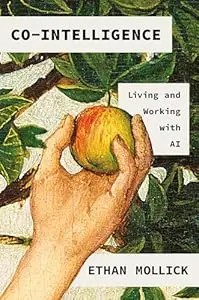
Co-Intelligence by Ethan Mollick book cover

1. Co-Intelligence

Ethan Mollick · 2024

The most practical AI book for people who just want to get good at using it, today, not in some hypothetical future.

Mollick spent two years running AI experiments on his own MBA students before writing this, and it shows. Co-Intelligence skips the hype and the doom, and just tells you how to actually work with the thing: invite it in, keep judgment human, and expect it to keep changing under you. If you touch an AI tool more than once a week, this pays for itself in an afternoon.

Read it if: anyone who uses ChatGPT or Claude at work and wants a real mental model instead of vibes

Skip it if: you want deep technical detail on how models work, or a doom/utopia thesis
Full verdict: Co-Intelligence →

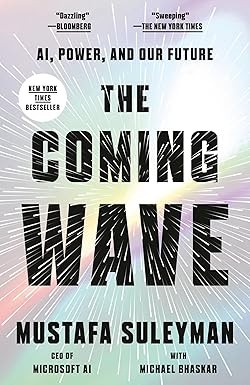
The Coming Wave by Mustafa Suleyman book cover

2. The Coming Wave

Mustafa Suleyman · 2023

A DeepMind and Inflection AI co-founder's case that AI and synthetic biology are about to break the nation-state's grip on power, whether we're ready or not.

Suleyman built DeepMind, then Inflection, then went to run Microsoft’s AI division, so when he says the containment problem is harder than anyone in power admits, it’s worth listening. The Coming Wave isn’t a productivity book, it’s an argument about who gets to hold power in the next decade, and why the old playbooks (nuclear-style secrecy, slow regulation) won’t work this time. Pair it with Co-Intelligence if you want both the stakes and the day-to-day tactics.

Read it if: readers who want the policy and power-structure argument for AI, not just the productivity angle

Skip it if: you want optimism, or a how-to-use-AI-today guide (that's Co-Intelligence)

Full verdict: The Coming Wave →

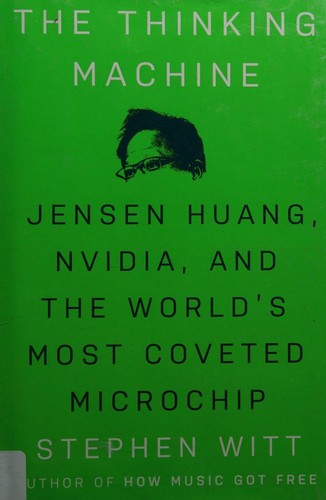
The Thinking Machine by Stephen Witt book cover

3. The Thinking Machine

Stephen Witt · 2025

How a Taiwanese immigrant kid who bussed tables at Denny's built the company that became the picks-and-shovels monopoly of the AI boom.

Every AI book on this list depends on chips Nvidia makes, and this is the one that tells you how that came to be. Witt’s access to Huang gives it real texture, and the CUDA-before-anyone-needed-it story is one of the better patient-bet narratives in recent tech writing.

Read it if: readers who want the founder story behind the hardware that makes the entire AI industry run

Skip it if: you want AI theory or safety arguments, this is a business and personality biography

Full verdict: The Thinking Machine →

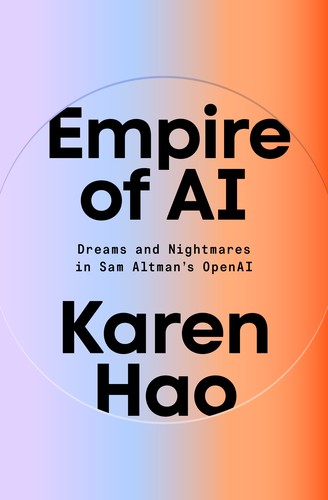
Empire of AI by Karen Hao book cover

4. Empire of AI

Karen Hao · 2025

An investigative journalist's inside account of OpenAI, tracing the gap between its nonprofit-for-humanity founding story and what it actually became.

Hao isn’t writing a hit piece or a hagiography, she’s doing the reporting most AI coverage skips: what actually happened inside the building when the mission statement met the cap table. If you’ve only followed OpenAI through press releases, this is the corrective.

Read it if: readers who want the reporting on how OpenAI's mission and its business reality diverged

Skip it if: you want technical AI content rather than corporate/organizational history

Full verdict: Empire of AI →

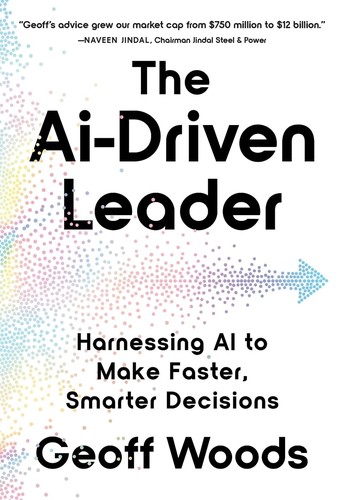
The AI-Driven Leader by Geoff Woods book cover

5. The AI-Driven Leader

Geoff Woods · 2024

Geoff Woods's take on business, the honest verdict is below.

Geoff Woods’s book argues AI is less a tool than a ‘leader’ you brief like a subordinate. I haven’t read it, so treat this as cautious. Read it if you want a pragmatic AI-at-work frame; skip it if you already live in ChatGPT daily, because the premise may be thin.

Read it if: anyone weighing whether The AI-Driven Leader belongs on their business and money shelf

Skip it if: you want a different angle than Geoff Woods's

Full verdict: The AI-Driven Leader →

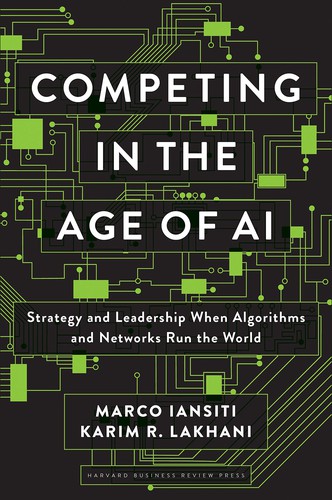
Competing in the Age of AI by Marco Iansiti and Karim R. Lakhani book cover

6. Competing in the Age of AI

Marco Iansiti and Karim R. Lakhani · 2020

Two Harvard Business School professors argue AI doesn't just improve your company, it forces you to rebuild the company's operating model from scratch.

This is the strategy-level book on the AI shelf, less about what AI can do and more about what it does to how a company has to be built to use it well. The Netflix and Ant Financial case studies alone are worth the read if you’re the one deciding org structure, not just using the tools.

Read it if: executives and operators deciding how deeply to rebuild around AI-driven decision-making

Skip it if: you want tactics for individual AI use, not organizational strategy

Full verdict: Competing in the Age of AI →

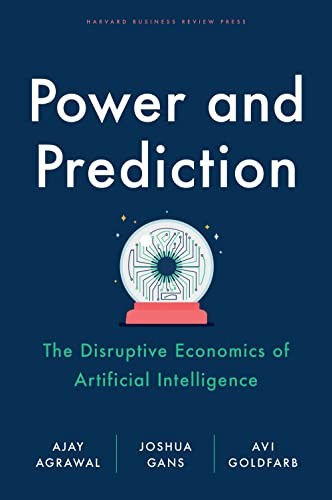
Power and Prediction by Ajay Agrawal, Joshua Gans, and Avi Goldfarb book cover

7. Power and Prediction

Ajay Agrawal, Joshua Gans, and Avi Goldfarb · 2022

The Toronto economists behind Prediction Machines return with the harder question: not what AI can predict, but who has to redesign their entire business to use it.

The authors’ first book, Prediction Machines, gave the field its best one-line explanation of what AI actually is economically. This sequel is the harder, more useful question: who actually wins when prediction gets cheap, and the electrification analogy is one of the best in business writing for explaining why bolting on new technology usually underperforms rebuilding around it.

Read it if: operators and strategists who liked the 'AI as cheap prediction' framing and want the sequel on system-level redesign

Skip it if: you haven't read Prediction Machines yet, start there first

Full verdict: Power and Prediction →

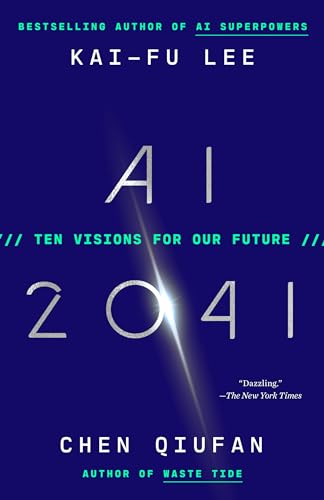
AI 2041 by Kai-Fu Lee and Chen Qiufan book cover

8. AI 2041

Kai-Fu Lee and Chen Qiufan · 2021

Ten short stories about life in 2041 paired with technical essays explaining exactly how each scenario could actually happen, from a former Google China president turned AI investor.

Most AI-future books argue in the abstract. AI 2041 makes you sit inside ten specific, lived-in scenarios first, then explains the mechanics after. It’s a different reading experience than the rest of this list, and a useful one if vague futurism has stopped landing for you.

Read it if: readers who learn better from concrete scenarios than abstract argument

Skip it if: you want a straight nonfiction argument, not fiction-plus-analysis

Full verdict: AI 2041 →

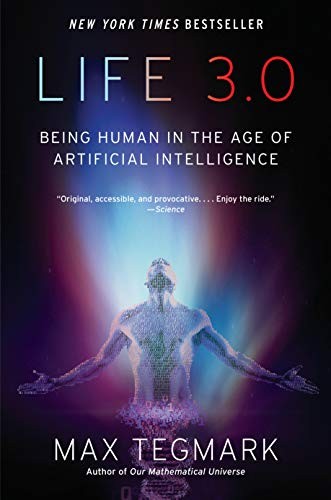
Life 3.0 by Max Tegmark book cover

9. Life 3.0

Max Tegmark · 2017

An MIT physicist's tour of every plausible AI future, from utopia to extinction, so you actually understand the range of outcomes instead of picking a side.

Tegmark doesn’t tell you what to believe about AI’s future, he shows you the actual shape of the decision tree, a dozen branches wide, and makes the case that which branch we end up on is still being decided. Denser than most books in this list, but the “Life 1.0/2.0/3.0” frame alone is worth the read.

Read it if: readers who want the full spectrum of AI outcomes mapped out by a physicist, not a pundit

Skip it if: you already know the AI-safety literature cold, or you want near-term practical advice

Full verdict: Life 3.0 →

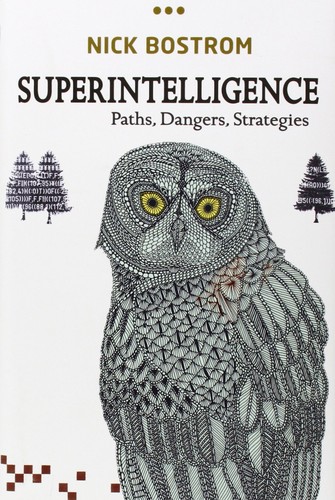
Superintelligence by Nick Bostrom book cover

10. Superintelligence

Nick Bostrom · 2014

The dense, academic book that got Elon Musk and Bill Gates publicly worried about AI, still the most rigorous case for why a superintelligent AI is a control problem, not a features problem.

This is the book that turned AI safety from a fringe worry into a boardroom topic. Bostrom writes like a philosopher, not a journalist, so it’s slower going than anything else on this list, but the orthogonality thesis and the control problem are load-bearing ideas for the entire field that followed. Read it once you’ve got your footing from something friendlier, then come back for the rigor.

Read it if: readers who want the philosophical foundation under every modern AI-safety argument

Skip it if: you want something readable on a beach, this is a philosophy textbook in disguise

Full verdict: Superintelligence →

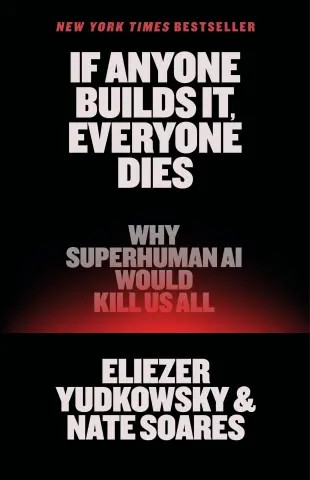
If Anyone Builds It, Everyone Dies by Eliezer Yudkowsky and Nate Soares book cover

11. If Anyone Builds It, Everyone Dies

Eliezer Yudkowsky and Nate Soares · 2025

The bluntest, least hedged book in the AI-risk genre, two longtime AI-safety researchers arguing that current methods can't safely build superhuman AI, full stop, no qualifier.

This is the most uncompromising book on the shelf, no hedging, no ‘it depends,’ just a hard argument that the industry is racing ahead of a problem it hasn’t solved. Whether you agree or not, it’s the clearest statement of the strongest version of the case, and worth reading precisely because it refuses to soften.

Read it if: readers who want the strongest, most unhedged version of the AI-doom argument

Skip it if: you want a balanced or optimistic take, this book has one thesis and argues it hard

Full verdict: If Anyone Builds It, Everyone Dies →

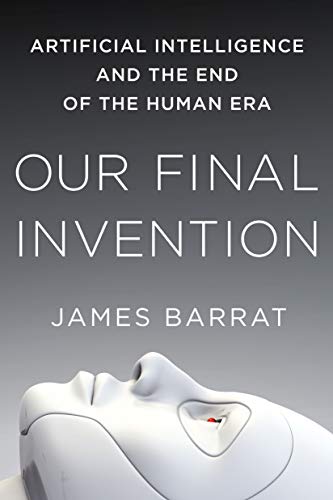
Our Final Invention by James Barrat book cover

12. Our Final Invention

James Barrat · 2013

A documentary filmmaker's investigation into AI risk, built on interviews with the researchers and futurists who were sounding the alarm years before ChatGPT made it mainstream.

Written years before large language models made AI a dinner-table topic, this is worth reading as the historical record: the people who saw this coming, in their own words, well before the rest of the world caught up. The alignment argument hasn’t aged, the technical landscape around it has.

Read it if: readers who want the journalistic, interview-driven case for AI risk rather than the philosophical one

Skip it if: you want the most current AI landscape, this predates the large-language-model era

Full verdict: Our Final Invention →

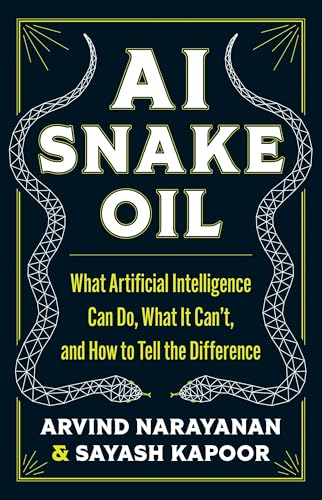
AI Snake Oil by Arvind Narayanan and Sayash Kapoor book cover

13. AI Snake Oil

Arvind Narayanan and Sayash Kapoor · 2024

Two Princeton computer scientists sort real AI capability from marketing hype, and name names.

Most AI books pick a side, hype or doom. This one refuses to, and is more useful for it: it names specific products, specific failures, and specific evidence, rather than arguing in the abstract. If you’re the person in the room asking “wait, does this actually work,” this is your reference book.

Read it if: readers tired of AI hype and doom alike who want a sober, evidence-based sorting of what actually works

Skip it if: you want optimism or alarm, this book is deliberately, usefully unglamorous

Full verdict: AI Snake Oil →

Frequently Asked Questions

What is the best AI book to start with?

Co-Intelligence by Ethan Mollick, if you want practical, immediately usable guidance on working with AI tools. Start with The Coming Wave instead if you want the stakes and policy argument before the tactics.

What is the best book on AI risk and safety?

Superintelligence by Nick Bostrom for the rigorous philosophical foundation, or If Anyone Builds It, Everyone Dies for the sharpest, least hedged current argument. Life 3.0 is the more balanced middle ground between them.

Is there a book that explains what AI actually gets wrong or overhyped?

AI Snake Oil, by Princeton computer scientists Arvind Narayanan and Sayash Kapoor. It's the sharpest corrective to both AI hype and AI doom, built on documented, case-by-case evidence.

What's the best AI book for a business leader deciding how to use it at work?

Co-Intelligence for individual use, Competing in the Age of AI for organizational strategy, and Power and Prediction for the economics of why redesigning your business around AI beats bolting it on.

Keep Reading