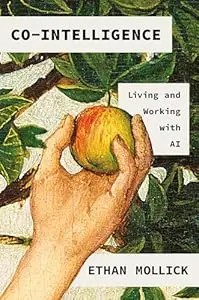
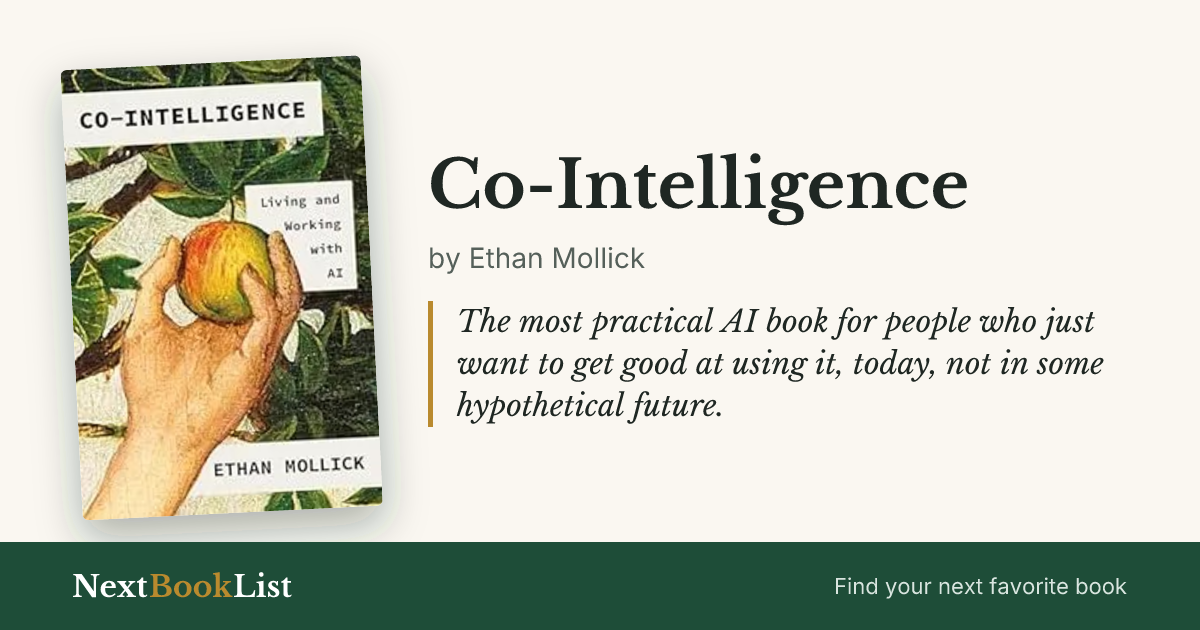
Co-Intelligence
by Ethan Mollick · 2024
The most practical AI book for people who just want to get good at using it, today, not in some hypothetical future.
Worth reading? Mollick's core move is treating AI as a coworker you have to learn to manage, not a search engine you query. His four rules (always invite AI to the table, be the human in the loop, treat it like a person while knowing it isn't, assume today is the worst it'll ever be) are more useful than most 'prompt engineering' guides combined. Read it if you use AI daily and want to get noticeably better at it in an afternoon. Skip it if you want technical depth on transformers or a grand AI-safety argument, this is a user's manual, not a manifesto.
| Full Title | Co-Intelligence: Living and Working with AI |
|---|---|
| Author | Ethan Mollick |
| Published | 2024 |
| Category | Business & Money |
The Verdict
Mollick spent two years running AI experiments on his own MBA students before writing this, and it shows. Co-Intelligence skips the hype and the doom, and just tells you how to actually work with the thing: invite it in, keep judgment human, and expect it to keep changing under you. If you touch an AI tool more than once a week, this pays for itself in an afternoon.
anyone who uses ChatGPT or Claude at work and wants a real mental model instead of vibes
you want deep technical detail on how models work, or a doom/utopia thesis
Book Summary
Mollick's central reframe: large language models behave less like software and more like an infinitely patient, occasionally brilliant, sometimes wrong intern. The skill worth building isn't prompting tricks, it's judgment about when to trust it, when to check it, and when to hand it the whole task versus keep a human in the loop.
He backs this with his own Wharton classroom experiments: students who used AI well outperformed students who didn't, and students who used it badly (accepting outputs uncritically) did worse than students who ignored it entirely. The gap isn't access to AI, it's skill in working with it, and that skill is learnable in weeks, not years.
Top 8 Lessons from Co-Intelligence
- Always invite AI to the table first, then decide if it earned a seat.
- Keep a human in the loop, especially for judgment calls, not just fact-checks.
- Treat AI like a person you're delegating to, knowing full well it isn't one.
- Today's AI is the worst AI you'll ever use again, plan for the trajectory, not the snapshot.
- The biggest performance gap isn't AI access, it's skill using it well.
- Blind trust in AI output is worse than not using AI at all.
- AI compresses the skill gap between novices and experts faster in some fields than others.
- Use AI to get a rough draft moving, not to make final decisions for you.
Frequently Asked Questions
Is Co-Intelligence worth reading?
Yes, if you use AI tools at work and want a practical framework instead of scattered tips. It's the most immediately useful AI book for daily users, not researchers.
What is the main idea of Co-Intelligence?
Treat AI as a co-worker to manage and judge, not an oracle to obey or a toy to dismiss. The skill gap between good and bad AI users matters more than access to AI itself.
Who should read Co-Intelligence?
Knowledge workers, managers, and students already using ChatGPT, Claude, or Copilot who want to get measurably better at it.
Ready to read it?
Get Co-Intelligence on Amazon