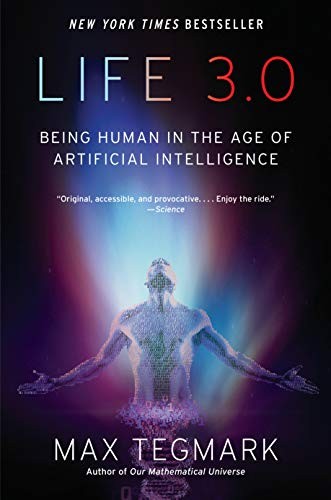
Life 3.0
by Max Tegmark · 2017
An MIT physicist's tour of every plausible AI future, from utopia to extinction, so you actually understand the range of outcomes instead of picking a side.
Worth reading? Tegmark's trick is 'Life 1.0, 2.0, 3.0': biological evolution designs your hardware and software (1.0), culture lets you redesign your software (2.0), and AI may let something redesign both (3.0). From there he walks through a dozen concrete future scenarios, benevolent dictator, egalitarian utopia, conqueror AI, self-destruction, without picking a winner, which is rarer and more useful than it sounds. Read it if you want your AI-future thinking to span more than 'it'll be fine' or 'we're all doomed.' Skip it if you've already read Bostrom and Yudkowsky and want something newer.
| Full Title | Life 3.0: Being Human in the Age of Artificial Intelligence |
|---|---|
| Author | Max Tegmark |
| Published | 2017 |
| Category | Business & Money |
| Favorite quote | “Everything we love about civilization is a product of intelligence, so amplifying our human intelligence with artificial intelligence has the potential of helping civilization flourish like never before.” |
The Verdict
Tegmark doesn’t tell you what to believe about AI’s future, he shows you the actual shape of the decision tree, a dozen branches wide, and makes the case that which branch we end up on is still being decided. Denser than most books in this list, but the “Life 1.0/2.0/3.0” frame alone is worth the read.
readers who want the full spectrum of AI outcomes mapped out by a physicist, not a pundit
you already know the AI-safety literature cold, or you want near-term practical advice
Book Summary
Tegmark's framework: Life 1.0 (bacteria) can't redesign its hardware or software within a lifetime. Life 2.0 (humans) can redesign its software through learning and culture, but not its hardware. Life 3.0 would be able to redesign both, and advanced AI is the first plausible path to that threshold.
The bulk of the book maps out roughly a dozen distinct futures this could produce, from a single benevolent AI dictator to human extinction to a diverse, thriving multiplanetary civilization, and argues the specific outcome depends heavily on choices being made right now about goals, control, and safety research, not on the technology itself being good or bad.
Top 7 Lessons from Life 3.0
- AI's danger isn't malice, it's competence pointed at the wrong goal.
- There are at least a dozen distinct plausible AI futures, not just 'utopia' or 'doom.'
- The goal-alignment problem matters more than the intelligence-level problem.
- Consciousness and intelligence are separable, an AI can be capable without being sentient.
- Whoever controls the first truly transformative AI shapes the resulting future disproportionately.
- Physical laws set real limits on what any intelligence, biological or artificial, can ultimately do.
- The window to influence AI's trajectory is now, not after it's built.
Top 1 Quotes from Life 3.0
"Everything we love about civilization is a product of intelligence, so amplifying our human intelligence with artificial intelligence has the potential of helping civilization flourish like never before."
Max Tegmark, Life 3.0
Frequently Asked Questions
Is Life 3.0 worth reading?
Yes, especially if you want the full range of AI futures mapped by a physicist rather than argued by a single-issue advocate. It's dense in places but more balanced than most entries in the genre.
What does 'Life 3.0' mean?
Tegmark's term for a form of life that can redesign both its hardware and software, something biological evolution (1.0) and human culture (2.0) can't do, but advanced AI might enable.
Who should read Life 3.0?
Readers who want a rigorous, scenario-based look at where AI could take civilization, from a physicist rather than a technologist or journalist.
Ready to read it?
Get Life 3.0 on Amazon