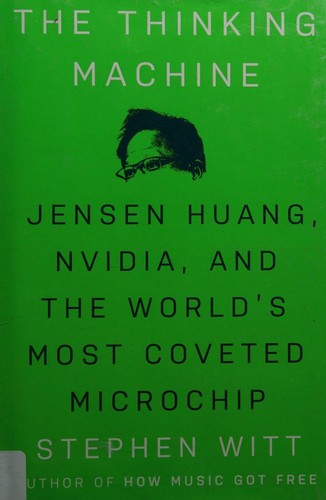
The Thinking Machine
by Stephen Witt · 2025
How a Taiwanese immigrant kid who bussed tables at Denny's built the company that became the picks-and-shovels monopoly of the AI boom.
Worth reading? Witt gets real access to Jensen Huang and traces Nvidia's decades-long bet on parallel computing, GPUs built for video games that turned out to be exactly the architecture deep learning needed, from near-bankruptcy to the most valuable chipmaker on earth. The through-line, that Huang's obsessive, occasionally brutal management style and his willingness to bet the company on unproven markets repeatedly paid off, makes this one of the better founder biographies in the recent AI wave. Read it if you want the hardware side of the AI story, not just the model side. Skip it if you're after AI capability or safety content.
| Full Title | The Thinking Machine: Jensen Huang, Nvidia, and the World's Most Coveted Microchip |
|---|---|
| Author | Stephen Witt |
| Published | 2025 |
| Category | Business & Money |
The Verdict
Every AI book on this list depends on chips Nvidia makes, and this is the one that tells you how that came to be. Witt’s access to Huang gives it real texture, and the CUDA-before-anyone-needed-it story is one of the better patient-bet narratives in recent tech writing.
readers who want the founder story behind the hardware that makes the entire AI industry run
you want AI theory or safety arguments, this is a business and personality biography
Book Summary
Witt's central argument: Nvidia's dominance wasn't luck, it was a two-decade bet that parallel processing (originally built to render video game graphics) would eventually matter for something bigger than games. Huang kept investing in CUDA, Nvidia's software layer, for years before deep learning researchers discovered GPUs could train neural networks dramatically faster than CPUs, a bet that looked reckless until it looked prophetic.
The book also digs into Huang's management style, described as intense, publicly confrontational, and relentlessly focused on speed, arguing it's inseparable from Nvidia's ability to out-execute better-funded rivals repeatedly. Witt doesn't romanticize this, he shows the cost to the people working under it alongside the results it produced.
Top 7 Lessons from The Thinking Machine
- Nvidia's AI dominance was a decade-long bet on parallel computing, not a lucky break.
- Building the software layer (CUDA) before anyone needed it created a moat competitors couldn't easily copy.
- Betting the company on an unproven market, repeatedly, is what separated Nvidia from safer competitors.
- Founder intensity that looks excessive from outside can be the actual mechanism behind sustained execution speed.
- Being the picks-and-shovels supplier to a boom can be more durable than betting on which prospector wins.
- Near-death moments (Nvidia nearly went bankrupt in the late 1990s) often precede a company's biggest bets.
- Owning the software ecosystem around your hardware is as valuable as the hardware itself.
Frequently Asked Questions
Is The Thinking Machine worth reading?
Yes, for the founder-and-hardware side of the AI boom that most AI books skip entirely, told through direct access to Jensen Huang.
What is The Thinking Machine about?
Journalist Stephen Witt's biography of Nvidia CEO Jensen Huang, tracing how a gaming-graphics chip company became the essential infrastructure of the AI industry.
Who should read The Thinking Machine?
Readers who want the business and personality story behind the GPUs powering AI, not model architecture or AI-safety content.
Ready to read it?
Get The Thinking Machine on Amazon