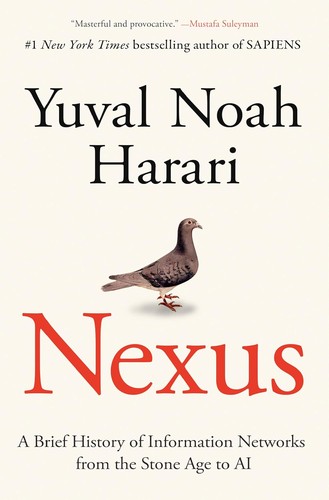
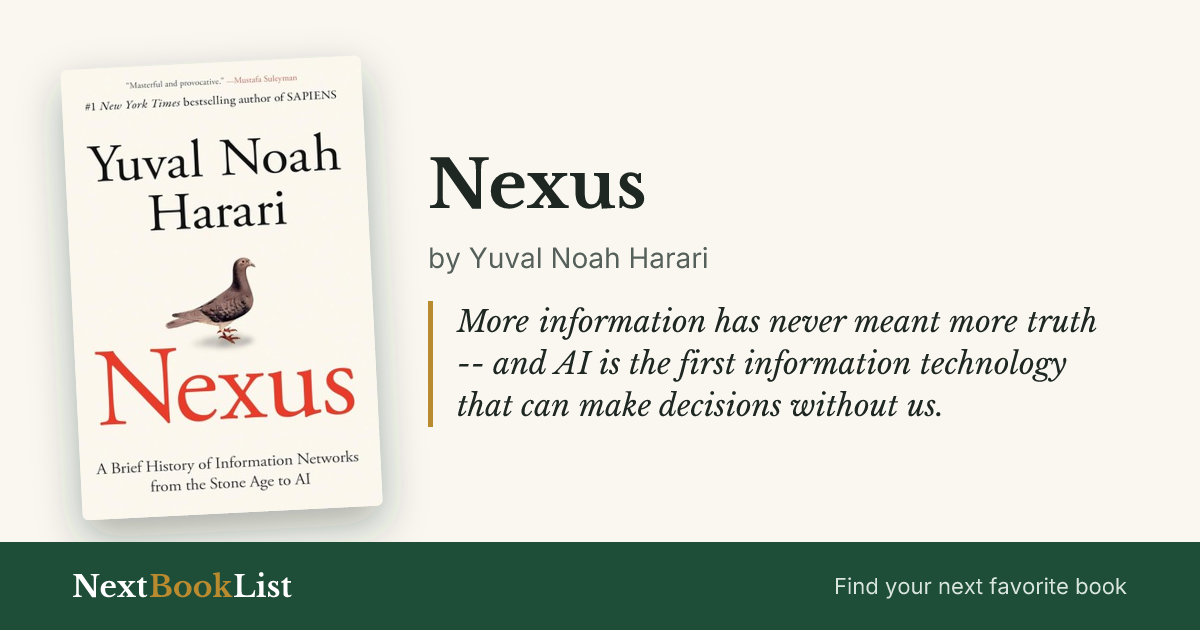
Nexus
by Yuval Noah Harari · 2024
More information has never meant more truth -- and AI is the first information technology that can make decisions without us.
Worth reading? Nexus is Harari doing what he does best -- taking a sprawling historical argument and aiming it at a present-day anxiety, this time AI. It's less tightly argued than Sapiens, and the back half on AI governance is more speculative than historical. Read it for the framing (information networks, not information itself, are the story); read Stuart Russell's Human Compatible if you want the technical version of the same worry.
| Full Title | Nexus: A Brief History of Information Networks from the Stone Age to AI |
|---|---|
| Author | Yuval Noah Harari |
| Published | 2024 |
| Publisher | Random House |
| Category | Sociology & Culture |
| Favorite quote | “History isn't the study of the past; it is the study of change. History teaches us what remains the same, what changes, and how things change.” |
The Verdict
Harari’s real trick is reframing the AI conversation away from “will the robots turn evil” and toward “will our institutions still be able to catch their own mistakes.” That’s a more useful question, and it’s the one Nexus actually spends its pages on.
The book is baggier than Sapiens – the AI chapters lean more speculative than historical – but the core idea (self-correction, not information volume, is what keeps a society sane) is worth the price of admission on its own.
you want Harari's big-picture framework for thinking about AI risk without the sci-fi hype
you already read Sapiens and Homo Deus and want something narrower than another sweeping civilizational thesis
Book Summary
Harari's central claim is that the "naive view" of information -- more information equals more truth equals better decisions -- is wrong. Information networks have always spread useful knowledge and dangerous fictions together, and large-scale human cooperation runs on shared stories and myths more than on shared facts. What makes a network resilient isn't accuracy, it's the ability to self-correct. Harari argues democracies survive because they build in error-correcting mechanisms -- free press, courts, elections -- while totalitarian systems collapse because errors compound unchecked. The printing press didn't just spread science; it also fueled witch hunts and religious wars, proof that information technology is never neutral in its effects. AI, in Harari's framing, is a genuinely new kind of actor in this history: the first information technology that can generate ideas and make decisions on its own, rather than just transmitting human-made content. The book's closing argument is that whether AI strengthens or destroys democratic self-correction is a choice societies still have time to make -- but not much time.
Top 10 Lessons from Nexus
- More information doesn't automatically produce more truth or better decisions.
- Large-scale human cooperation runs on shared stories and myths, not shared facts.
- Democracies survive by building self-correcting mechanisms -- free press, courts, elections -- that catch and fix errors.
- Totalitarian systems fail because they suppress the very feedback that would let them correct mistakes.
- The printing press amplified both scientific progress and witch-hunts, showing information technology is never inherently good.
- Bureaucracies are themselves information networks, prone to prioritizing their own paperwork over reality.
- AI is framed as fundamentally different from prior information technologies because it can generate ideas and make decisions independently.
- AI systems could out-negotiate, out-persuade, and out-organize humans, reshaping who actually holds power.
- Harari argues the outcome of the AI transition is a matter of political choice, not technological inevitability.
- Human institutions, not the technology itself, will determine whether AI serves democratic self-correction or autocratic control.
Top 4 Quotes from Nexus
"History isn't the study of the past; it is the study of change. History teaches us what remains the same, what changes, and how things change."
Yuval Noah Harari, Nexus
"Democracy is a system that guarantees everyone certain liberties, which even the majority cannot take away."
Yuval Noah Harari, Nexus
"Stories were the first crucial information technology developed by humans."
Yuval Noah Harari, Nexus
"The cultural obsession with purity originates in the evolutionary struggle to avoid pollution. All animals are torn between the need to try new food and the fear of being poisoned. Evolution therefore equipped animals with both curiosity and the capacity to feel disgust on coming into contact with something toxic or otherwise dangerous. Politicians and prophets have learned how to manipulate these disgust mechanisms."
Yuval Noah Harari, Nexus
Frequently Asked Questions
Is Nexus worth reading?
Yes, if you want Harari's framework for thinking about AI as the latest chapter in a much longer history of information networks. It's less essential if you've already absorbed Sapiens and Homo Deus and want a narrower, more technical AI book.
What is the main argument of Nexus?
That information networks succeed or fail based on their ability to self-correct, not on how much information they contain, and that AI is the first information technology capable of generating ideas and decisions independent of humans.
Is Nexus as good as Sapiens?
It's more focused but less tightly argued. Sapiens builds one sweeping thesis; Nexus splits its attention between deep history and near-term AI speculation.
Who should read Nexus?
Readers who want big-picture context for AI anxiety, not a technical manual. Skip it if you want specifics on how current AI models actually work.
Ready to read it?
Get Nexus on Amazon