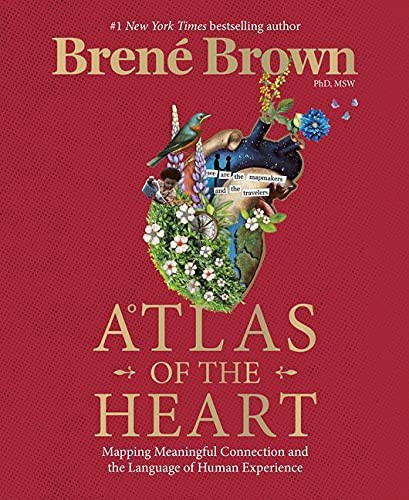
Atlas of the Heart
by Brené Brown · 2021
Brown's field guide to 87 emotions, built so you stop calling everything 'stressed' or 'fine.'
Worth reading? Atlas of the Heart is less a book you read cover to cover and more a reference you keep returning to. Compared to Emotional Intelligence 2.0, it's slower and more academic, but it goes deeper on the distinctions that actually matter -- disappointment versus regret, anxiety versus fear, envy versus jealousy. The core insight survives on its own: naming an emotion precisely is itself a regulation skill, not just a vocabulary exercise. Skip it if you want plot or memoir. Read it if your emotional vocabulary tops out at "fine" and "stressed."
| Full Title | Atlas of the Heart: Mapping Meaningful Connection and the Language of Human Experience |
|---|---|
| Author | Brené Brown |
| Published | 2021 |
| Publisher | Random House |
| Category | Self-Improvement & Psychology |
| Favorite quote | “Connection is why we're here. It's what gives purpose and meaning to our lives.” |
The Verdict
Brown’s pitch is simple: you can’t regulate what you can’t name, and most people’s emotional vocabulary is embarrassingly small. Atlas of the Heart fixes that by mapping 87 emotions against each other so “disappointed” stops doing the work of ten different feelings. Treat it as a reference, not a page-turner.
you want precise language for what you're actually feeling instead of three catch-all words
you want a narrative memoir -- this reads like an emotional dictionary with research stitched in, not a story
Book Summary
Most people run on a tiny emotional vocabulary, mad, sad, happy, fine, and that poverty of language makes it harder to regulate or communicate what's actually happening inside them.
Brown pairs and contrasts emotions that get confused for each other constantly: envy versus jealousy, disappointment versus regret, anxiety versus fear. Telling them apart in the moment changes how you respond to them.
Naming an emotion accurately is a regulation skill on its own. Research on affect labeling shows precise naming calms the nervous system before you've "solved" anything -- the vocabulary is the intervention.
Top 9 Lessons from Atlas of the Heart
- Comparison and connection can't coexist -- you're doing one or the other, never both.
- Anxiety and excitement feel almost identical in the body; the label you give them changes the experience.
- Boundaries are what's okay and not okay, and clear boundaries build more trust than endless flexibility.
- Belonging never requires you to change who you are; fitting in always does.
- Perfectionism is fear wearing a productivity costume, not a high standard.
- Empathy is 'I get it,' sympathy is 'I feel for you' -- they land completely differently on the other person.
- Shame needs secrecy, silence, and judgment to survive; say it out loud and it loses its grip.
- Disappointment is about unmet expectations you can name; regret is about a choice you'd take back.
- You can't get to courage without walking through vulnerability first -- there's no shortcut around it.
Top 4 Quotes from Atlas of the Heart
"Connection is why we're here. It's what gives purpose and meaning to our lives."
Brené Brown, Atlas of the Heart
"You can't get to courage without rumbling with vulnerability."
Brené Brown, Atlas of the Heart
"Language is our portal to meaning-making, connection, and healing."
Brené Brown, Atlas of the Heart
"Stories are just data with a soul."
Brené Brown, Atlas of the Heart
Frequently Asked Questions
Is Atlas of the Heart worth reading?
Yes, if you want precise language for emotions you already feel but can't name. It's built as a reference more than a straight-through read.
What's the main idea of Atlas of the Heart?
Precise emotional vocabulary changes how you experience and communicate feelings. Brown maps 87 emotions and the research distinguishing each from its near-neighbors.
Is it based on the HBO series?
The book inspired an HBO Max series of the same name, but the book came first and goes far deeper than the show.
Ready to read it?
Get Atlas of the Heart on Amazon