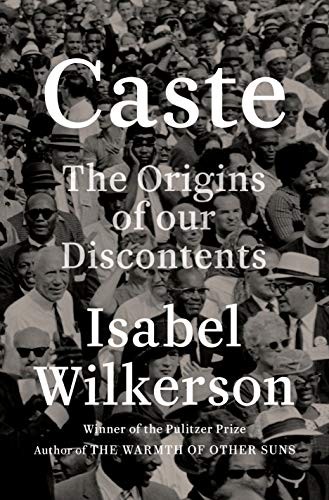
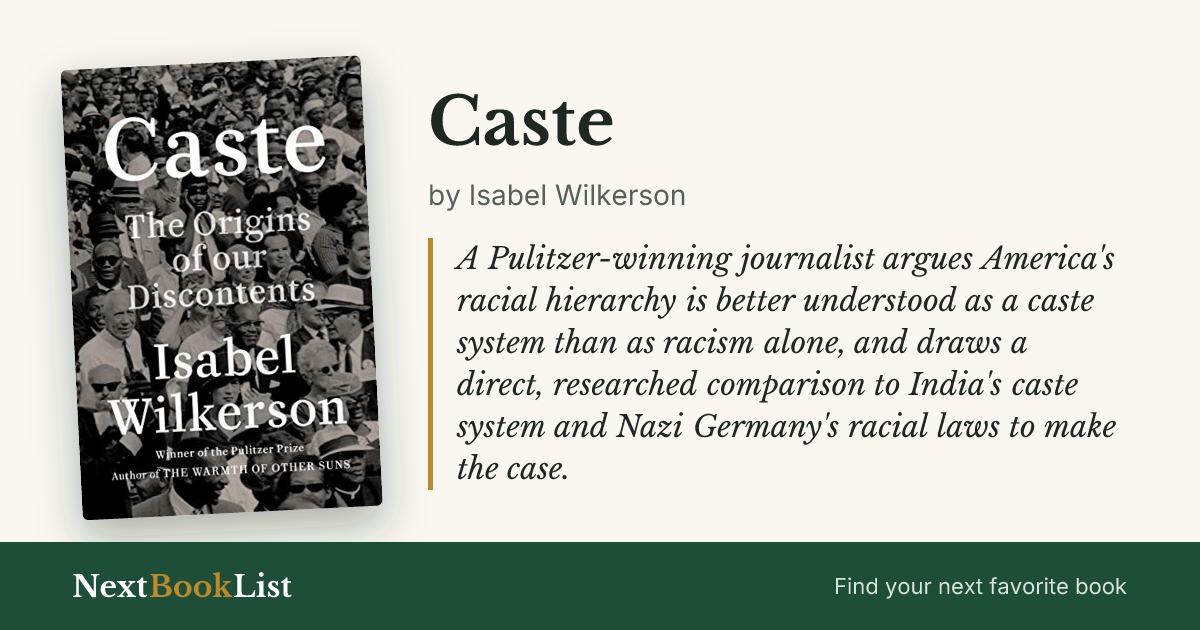
Caste
by Isabel Wilkerson · 2020
A Pulitzer-winning journalist argues America's racial hierarchy is better understood as a caste system than as racism alone, and draws a direct, researched comparison to India's caste system and Nazi Germany's racial laws to make the case.
Worth reading? Wilkerson's central argument is that 'racism' as a term focuses attention on individual attitudes and prejudice, while 'caste' better captures what she argues is actually a structural, hierarchical system assigning status and worth based on birth characteristics -- a framework she builds by directly comparing American racial hierarchy to India's caste system and Nazi Germany's racial laws, drawing on original research including her own travel to India to interview scholars and Dalits (formerly known as 'untouchables') directly. The book became a number one New York Times bestseller and Oprah's Book Club pick, and it's structured more analytically than her earlier, more narrative-driven The Warmth of Other Suns.
| Full Title | Caste: The Origins of Our Discontents |
|---|---|
| Author | Isabel Wilkerson |
| Published | 2020 |
| Category | Sociology & Culture |
| Favorite quote | “Caste is the bones, race the skin.” |
The Verdict
Wilkerson’s decision to build this as an explicitly comparative, structural argument, rather than another narrative history, is what makes it a genuine companion to rather than a repeat of The Warmth of Other Suns – the two books address the same underlying subject through almost entirely different methods, and reading them together gives you both the individual and structural view.
you want a rigorously researched, comparative framework for understanding American racial hierarchy as a structural system, not just individual prejudice
you want a purely historical narrative -- Caste is more analytical and comparative in structure than Wilkerson's earlier The Warmth of Other Suns, building an explicit theoretical framework rather than following individual life stories
Book Summary
Wilkerson argues "caste" is a more structurally accurate term than "racism" for understanding American racial hierarchy, because caste describes a fixed, inherited system assigning status and access based on birth characteristics -- independent of individual attitudes or intentions -- while "racism" tends to focus attention narrowly on conscious individual prejudice, potentially missing the structural, self-perpetuating dimension of the hierarchy itself.
She builds this argument through direct comparative research across three case studies: the United States, India's caste system, and Nazi Germany's racial laws (which, she documents, were partly modeled on American Jim Crow statutes when German officials researched existing racial legal codes), identifying eight recurring "pillars" of caste systems -- including divine or natural sanction, heritability, endogamy, and dehumanization of the lowest caste -- that appear across all three otherwise very different societies.
Top 7 Lessons from Caste
- 'Caste' describes a structural, inherited hierarchy assigning status based on birth characteristics, distinct from and broader than individual racist attitudes.
- Nazi Germany's racial laws were partly modeled on American Jim Crow statutes, which German officials researched as existing legal precedent.
- Caste systems across different societies (US, India, Nazi Germany) share recurring structural 'pillars' despite very different specific histories and ideologies.
- Focusing analysis narrowly on individual prejudice can miss the self-perpetuating, structural dimension of a hierarchical system.
- Comparative research across otherwise very different societies can reveal structural patterns that a single-country analysis misses.
- A hierarchical system can persist and self-perpetuate independent of any individual's conscious intent to maintain it.
- Direct field research (traveling to India to interview Dalits and scholars) can ground a comparative theoretical argument in specific, lived testimony.
Top 2 Quotes from Caste
"Caste is the bones, race the skin."
Isabel Wilkerson, Caste
"A caste system builds rigid boundaries that... cannot be undone by individual will or by even the most heartfelt goodness."
Isabel Wilkerson, Caste
Frequently Asked Questions
Is Caste worth reading?
Yes -- it's a rigorously researched, comparative framework that became a number one New York Times bestseller and an Oprah's Book Club selection, offering a structural lens on American racial hierarchy through direct comparison to India and Nazi Germany.
What is Caste about?
Isabel Wilkerson's argument that American racial hierarchy is better understood through the structural framework of caste -- a fixed, inherited system of status assigned by birth -- comparing it directly to India's caste system and Nazi Germany's racial laws.
How is Caste different from The Warmth of Other Suns?
The Warmth of Other Suns follows three individual lives to tell the history of the Great Migration. Caste is more analytical and comparative, building an explicit theoretical framework across three societies rather than following individual narrative arcs.
Did Nazi Germany model its racial laws on American laws?
Per Wilkerson's research, German officials studying existing racial legal codes when drafting the Nuremberg Laws examined American Jim Crow statutes as precedent, a documented historical connection the book covers directly.
Ready to read it?
Get Caste on Amazon