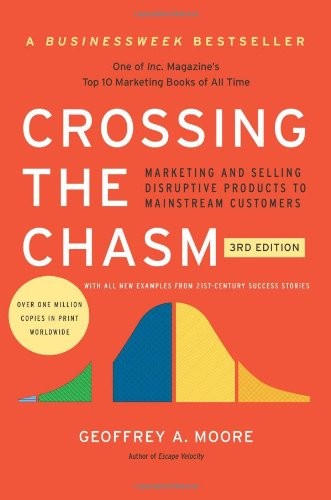
Crossing the Chasm
by Geoffrey Moore · 1991
The book that explained why so many promising tech products win over early adopters and then die trying to reach everyone else.
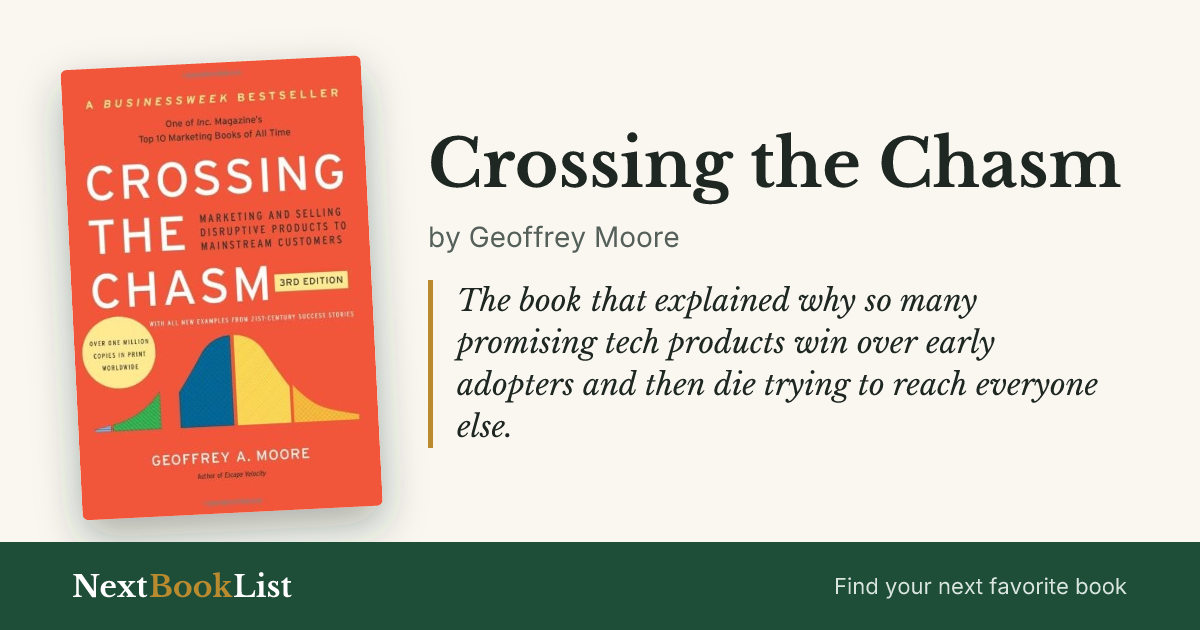
Worth reading? Crossing the Chasm took the standard technology adoption lifecycle curve (innovators, early adopters, early majority, late majority, laggards) and added the one insight that made it genuinely useful: there's a chasm between early adopters and the early majority, because the two groups buy for completely different reasons, and products that win over visionary early adopters routinely fail to cross into the pragmatic mainstream. Pair it with The Innovator's Dilemma if you want the full picture of disruptive product strategy -- Moore focuses on the marketing and go-to-market side, Christensen on the strategic and organizational side.
| Full Title | Crossing the Chasm: Marketing and Selling Disruptive Products to Mainstream Customers |
|---|---|
| Author | Geoffrey Moore |
| Published | 1991 |
| Category | Business & Money |
| Favorite quote | “The chasm... is that this huge, seemingly obvious market opportunity, once tested, turns out to have no viable way to get to it.” |
The Verdict
Moore’s chasm concept explains a failure pattern that’s easy to see in hindsight and easy to miss while you’re living through it – a product with passionate early users that just can’t seem to break out further. The beachhead strategy (dominate narrow, then expand) has become close to standard doctrine in startup go-to-market planning for exactly that reason.
you're building or marketing a tech product and need to understand why early traction doesn't automatically convert to mainstream adoption
you're not in tech or a disruptive-product category, the chasm framework is specifically about technology adoption lifecycle, less applicable to established, non-disruptive markets
Book Summary
The technology adoption lifecycle isn't a smooth curve -- it has a chasm between early adopters (visionaries who buy for competitive advantage and tolerate rough products) and the early majority (pragmatists who buy for productivity and want proven, low-risk solutions with references from peers). Products that thrill visionaries often fail completely with pragmatists because pragmatists actively distrust anything that sounds too revolutionary or untested.
Moore's prescribed strategy for crossing the chasm is to target a single, narrow beachhead market segment first -- not to broaden appeal, but to dominate one specific niche completely enough to become the safe, proven, referenceable choice pragmatists in that niche trust, and then expand outward from that beachhead into adjacent segments using the same playbook, rather than trying to appeal broadly all at once.
Top 7 Lessons from Crossing the Chasm
- Recognize the chasm between early adopters (buy for advantage) and the early majority (buy for proven, low-risk value).
- Pragmatist buyers want peer references and proof, not visionary pitches -- different messaging is required for each group.
- Target a single, narrow beachhead market and dominate it completely before expanding.
- Whole product thinking: pragmatists need the complete solution (support, integrations, ecosystem), not just the core innovation.
- Word of mouth and reference customers within a specific niche matter more to pragmatists than broad marketing claims.
- Expand from a dominated beachhead into adjacent segments using the same proven playbook, rather than broadening too early.
- A product that thrills early adopters can still completely fail with the mainstream market if the chasm isn't deliberately addressed.
Top 4 Quotes from Crossing the Chasm
"The pragmatist customer wants to buy from the market leader."
Geoffrey Moore, Crossing the Chasm
"Whole product management is at the heart of go-to-market strategy for high-tech enterprises."
Geoffrey Moore, Crossing the Chasm
"As members of a market, our behavior is invariable: we move as a herd, we mill and mill and mill around, and then all of a sudden we stampede."
Geoffrey Moore, Crossing the Chasm
"Entering the mainstream market is an act of burglary, of breaking and entering, of deception, often even of stealth."
Geoffrey Moore, Crossing the Chasm
Frequently Asked Questions
Is Crossing the Chasm worth reading?
Yes, especially if you work in tech marketing, product, or startup go-to-market strategy. The chasm concept explains a specific, common failure mode that generic marketing advice misses.
What is 'the chasm' in Crossing the Chasm?
The gap between early adopters, who buy disruptive products for competitive advantage and tolerate rough edges, and the early majority (pragmatists), who want proven, low-risk, referenceable solutions. Many products win the former group and then fail to cross to the latter.
What is a 'beachhead market' in Crossing the Chasm?
A single, narrow market segment a company deliberately targets and dominates completely before expanding, rather than trying to appeal broadly across many segments at once.
How is Crossing the Chasm different from The Innovator's Dilemma?
Crossing the Chasm focuses on marketing and go-to-market strategy for reaching mainstream adoption. The Innovator's Dilemma focuses on why established companies structurally fail to respond to disruptive innovation. They address adjacent but different problems.
Ready to read it?
Get Crossing the Chasm on Amazon