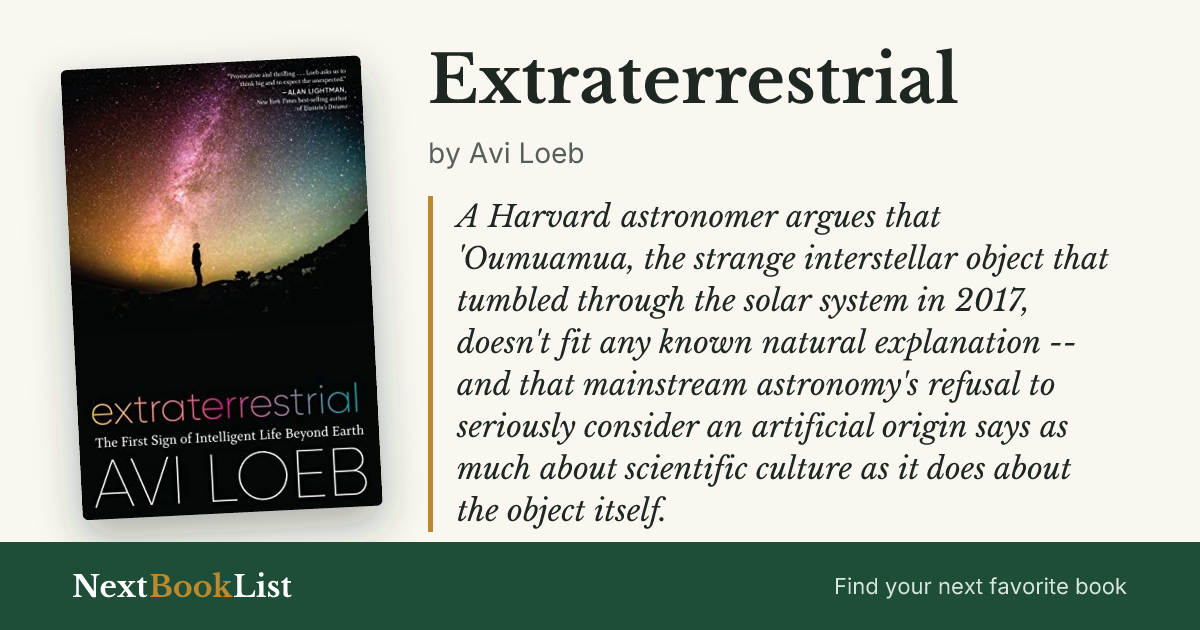
Extraterrestrial
by Avi Loeb · 2021
A Harvard astronomer argues that 'Oumuamua, the strange interstellar object that tumbled through the solar system in 2017, doesn't fit any known natural explanation -- and that mainstream astronomy's refusal to seriously consider an artificial origin says as much about scientific culture as it does about the object itself.
Worth reading? Extraterrestrial is more interesting as a case study in scientific open-mindedness than as a slam-dunk case for aliens. Loeb's data on 'Oumuamua's unusual acceleration and shape is real and genuinely strange; whether it points to alien technology or an unusual natural object (a hydrogen iceberg, a nitrogen fragment, something else entirely) is where most of the field parts ways with him. The book is most valuable for the argument that dismissing the hypothesis without investigating it is its own kind of bias.
| Full Title | Extraterrestrial: The First Sign of Intelligent Life Beyond Earth |
|---|---|
| Author | Avi Loeb |
| Published | 2021 |
| Publisher | Houghton Mifflin Harcourt |
| Category | Science & Nature |
The Verdict
Loeb is at his best when he’s just laying out the data: the odd shape, the acceleration that standard comet outgassing doesn’t fully explain. That part reads like real science writing, not speculation dressed up as fact.
Where the book gets more debatable is the leap from “this is strange and unexplained” to “this might be alien technology.” Loeb knows this is where most of his field disagrees with him, and to his credit he says so directly rather than pretending consensus exists where it doesn’t.
Read it if you want a scientist’s case for taking anomalous data seriously even when the implications invite ridicule. Skip it if you want a neutral survey of ’Oumuamua theories – this is Loeb’s argument for his own hypothesis, not a balanced roundup of the field’s views.
you want a provocative, readable case for taking the search for extraterrestrial intelligence seriously as science, written by someone with real astrophysics credentials making an argument most of his field rejects
you want settled science or a consensus view -- Loeb's central claim about 'Oumuamua is a minority position within astronomy, and the book is openly an argument, not a neutral survey
Book Summary
In 2017, astronomers detected 'Oumuamua, the first confirmed interstellar object to pass through the solar system, and Loeb argues its unusual characteristics -- an extreme, cigar-like or disc-like shape and a small but measurable non-gravitational acceleration as it left the solar system -- don't fit standard explanations for a comet or asteroid.
Loeb's central hypothesis is that 'Oumuamua could be artificial, possibly a lightsail or piece of technological debris, and he argues the astronomy community's reflexive dismissal of the idea reflects institutional caution and reputational risk more than a genuine evaluation of the evidence.
The book doubles as an argument for how science should treat outlier data: rather than forcing an anomaly into the least strange available explanation, Loeb argues researchers should follow the evidence even toward conclusions that invite ridicule, and he uses this case to call for more systematic searches (like his Galileo Project) for extraterrestrial technological artifacts.
Top 8 Lessons from Extraterrestrial
- 'Oumuamua, detected in 2017, was the first confirmed object from outside the solar system ever observed passing through it, making it a genuinely rare data point regardless of what it turns out to be.
- The object's unusual, elongated shape and its small non-gravitational acceleration as it left the solar system don't cleanly match the behavior expected of a typical comet or asteroid.
- Loeb argues that scientific institutions can be reputationally risk-averse in ways that discourage investigating genuinely strange anomalies, not just the extraterrestrial-technology hypothesis specifically.
- A lightsail -- a thin, reflective structure that could be pushed by sunlight or a directed light source -- is one of the specific artificial explanations Loeb proposes for the object's motion.
- Alternative natural explanations for 'Oumuamua exist (including a fragment of nitrogen ice or an unusually fragile 'dark comet'), and Loeb argues these carry their own unproven assumptions rather than being automatically more credible than an artificial explanation.
- Loeb calls for treating the search for extraterrestrial technological artifacts (not just radio signals, as in traditional SETI) as a legitimate area of systematic astronomical research.
- The book frames scientific open-mindedness as a discipline: following data toward an unpopular conclusion rather than reshaping the conclusion to fit what's comfortable to publish.
- Loeb's Galileo Project, founded partly in response to the 'Oumuamua case, is presented as an attempt to build the observational infrastructure needed to systematically search for more objects like it.
Frequently Asked Questions
Is Extraterrestrial worth reading?
Yes, if you want a provocative, well-argued minority position from a credentialed astronomer -- just go in knowing his central claim about 'Oumuamua isn't mainstream consensus.
What is Extraterrestrial about?
Avi Loeb argues that 'Oumuamua, the interstellar object observed in 2017, has characteristics that don't fit standard natural explanations and may indicate an artificial origin.
Is Avi Loeb's 'Oumuamua theory accepted by mainstream astronomy?
No -- most astronomers favor natural explanations (like an unusual comet or icy fragment), and Loeb's artificial-origin hypothesis remains a minority view within the field.
Do I need an astronomy background to read this book?
No -- Loeb explains the relevant astrophysics for a general audience as the argument develops.
What is the Galileo Project mentioned in the book?
A research initiative Loeb founded to systematically search for extraterrestrial technological artifacts, partly motivated by the unanswered questions 'Oumuamua raised.
Ready to read it?
Get Extraterrestrial on Amazon