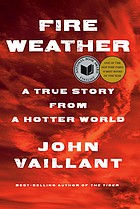
Fire Weather
by John Vaillant · 2023
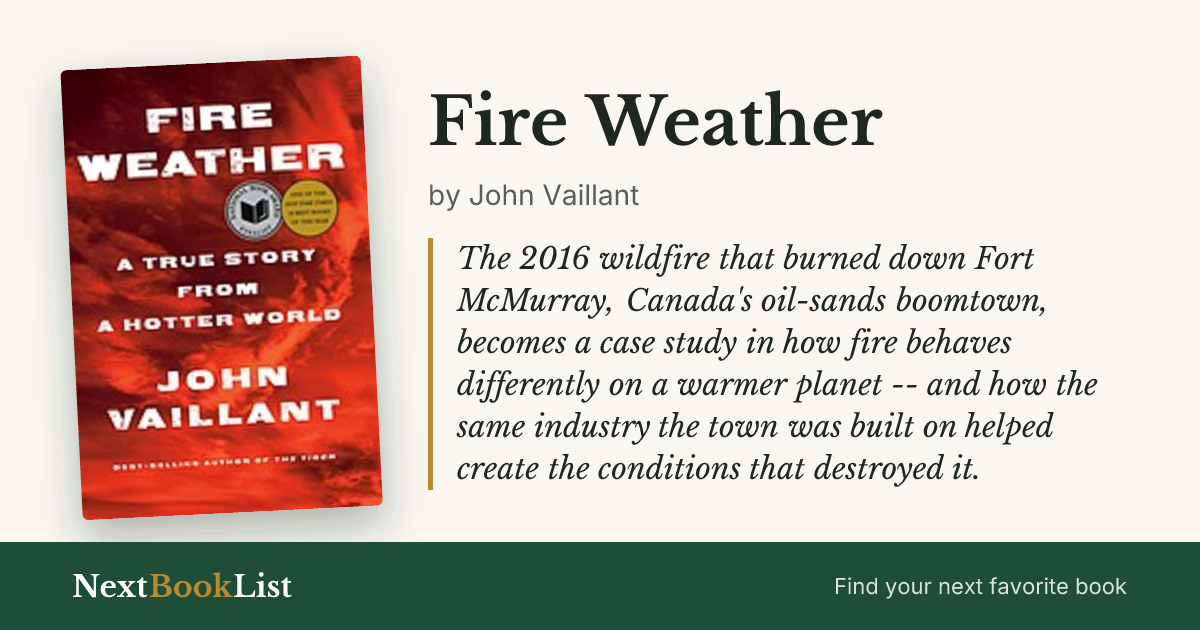
The 2016 wildfire that burned down Fort McMurray, Canada's oil-sands boomtown, becomes a case study in how fire behaves differently on a warmer planet -- and how the same industry the town was built on helped create the conditions that destroyed it.
Worth reading? Fire Weather earns its comparisons to The Big Burn and The Perfect Storm by treating a single disaster as a lens on a much larger shift. Vaillant is at his best explaining the physics of how modern houses, cars, and synthetic materials burn hotter and faster than anything a firefighter trained decades ago was prepared for. The Fort McMurray backdrop, a town built entirely on extracting oil sands, adds an irony the book doesn't need to underline because the facts already do the work.
| Full Title | Fire Weather: A True Story from a Hotter World |
|---|---|
| Author | John Vaillant |
| Published | 2023 |
| Publisher | Knopf |
| Category | Science & Nature |
| Favorite quote | “This is not planet Earth as we found it. This is a new place -- a fire planet we have made, with an atmosphere more conducive to combustion than at any time in the past 3 million years.” |
The Verdict
Vaillant spends the first third of the book just building Fort McMurray as a place before he burns it down, and that patience pays off. You need to understand the town as a functioning oil-sands boomtown, houses and cars and infrastructure built on cheap synthetic materials, before the fire science lands with any weight.
The chapters explaining pyrocumulonimbus clouds and self-generating fire weather are the strongest in the book. This isn’t abstract climate anxiety, it’s mechanism: warmer, drier air plus modern building materials produce fires that move faster than the evacuation plans built to outrun them.
Read it if you want a disaster narrative that doubles as an honest explanation of why wildfires are changing. Skip it if you want the book to spell out the oil-town irony explicitly instead of trusting you to notice it yourself.
you want a gripping disaster narrative that also functions as a clear-eyed explanation of fire science and climate change, with the irony of an oil town burned by an oil-fueled climate left mostly to speak for itself
you want a dry climate-science textbook or a book that spends its energy moralizing at the reader -- Vaillant mostly lets the events and the science make the argument
Book Summary
In May 2016, a wildfire overran Fort McMurray, Alberta -- the center of Canada's oil-sands industry -- forcing the evacuation of roughly 90,000 people in one of the largest fire evacuations in North American history, and Vaillant reconstructs the event hour by hour through the people who lived it.
The book's real argument is about "fire weather" itself: hotter average temperatures, drier boreal forests, and homes built with more synthetic, petroleum-based materials than in past decades combine to produce fires that burn faster, hotter, and less predictably than the wildfire science most fire departments were trained on.
Vaillant places the disaster inside the industry that built the town, tracing how a community whose entire economy depends on extracting fossil fuels was overrun by a fire supercharged by the same warming those fuels helped cause, without needing to state the irony outright.
Top 8 Lessons from Fire Weather
- Modern homes burn faster and hotter than older ones because synthetic, petroleum-based building materials (vinyl siding, plastics, synthetic insulation) ignite and spread differently than the wood and natural fiber materials firefighting doctrine was built around.
- 'Fire weather' -- the specific combination of heat, low humidity, and wind that makes extreme fire behavior possible -- is becoming more common as average temperatures rise, even in regions, like Alberta's boreal forest, not historically thought of as fire-prone.
- Fort McMurray's economy is built entirely on extracting oil from the Athabasca oil sands, making it a literal company town for the fossil fuel industry the book ties to the changing climate that endangered it.
- Wildfires can generate their own weather, including pyrocumulonimbus clouds capable of producing fire-generated lightning that ignites new fires far from the original blaze.
- Evacuating roughly 90,000 people from a single town in a matter of hours reveals how thin the margin is between an orderly evacuation and gridlock, especially on a limited road network.
- Firefighting agencies trained on 20th-century fire behavior models are increasingly outmatched by fires that move and intensify faster than those models predict.
- Insurance and rebuilding decisions after the fire reveal a tension between wanting to return to normal quickly and acknowledging that the underlying conditions that produced the fire haven't gone away.
- The oil sands industry itself faced brief disruption from the fire, showing how even the infrastructure of fossil fuel extraction is not insulated from the climate effects of the product it extracts.
Top 3 Quotes from Fire Weather
"This is not planet Earth as we found it. This is a new place -- a fire planet we have made, with an atmosphere more conducive to combustion than at any time in the past 3 million years."
John Vaillant, Fire Weather
"But hope is a human construct, a coping mechanism in the face of uncertainty that holds no sway in the natural world."
John Vaillant, Fire Weather
"The willful and ongoing failure to act on climate science is unforgivable; recrimination is justified, but none will be sufficient."
John Vaillant, Fire Weather
Frequently Asked Questions
Is Fire Weather worth reading?
Yes -- it's a gripping account of the Fort McMurray wildfire that also clearly explains why modern fires behave differently than the fires firefighting science was built to fight.
What is Fire Weather about?
John Vaillant's account of the 2016 wildfire that destroyed Fort McMurray, Alberta, the center of Canada's oil-sands industry, and what the fire reveals about climate change and modern fire behavior.
Is Fire Weather a climate change book or a disaster narrative?
Both -- it's structured as a disaster narrative but uses the event to explain the climate science and fire science behind why such fires are becoming more common and more destructive.
Do I need a science background to read Fire Weather?
No -- Vaillant explains the fire science and climate concepts for a general audience as the narrative unfolds.
Did Fire Weather win any awards?
Yes -- it won the 2023 Baillie Gifford Prize for Nonfiction.
Ready to read it?
Get Fire Weather on Amazon