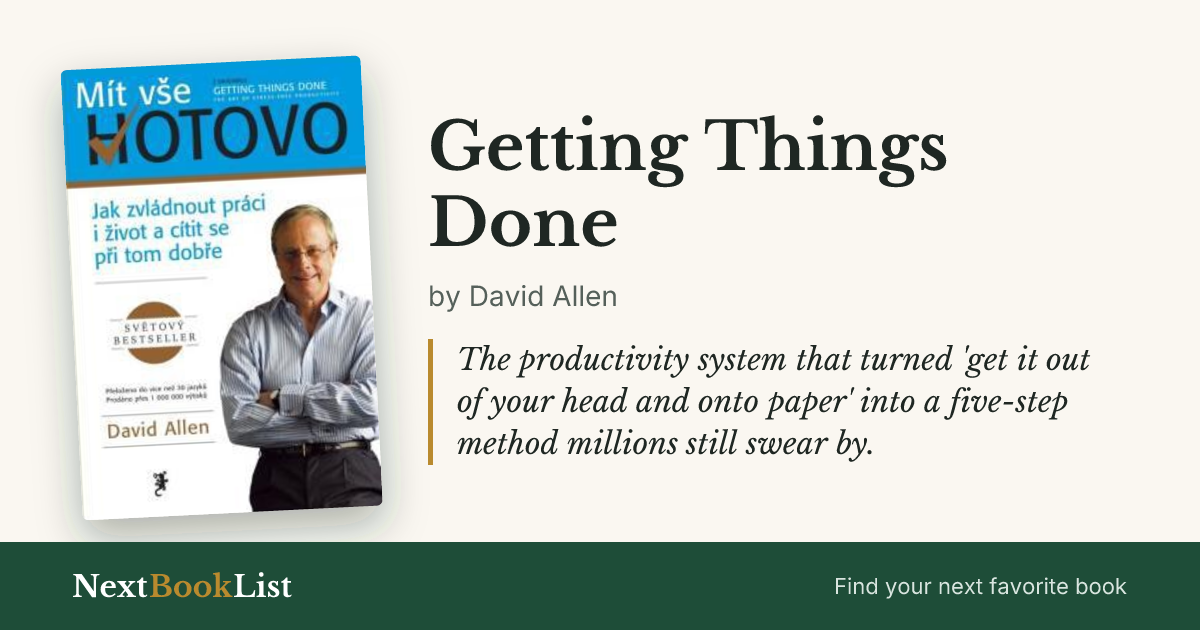
Getting Things Done
by David Allen · 2001
The productivity system that turned 'get it out of your head and onto paper' into a five-step method millions still swear by.
Worth reading? Getting Things Done is the most influential productivity book of the last 25 years for a real reason: the core insight that unresolved commitments create background stress whether or not you're consciously thinking about them, and that capturing everything into a trusted external system is what actually quiets that noise. It's more process-heavy than Eat That Frog or Atomic Habits, and the weekly review discipline is where most people's GTD system quietly dies -- but the capture-clarify-organize-reflect-engage workflow is worth adopting even in a lighter form.
| Full Title | Getting Things Done: The Art of Stress-Free Productivity |
|---|---|
| Author | David Allen |
| Published | 2001 |
| Category | Self-Improvement & Psychology |
| Favorite quote | “Your mind is for having ideas, not holding them.” |
The Verdict
Allen’s core claim, that an unresolved commitment nags at you whether or not you’re thinking about it, is genuinely testable in your own life within a day of trying the capture step. The full system asks for real discipline to maintain, especially the weekly review, so treat this as a framework to adapt rather than a rulebook to follow exactly.
your to-do list lives in your head and it's stressing you out, you want a complete external system instead
you want a light, minimal system. GTD has real setup overhead (folders, lists, weekly reviews) and it's easy to spend more time maintaining it than doing the work
Book Summary
Your brain is bad at storage and good at processing, but most people use it backwards -- holding a mental list of everything unfinished, which creates constant low-grade anxiety (what Allen calls "open loops") even when you're not actively working. The fix is to capture every commitment, idea, and task into a trusted external system immediately, freeing your mind to actually think instead of rehearsing a to-do list.
Allen's five-step workflow -- capture, clarify, organize, reflect, engage -- turns that principle into a repeatable system: capture everything without filtering, clarify what each item actually requires (is it actionable? what's the next physical action?), organize by context and project, review weekly to keep the system trustworthy, and then engage with confidence because you know nothing's been dropped.
Top 7 Lessons from Getting Things Done
- Capture every commitment and idea into an external system immediately -- don't trust your memory to hold it.
- Define the next concrete physical action for every task, not a vague intention.
- Two-minute rule: if a task takes under two minutes, do it immediately instead of logging it.
- Organize tasks by context (where/what tool you need) rather than by arbitrary priority alone.
- Run a weekly review to keep your system trustworthy -- an untrusted system gets abandoned.
- Separate 'projects' (anything requiring more than one action) from single-step tasks.
- A cluttered mental to-do list creates stress even when you're not actively thinking about it -- externalize to relieve that.
Top 4 Quotes from Getting Things Done
"Your mind is for having ideas, not holding them."
David Allen, Getting Things Done
"You can do anything, but not everything."
David Allen, Getting Things Done
"The primary reason for identifying the very next physical action required is to force the kind of thinking that will reveal and resolve all the sticking points."
David Allen, Getting Things Done
"Much of the stress that people feel doesn't come from having too much to do. It comes from not finishing what they've started."
David Allen, Getting Things Done
Frequently Asked Questions
Is Getting Things Done worth reading?
Yes, if your to-do list currently lives mostly in your head. The capture-everything principle alone reduces a real amount of background stress, even if you don't adopt the full system.
What is the main idea of Getting Things Done?
Unresolved commitments create stress whether or not you're consciously thinking about them, and capturing everything into a trusted external system, then defining the next concrete action for each item, is what relieves that stress and improves execution.
Is GTD hard to maintain?
Yes, more than most productivity systems. The weekly review is essential to keeping it trustworthy, and it's the step most people skip, at which point the system stops working and gets abandoned.
How is GTD different from Eat That Frog?
Eat That Frog is about prioritization -- do the hardest task first. GTD is a full capture-and-organize system for managing everything you have to do, with less emphasis on which task to tackle first.
Ready to read it?
Get Getting Things Done on Amazon