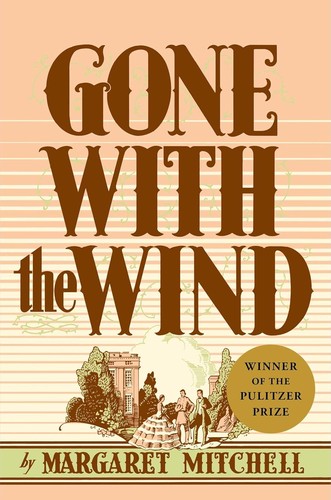
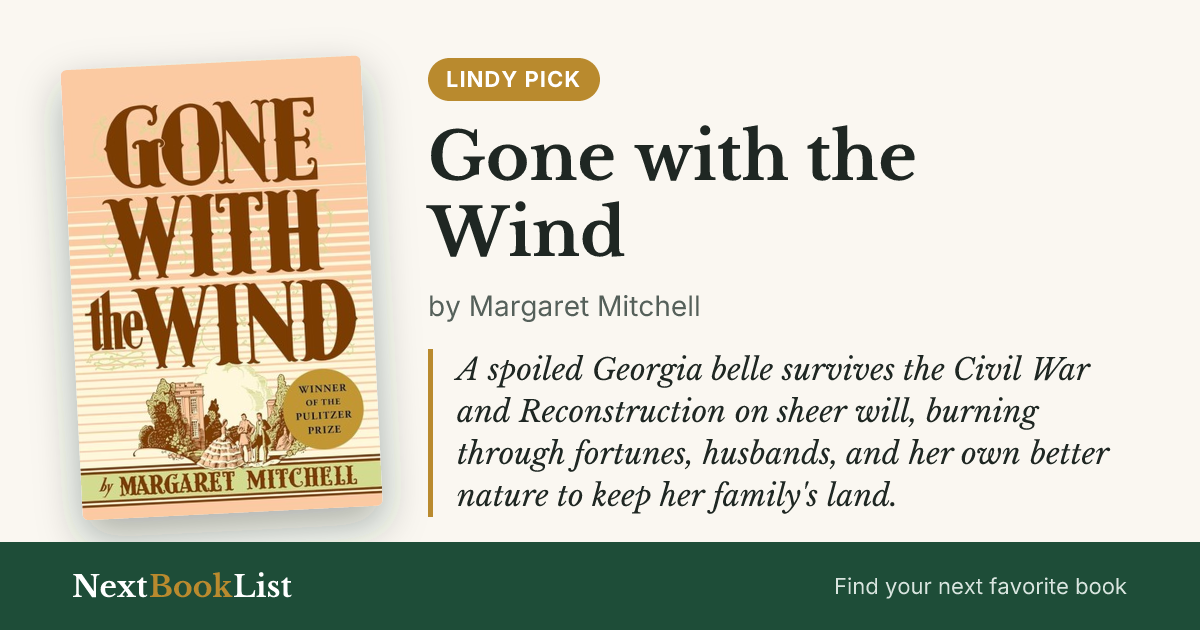
Gone with the Wind
by Margaret Mitchell · 1936
A spoiled Georgia belle survives the Civil War and Reconstruction on sheer will, burning through fortunes, husbands, and her own better nature to keep her family's land.
Worth reading? Gone with the Wind is the best-selling Civil War novel ever written for a reason -- Scarlett O'Hara is one of the most propulsive protagonists in American fiction, selfish and resourceful in equal measure, and the plot never lets up for 1,000 pages. It beats other plantation-era romances on sheer narrative drive, but it's also the most nakedly 'Lost Cause' one, romanticizing the antebellum South in a way that requires a critical eye going in. Read it for the character study and the pace, not for history.
| Author | Margaret Mitchell |
|---|---|
| Published | 1936 |
| Publisher | Scribner |
| Category | Fiction |
| Favorite quote | “After all, tomorrow is another day.” |
The Verdict
The reason this has outsold nearly every other Civil War-era novel for almost a century isn’t subtle: Scarlett is a genuinely great, ruthless protagonist, and Mitchell never slows down long enough to let the plot sag. That’s the case for reading it.
The case against reading it uncritically is just as real – this is Lost Cause mythology dressed up as sweeping romance, and it shaped a lot of Americans’ (wrong) understanding of the antebellum South and Reconstruction for generations. Read it for the character and the pace. Don’t read it for the history.
you want the sweeping, propulsive, morally messy Civil War epic that basically defined the historical romance genre, centered on one of fiction's most compelling, unlikeable protagonists
you want a book that treats slavery and the antebellum South honestly -- Mitchell's novel is deeply romanticized 'Lost Cause' mythology, and that framing hasn't aged well; go in aware of it rather than surprised by it
Book Summary
Scarlett O'Hara survives the collapse of the world she was raised for (plantation wealth, social status, a leisure class built on slavery) not through virtue but through ruthlessness -- she lies, manipulates, marries for money, and runs a business by underpaying convict labor, and the novel largely admires her for it. Mitchell built a heroine defined by survival instinct rather than likability, which is rarer than it sounds in 1930s popular fiction.
The novel's central irony is that Scarlett spends the whole book chasing Ashley Wilkes, a man who represents the genteel Old South she claims to despise being trapped by, while ignoring Rhett Butler, the pragmatic outsider who actually understands and matches her. She only recognizes what she wants once it's gone.
Mitchell frames the antebellum South and the Confederacy through deeply romanticized 'Lost Cause' mythology -- enslaved characters are largely rendered as loyal and content, and Reconstruction is portrayed as a grievance rather than the emancipation and rebuilding it was. That framing is inseparable from the book's popularity in its time and is exactly what makes it a document of its era's politics as much as a novel.
Top 8 Lessons from Gone with the Wind
- Scarlett O'Hara survives on ruthlessness and adaptability, not virtue -- the novel treats her selfishness as a survival asset more often than a flaw.
- The chase after Ashley Wilkes versus the overlooked Rhett Butler is the novel's central romantic irony: Scarlett wants what represents the past, not what actually suits her.
- Scarlett's postwar sawmill business, built partly on underpaid convict labor, shows Mitchell letting her heroine be genuinely morally compromised rather than sanitized.
- Melanie Wilkes is written as Scarlett's opposite (gentle, loyal, conventionally virtuous) and the novel quietly argues Melanie's steadiness matters more than anyone, Scarlett included, gives her credit for.
- The fall of Tara and the O'Hara family's near-ruin reframes the entire back half of the book as a survival story, not a romance.
- Mitchell's portrayal of enslaved people and Reconstruction reflects 'Lost Cause' mythology, softening slavery and framing emancipation-era change as loss rather than justice.
- Rhett Butler's famous exit ('I don't give a damn') isn't cruelty for its own sake -- it's the novel's argument that even the most patient devotion runs out.
- The closing line, 'tomorrow is another day,' reframes the entire saga as one chapter in Scarlett's ongoing survival rather than a resolved ending.
Top 5 Quotes from Gone with the Wind
"My dear, I don't give a damn."
Margaret Mitchell, Gone with the Wind
"After all, tomorrow is another day."
Margaret Mitchell, Gone with the Wind
"As God is my witness, I'll never be hungry again."
Margaret Mitchell, Gone with the Wind
"Land is the only thing in the world worth working for, worth fighting for, worth dying for, because it's the only thing that lasts."
Margaret Mitchell, Gone with the Wind
"Death, taxes and childbirth! There's never any convenient time for any of them."
Margaret Mitchell, Gone with the Wind
Frequently Asked Questions
Is Gone with the Wind worth reading?
As a character study and a piece of publishing history, yes -- Scarlett is genuinely compelling and the pacing rarely sags for a 1,000-page book. As history, read it critically; its 'Lost Cause' framing of the antebellum South and slavery is a major flaw, not a minor one.
What is the main theme of Gone with the Wind?
Survival through a collapsing social order -- Scarlett's ruthless adaptability against the romanticized, doomed Old South that raised her.
Is the book different from the movie?
The 1939 film is famously faithful to the plot but softens some of Scarlett's harder edges and compresses the postwar business plotline; the novel spends more time on her ruthlessness as a businesswoman.
Is Gone with the Wind historically accurate?
No, not as a portrayal of slavery or Reconstruction -- it romanticizes the antebellum South through 'Lost Cause' mythology. Read it as a novel and a document of 1930s Southern nostalgia, not a history.
Ready to read it?
Get Gone with the Wind on Amazon