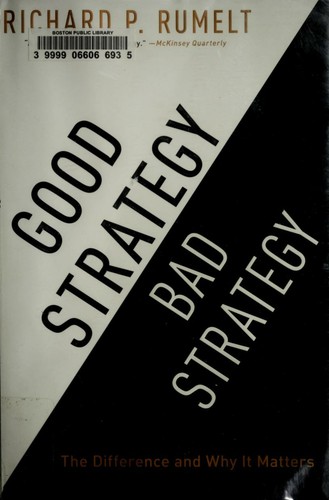
Good Strategy Bad Strategy
by Richard Rumelt · 2011
Most 'strategy' is a wish list with a deadline. Rumelt tells you what an actual one looks like.
Worth reading? Rumelt's Good Strategy Bad Strategy is the diagnostic tool; Playing to Win by A.G. Lafley and Roger Martin is the choice-making framework you apply once you've passed it. Rumelt tells you why your strategy document is actually a wish list dressed up in buzzwords; Playing to Win gives you the five questions (where to play, how to win) to build the real thing. Read Rumelt first -- it's the harder-nosed, more skeptical read, and it'll stop you from mistaking ambition for strategy. Skip it if you want a motivational business read; this one is closer to a diagnostic exam than a pep talk.
| Full Title | Good Strategy Bad Strategy: The Difference and Why It Matters |
|---|---|
| Author | Richard Rumelt |
| Published | 2011 |
| Publisher | Crown Business |
| Category | Business & Money |
| Favorite quote | “A good strategy honestly acknowledges the challenges being faced and provides an approach to overcoming them.” |
The Verdict
Rumelt is an academic, not a consultant selling a framework, and it shows in how little patience the book has for buzzwords. If you’ve ever sat in a room nodding along to a strategy presentation that was actually just a list of hopes, this book names exactly what went wrong and gives you the language to say so next time.
you've sat through a strategy offsite that produced a vision statement and nothing else
you want inspiration and slogans, not a diagnostic that will expose your plan has no strategy in it
Book Summary
Rumelt's core move is separating real strategy from what he calls bad strategy -- the fluff of vision statements, buzzwords, and goals dressed up as plans. Bad strategy is usually a list of things you want (grow revenue, delight customers, be number one) with no explanation of how you'll get there given the actual obstacles in your way.
Good strategy has a specific shape he calls the kernel: a diagnosis (what the problem actually is, once you cut through the noise), a guiding policy (an overall approach to the obstacle), and coherent action (a set of steps that work together, not a grab-bag of unrelated initiatives). Most companies skip the diagnosis entirely and jump straight to the list of actions.
The book leans hard on real case studies -- Apple's turnaround, Walmart's logistics, Cold War military doctrine -- to show good strategy exploiting one specific advantage rather than announcing an ambition. Rumelt's test for any strategy document is simple: does it name the obstacle, or does it just name the goal?
Top 11 Lessons from Good Strategy Bad Strategy
- Bad strategy is a wish list dressed up as a plan.
- Good strategy names the obstacle before it names the goal.
- The kernel of any real strategy: diagnosis, guiding policy, coherent action.
- A vision statement is not a strategy -- it's a hope.
- Coherent action beats a list of disconnected initiatives.
- Find the one place your strength gives you real leverage, then push there.
- Buzzwords standing in for hard thinking are the enemy of clarity.
- A strategy that fits every situation actually fits none of them.
- Leaders avoid hard choices by calling every priority a priority.
- Strategy means concentrating force at a decisive point, not spreading effort evenly.
- Good strategy often looks obvious in hindsight because the diagnosis was correct.
Top 4 Quotes from Good Strategy Bad Strategy
"The most basic idea of strategy is the application of strength against weakness."
Richard Rumelt, Good Strategy Bad Strategy
"Bad strategy is not simply the absence of good strategy."
Richard Rumelt, Good Strategy Bad Strategy
"A good strategy honestly acknowledges the challenges being faced and provides an approach to overcoming them."
Richard Rumelt, Good Strategy Bad Strategy
"Good strategy works by focusing energy and resources on one, or a very few, pivotal objectives whose accomplishment will lead to a cascade of favorable outcomes."
Richard Rumelt, Good Strategy Bad Strategy
Frequently Asked Questions
Is Good Strategy Bad Strategy worth reading?
Yes, especially if you've sat through a planning session that produced a vision statement and a list of goals but no actual strategy. Rumelt gives you a fast way to tell the difference, and it'll change how you read every strategy deck after.
What is the main idea of Good Strategy Bad Strategy?
Most 'strategy' is really just a list of goals with no explanation of how to reach them. Real strategy has a kernel: a clear diagnosis of the actual problem, a guiding policy for tackling it, and a coherent set of actions that reinforce each other.
What makes a strategy 'bad' according to Rumelt?
Fluff (buzzwords standing in for hard thinking), failure to face the problem (skipping the diagnosis), mistaking goals for strategy, and a laundry list of disconnected initiatives instead of one coherent approach.
Should I read this or Playing to Win?
Read Rumelt first. Good Strategy Bad Strategy is the sharper, more skeptical diagnostic for spotting a bad plan; Playing to Win is the more constructive framework for building the choices that make up a good one.
Ready to read it?
Get Good Strategy Bad Strategy on Amazon