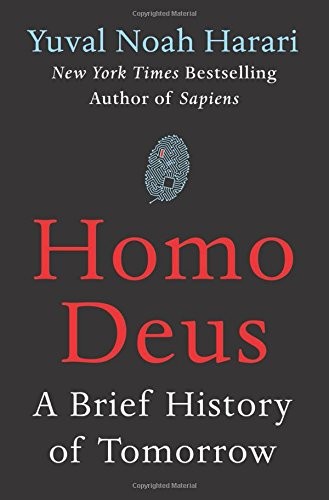
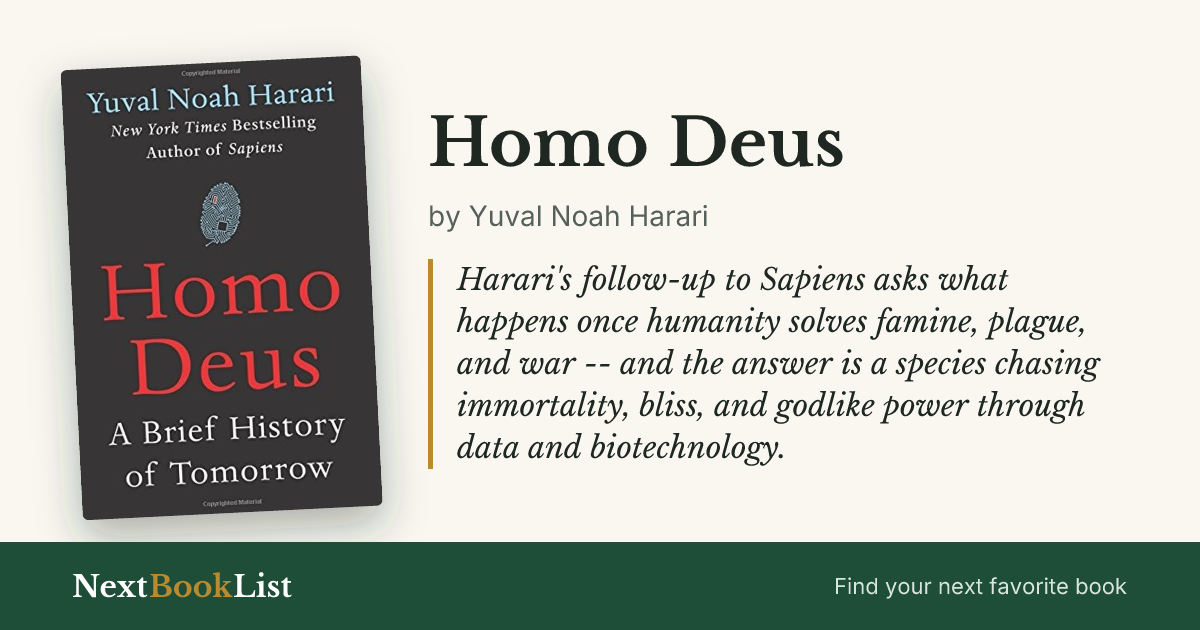
Homo Deus
by Yuval Noah Harari · 2017
Harari's follow-up to Sapiens asks what happens once humanity solves famine, plague, and war -- and the answer is a species chasing immortality, bliss, and godlike power through data and biotechnology.
Worth reading? Homo Deus is less rigorous than Sapiens and knows it -- Harari is explicit that this is speculation, not prophecy. Its value isn't predicting the future correctly; it's forcing you to notice that liberal humanism, the story most of the developed world still lives by, might already be losing ground to a new story where data and algorithms know you better than you know yourself. Read it for the questions, not the answers.
| Full Title | Homo Deus: A Brief History of Tomorrow |
|---|---|
| Author | Yuval Noah Harari |
| Published | 2017 |
| Publisher | Harper |
| Category | Science & Nature |
| Favorite quote | “Once technology enables us to re-engineer human minds, Homo sapiens will disappear, human history will come to an end and a completely new process will begin.” |
The Verdict
Harari’s trick in Sapiens was making 300,000 years of history feel like one coherent story. Homo Deus tries the same move pointed at the future, and it’s shakier – speculation about AI and biotech ages faster than history does, and some of the book already reads as a product of its 2016 moment.
But the core provocation holds up: what happens to a worldview built on trusting your own feelings when algorithms start predicting those feelings better than you can? Harari doesn’t answer it so much as make sure you can’t unsee it once he’s pointed it out.
Read it if you want Sapiens’ scope pointed at tomorrow instead of yesterday, and you’re comfortable treating the specifics as thought experiments. Skip it if you want grounded, technical forecasting about AI or biotech – this is philosophy in futurist’s clothing, not a roadmap.
you loved Sapiens' big-picture style and want the same treatment applied to the future -- AI, biotech, and the rise of data as a belief system
you want concrete predictions or a technical grounding in AI/biotech -- this is speculative philosophy dressed as futurism, not a forecasting document
Book Summary
Having largely tamed famine, plague, and war (Harari's argument, not universally accepted), humanity's new projects become upgrading humans toward immortality, bliss, and divinity -- turning Homo sapiens into what Harari calls Homo Deus.
The book's central warning is the rise of "Dataism": a new worldview where the value of anything, including a human life, is measured by its contribution to data processing, and where algorithms that know your preferences better than you do start making your decisions for you -- eroding the liberal humanist assumption that human feelings are the ultimate authority.
Harari argues this shift could produce a small "upgraded" elite alongside a vast "useless class" left behind by automation, not because of malice but because economic and military systems no longer need mass human labor or mass human soldiers the way they once did.
Top 8 Lessons from Homo Deus
- Humanity's traditional enemies (famine, plague, war) have been substantially tamed, at least statistically, freeing civilization's attention for new projects.
- The next targets become immortality, engineered happiness, and enhanced abilities -- treating death and suffering as engineering problems rather than fixed facts of life.
- Dataism reframes value itself: an experience, an institution, or a life matters to the extent it contributes useful data, not for its own sake.
- Algorithms that out-predict your own self-knowledge (what you'll buy, who you'll love, how you'll vote) quietly transfer authority from individual feeling to external systems.
- Automation threatens to create a 'useless class' -- not unemployed in a temporary sense, but structurally unnecessary to the economy or military in a way no retraining fixes.
- Liberal humanism's core assumption, that individual human feeling is the ultimate source of meaning and authority, is a historically recent belief, not a natural law -- and it can be displaced the way earlier belief systems were.
- Biotechnology and AI are converging on the same project: engineering minds and bodies rather than just building tools that sit outside them.
- Harari repeatedly frames his own scenarios as one possible future, not a prediction -- the point is to widen the range of futures you're willing to take seriously.
Top 4 Quotes from Homo Deus
"Humans were always far better at inventing tools than using them wisely."
Yuval Noah Harari, Homo Deus
"Once technology enables us to re-engineer human minds, Homo sapiens will disappear, human history will come to an end and a completely new process will begin."
Yuval Noah Harari, Homo Deus
"In the twenty-first century we will create more powerful fictions and more totalitarian religions than in any previous era."
Yuval Noah Harari, Homo Deus
"Everybody's number one question: What will happen to the job market once artificial intelligence outperforms humans in most cognitive tasks?"
Yuval Noah Harari, Homo Deus
Frequently Asked Questions
Is Homo Deus worth reading?
Yes, if you want a provocative big-picture look at where technology could take humanity -- just treat it as speculative philosophy, not a forecast.
What is Homo Deus about?
Yuval Noah Harari's argument that having largely solved famine, plague, and war, humanity's next projects are immortality, bliss, and enhanced power, driven by AI, biotechnology, and a new data-centered worldview he calls Dataism.
Do I need to read Sapiens before Homo Deus?
No, but it helps -- Homo Deus assumes the historical framing from Sapiens and spends more time speculating forward than re-explaining the past.
Is Homo Deus scientifically accurate?
It's a mix of established science and open speculation, clearly framed by Harari as one possible future, not settled prediction -- read it for the questions it raises, not as a technical reference.
How does Homo Deus compare to Sapiens?
Sapiens looks backward at 300,000 years of human history; Homo Deus looks forward, and is more speculative and more openly philosophical as a result.
Ready to read it?
Get Homo Deus on Amazon