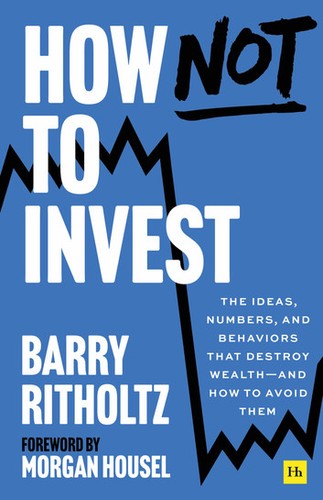
How Not to Invest
by Barry Ritholtz · 2025
Ritholtz catalogs the specific ideas and behaviors, market timing, hot stock tips, panic selling, that quietly destroy investor returns.
Worth reading? How Not to Invest works by subtraction: instead of another list of things to do, Ritholtz, a longtime market commentator, catalogs the specific, well-documented ways investors sabotage their own returns, from chasing hot sectors to panic-selling at the bottom. It's a useful companion to more prescriptive investing books precisely because it targets the behaviors those books don't spend enough time on. Skip it if you want a positive plan rather than a list of what not to do, pair it with a book like The Simple Path to Wealth for the other half.
| Full Title | How Not to Invest: The Ideas, Numbers, and Behaviors that Destroy Wealth. And How to Avoid Them |
|---|---|
| Author | Barry Ritholtz |
| Published | 2025 |
| Category | Business & Money |
| Favorite quote | “Investing is simple but hard, and therein lies our challenge.” |
The Verdict
How Not to Invest works by subtraction: instead of another list of things to do, Ritholtz catalogs the specific, well-documented ways investors sabotage their own returns, from chasing hot sectors to panic-selling at the bottom. It’s a useful companion to more prescriptive investing books precisely because it targets the behaviors those books don’t spend enough time on. Skip it if you want a positive plan rather than a list of what not to do.
investors who want to know exactly which common habits are costing them money
you want a positive step-by-step plan rather than a catalog of mistakes to avoid
Book Summary
Ritholtz catalogs the specific ideas and behaviors, market timing, hot stock tips, panic selling, that quietly destroy investor returns. It earns its place by naming failure modes most investing books only gesture at. Trying to time the market costs most investors more than the crashes they're trying to avoid. Chasing last year's best-performing sector is a reliably bad strategy dressed up as common sense. The practical move is to read it once, then act on the one idea that maps to your current bottleneck, rereading the whole thing rarely adds more than executing the part you skipped.
Top 7 Lessons from How Not to Invest
- Trying to time the market costs most investors more than the crashes they're trying to avoid.
- Chasing last year's best-performing sector is a reliably bad strategy dressed up as common sense.
- Financial media incentives favor exciting predictions over accurate, boring ones.
- Panic-selling during a downturn locks in losses that a recovery would otherwise have erased.
- Complex investment products often exist to generate fees, not superior returns.
- Overconfidence after a few good picks leads to bigger, less disciplined bets later.
- Avoiding the worst, most common mistakes matters more than finding the single best strategy.
Top 4 Quotes from How Not to Invest
"Investing is really the study of human decision-making. It is about the art of using imperfect information to make probabilistic assessments about an inherently unknowable future."
Barry Ritholtz, How Not to Invest
"Investing is simple but hard, and therein lies our challenge."
Barry Ritholtz, How Not to Invest
"We evolved in an arithmetic world, so we are unprepared for the exponential math of finance."
Barry Ritholtz, How Not to Invest
"You're human – unfortunately, that hurts your portfolio. Our brains evolved to keep us alive on the savannah, not to make risk/reward decisions in the capital markets."
Barry Ritholtz, How Not to Invest
Frequently Asked Questions
Is How Not to Invest worth reading?
Yes, if the description fits you, investors who want to know exactly which common habits are costing them money. Skip it if you want a positive step-by-step plan rather than a catalog of mistakes to avoid.
What is the main idea of How Not to Invest?
Ritholtz catalogs the specific, well-documented investor behaviors, market timing, chasing hot sectors, panic selling, that quietly destroy long-term returns.
Who should read How Not to Invest?
Investors who want to know exactly which common habits are costing them money. Skip it if you want a positive plan rather than a list of mistakes.
What will you get out of How Not to Invest?
A clearer, opinionated take you can act on, plus the sharpest lessons pulled into a short list so you don't have to read the whole book to decide.
Ready to read it?
Get How Not to Invest on Amazon