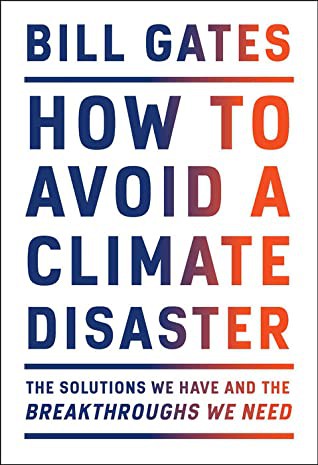
How to Avoid a Climate Disaster
by Bill Gates · 2021
Bill Gates reframes climate change as an engineering and investment problem, anchored on one number -- 51 billion tons of greenhouse gas a year -- that every solution has to actually move.
Worth reading? Gates's contribution here isn't new climate science -- it's a framework: every proposed solution gets measured against getting from 51 billion tons of annual emissions to zero, and against the 'green premium' (the extra cost of the clean version versus the fossil version) for each sector. That framing is genuinely useful for cutting through vague climate optimism, because it forces a blunt question for every technology: does this actually move the 51-billion-ton number, and at what cost. It's stronger as an engineering triage document than as a manifesto -- if you want moral urgency, look elsewhere; if you want a sober list of where the hardest problems (steel, cement, aviation, agriculture) actually are, this delivers it.
| Full Title | How to Avoid a Climate Disaster: The Solutions We Have and the Breakthroughs We Need |
|---|---|
| Author | Bill Gates |
| Published | 2021 |
| Publisher | Knopf |
| Category | Science & Nature |
| Favorite quote | “The climate is like a bathtub that's slowly filling up with water. Even if we slow the flow of water to a trickle, the tub will eventually fill up and water will come spilling out onto the floor.” |
The Verdict
Gates’s real contribution is the discipline of the framework, not any single technology pick – once you’ve got the 51-billion-ton number and the green premium concept in your head, it’s hard to read climate news the same way again. Skip it if you wanted moral urgency; read it if you wanted the actual math behind why some sectors are so much harder than others.
you want a systems-level, numbers-first framework for which climate solutions matter at scale, not another book on individual lifestyle choices
you want a book centered on climate justice, activism, or policy politics -- this stays close to technology and investment, not the social movement
Book Summary
Every year, human activity adds roughly 51 billion tons of greenhouse gases to the atmosphere, and Gates argues this single number should be the yardstick for every proposed climate solution -- does it meaningfully reduce that 51 billion, or is it a rounding error dressed up as progress.
The "green premium" -- the extra cost of a clean technology over its fossil-fuel equivalent -- is the practical bottleneck for adoption at scale, and it varies wildly by sector: electricity and passenger cars have a manageable premium today, while steel, cement, aviation fuel, and fertilizer-dependent agriculture have a much higher one and need real technological breakthroughs, not just subsidies, to close.
Gates places heavy weight on innovation and R&D investment (including nuclear and unproven high-risk technologies) alongside deployment of existing solutions, arguing that without genuine breakthroughs in the hardest sectors, no amount of policy will hit net zero -- a stance that puts him at odds with degrowth or purely behavioral-change framings of the problem.
Top 8 Lessons from How to Avoid a Climate Disaster
- 51 billion tons of annual greenhouse gas emissions is the benchmark every proposed climate solution should be measured against.
- The 'green premium' -- the cost gap between a clean technology and its fossil equivalent -- differs enormously by sector.
- Electricity generation and passenger vehicles have relatively low green premiums today; steel, cement, and aviation fuel have much higher ones.
- Genuine technological breakthroughs, not just policy incentives, are required to decarbonize the hardest sectors like heavy industry and agriculture.
- Individual lifestyle changes, while not worthless, are a rounding error against the scale of the 51-billion-ton problem.
- R&D investment in unproven or high-risk technologies (including next-generation nuclear) deserves serious funding alongside deploying what already works.
- Fertilizer production and agricultural emissions are a bigger and harder piece of the climate problem than most public discussion accounts for.
- Government policy that lowers the green premium (through carbon pricing, R&D funding, or mandates) is necessary because market forces alone won't close the cost gap fast enough.
Top 3 Quotes from How to Avoid a Climate Disaster
"The climate is like a bathtub that's slowly filling up with water. Even if we slow the flow of water to a trickle, the tub will eventually fill up and water will come spilling out onto the floor."
Bill Gates, How to Avoid a Climate Disaster
"The cruel injustice is that even though the world's poor are doing essentially nothing to cause climate change, they're going to suffer the most from it."
Bill Gates, How to Avoid a Climate Disaster
"We need to deploy the tools we already have, like solar and wind, faster and smarter. And we need to create and roll out breakthrough technologies that can take us the rest of the way."
Bill Gates, How to Avoid a Climate Disaster
Frequently Asked Questions
Is How to Avoid a Climate Disaster worth reading?
Yes, if you want a systems-level, cost-and-scale framework for evaluating climate solutions. It's less useful if you're looking for climate justice or activist framing rather than an engineering and investment lens.
What is the 'green premium' in How to Avoid a Climate Disaster?
The extra cost of choosing a clean-energy version of a product or process over its fossil-fuel equivalent -- Gates uses it as the central metric for judging how close any sector is to viable decarbonization.
Does How to Avoid a Climate Disaster focus on individual actions?
No. It's centered on large-scale technology, investment, and policy questions -- individual lifestyle changes get acknowledged but treated as minor next to the 51-billion-ton scale of the problem.
What sectors does Gates say are hardest to decarbonize?
Steel and cement production, aviation, and fertilizer-dependent agriculture -- sectors where the green premium is currently highest and existing clean alternatives aren't yet cost-competitive.
Ready to read it?
Get How to Avoid a Climate Disaster on Amazon