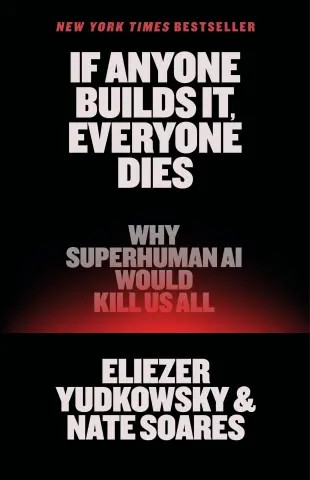
If Anyone Builds It, Everyone Dies
by Eliezer Yudkowsky and Nate Soares · 2025
The bluntest, least hedged book in the AI-risk genre, two longtime AI-safety researchers arguing that current methods can't safely build superhuman AI, full stop, no qualifier.
Worth reading? Yudkowsky and Soares have spent two decades on AI alignment at MIRI, and this book is their case, stripped of academic hedging, that we do not currently know how to build a superhuman AI whose goals stay aligned with ours, and that building one anyway is a bet against the species. It's polarizing by design: supporters call it the clearest warning available, critics call it overconfident. Read it as the sharpest edge of the argument, then weigh it against calmer books like Life 3.0. Skip it if you want nuance over conviction.
| Full Title | If Anyone Builds It, Everyone Dies: Why Superhuman AI Would Kill Us All |
|---|---|
| Author | Eliezer Yudkowsky and Nate Soares |
| Published | 2025 |
| Category | Business & Money |
The Verdict
This is the most uncompromising book on the shelf, no hedging, no ‘it depends,’ just a hard argument that the industry is racing ahead of a problem it hasn’t solved. Whether you agree or not, it’s the clearest statement of the strongest version of the case, and worth reading precisely because it refuses to soften.
readers who want the strongest, most unhedged version of the AI-doom argument
you want a balanced or optimistic take, this book has one thesis and argues it hard
Book Summary
The authors' core claim: current AI training methods (gradient descent on huge models) produce systems whose internal goals we don't actually understand or control, we only shape their outward behavior during training, which is not the same thing as aligning their true objectives. Scaling that process up to superhuman capability, they argue, doesn't fix this gap, it just makes the consequences of getting it wrong catastrophic and irreversible.
Unlike more measured entries in the genre, the book explicitly rejects 'wait and see' as a strategy, arguing that by the time misalignment becomes obvious in a superhuman system, it's too late to correct. Their policy prescription is blunt: treat frontier AI development the way the world (imperfectly) treats nuclear proliferation, with hard limits, not just voluntary safety pledges.
Top 7 Lessons from If Anyone Builds It, Everyone Dies
- Training shapes an AI's visible behavior, not necessarily its actual internal goals.
- A system can pass every safety test during training and still be misaligned at superhuman scale.
- Waiting for clear warning signs of misalignment may come too late to act on.
- Voluntary industry safety pledges are not a substitute for enforceable limits.
- The gap between 'looks aligned' and 'is aligned' is the whole ballgame, and it's currently unsolved.
- Scaling capability without solving alignment first increases risk, it doesn't average it out.
- The authors treat this as an emergency, not a long-term research agenda, which is the book's central, contested claim.
Frequently Asked Questions
Is If Anyone Builds It, Everyone Dies worth reading?
Yes, as the sharpest, least hedged version of the AI-doom argument, from two of the field's longest-tenured safety researchers. Read it alongside a calmer counterpoint like Life 3.0 for balance.
What is the main argument of If Anyone Builds It, Everyone Dies?
That current AI training methods can't reliably align a superhuman system's true internal goals with human intent, and that building one before solving alignment is an irreversible bet against humanity.
Who are Eliezer Yudkowsky and Nate Soares?
Longtime AI-alignment researchers at the Machine Intelligence Research Institute (MIRI), among the earliest voices arguing AI safety needed serious technical and policy attention.
Ready to read it?
Get If Anyone Builds It, Everyone Dies on Amazon