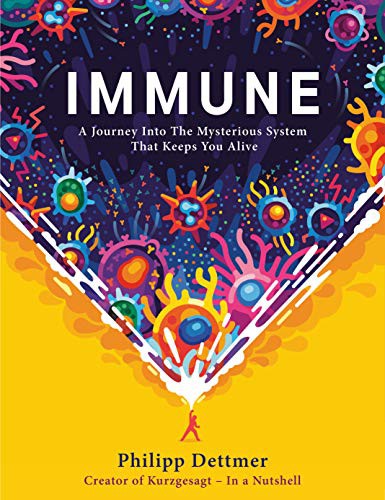
Immune
by Philipp Dettmer · 2021
The creator of Kurzgesagt turns the immune system, arguably the most complex thing in your body, into a genuinely gripping story of war, diplomacy, and constant low-grade crisis happening inside you right now.
Worth reading? Dettmer's real achievement is turning an notoriously confusing system, dozens of cell types with near-identical acronyms, into something you can actually follow, using consistent analogies and recurring 'characters' (cells and pathogens) instead of just naming everything and moving on. It's the most readable single explanation of the immune system for a general audience, full stop, even if immunologists will wince at a simplification here and there.
| Full Title | Immune: A Journey into the Mysterious System That Keeps You Alive |
|---|---|
| Author | Philipp Dettmer |
| Published | 2021 |
| Publisher | Random House |
| Category | Science & Nature |
| Favorite quote | “Fever is not a malfunction. It is a weapon.” |
The Verdict
The immune system is genuinely one of the hardest subjects to explain well, because it’s not one mechanism, it’s dozens of cell types with near-identical acronyms cooperating and fighting each other in overlapping ways. Dettmer solves this the same way Kurzgesagt solves it on video: consistent visual language and recurring characters instead of just naming everything and hoping it sticks.
It won’t satisfy anyone who already has formal immunology training, and it isn’t trying to. What it does better than almost anything else on the shelf is make a beginner actually understand why you get a fever, why vaccines work, and why your own immune system occasionally attacks you.
Read it if you want the clearest possible walkthrough of how your immune system actually functions. Skip it if you’ve already studied immunology formally, the simplifications here are a feature for beginners and a limitation for experts.
you want the clearest possible explanation of how your immune system actually works, told with the same visual, story-driven clarity as Kurzgesagt's videos
you already have a strong immunology background -- this is written for total beginners, and the simplifications that make it accessible will feel basic if you've studied the subject formally
Book Summary
The immune system isn't one thing but two cooperating systems: the fast, nonspecific innate immune system (skin, mucus, general-purpose cells like macrophages and neutrophils) that responds immediately to anything foreign, and the slower, highly specific adaptive immune system (T cells, B cells, antibodies) that learns to recognize particular threats and remembers them for years or decades.
Dettmer frames most of what you experience as being sick, fever, fatigue, inflammation, swelling, as your immune system's side effects rather than the disease itself doing the damage directly; the immune response is often what makes you feel bad, because a full-scale internal war is genuinely costly to run.
A recurring theme is how much of the immune system's danger comes from misfiring against the body itself: allergies, autoimmune disease, and the dangerous overreaction called a cytokine storm are all framed as the same well-intentioned system going wrong in different ways, not as separate categories of failure.
Top 8 Lessons from Immune
- Your immune system has two distinct arms: a fast, general-purpose innate response and a slower, highly specific adaptive response that builds long-term memory of past threats.
- Most symptoms of being sick, fever, fatigue, inflammation, are caused by your immune system's own response, not by the pathogen directly damaging you.
- Vaccines work by training the adaptive immune system's memory cells against a harmless version or piece of a pathogen, so the full response is ready before a real infection hits.
- Autoimmune disease, allergies, and cytokine storms are all variations of the same underlying failure mode: an otherwise well-functioning immune system misidentifying a threat or overreacting to a real one.
- Cancer largely exists because it evades immune detection by looking enough like normal cells to avoid triggering a response, not because the immune system can't in principle kill abnormal cells.
- The immune system's complexity (thousands of interacting cell types and signaling molecules) makes it more comparable to a whole ecosystem or bureaucracy than a single simple mechanism.
- Chronic, low-grade inflammation, distinct from an acute immune response to infection, is increasingly linked to a wide range of long-term health problems.
- The immune system has to constantly balance aggression against the body's own tissue -- too weak a response allows infection to spread, too strong a response causes autoimmune damage or a dangerous overreaction.
Top 6 Quotes from Immune
"Your body is a battlefield, and you don't even know it."
Philipp Dettmer, Immune
"Fever is not a malfunction. It is a weapon."
Philipp Dettmer, Immune
"The immune system is not a wall, it is a society."
Philipp Dettmer, Immune
"Your immune system needs to be able to kill your own cells. Your immune system has an actual license to kill you."
Philipp Dettmer, Immune
"At its very core, the immune system is a tool to distinguish the other from the self."
Philipp Dettmer, Immune
"Your immune system is also not a singular thing. It is a complex and interconnected collection of hundreds of bases and recruitment centers all over your body."
Philipp Dettmer, Immune
Frequently Asked Questions
Is Immune worth reading?
Yes -- it's the clearest general-audience explanation of the immune system available, turning a notoriously confusing subject into something genuinely followable.
What is Immune about?
Philipp Dettmer's explanation of how the human immune system works, covering the innate and adaptive immune responses, vaccines, allergies, autoimmune disease, and cancer, using consistent analogies and illustrations.
Do I need a science background to read Immune?
No -- it's written for complete beginners, with the same accessible style as Dettmer's Kurzgesagt YouTube videos.
Is Immune scientifically accurate?
Broadly yes, though as an accessible primer it simplifies some nuance that a formal immunology background would fill in -- treat it as an excellent starting point, not a clinical reference.
Does Immune have illustrations?
Yes -- the book is heavily illustrated in the same visual style as Kurzgesagt's videos, which helps track the many cell types involved.
Ready to read it?
Get Immune on Amazon