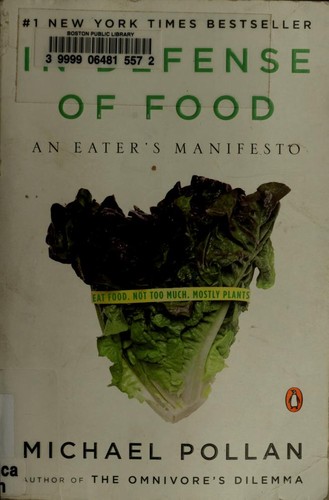
In Defense of Food
by Michael Pollan · 2008
Michael Pollan condenses his eating philosophy into seven words -- 'Eat food. Not too much. Mostly plants.' -- then spends the book explaining why decades of nutrition science got the details wrong.
Worth reading? In Defense of Food is the sharper, more useful sequel to The Omnivore's Dilemma because it finally answers the question that book raised but didn't: given all this, what should I actually eat? Pollan's critique of 'nutritionism' -- the reduction of food to isolated nutrients like fat or fiber, which food science then either demonizes or promotes -- is a genuinely useful lens for reading nutrition headlines skeptically. The seven-word mantra at its center is memorable because it's simple, not because it's the final scientific word.
| Full Title | In Defense of Food: An Eater's Manifesto |
|---|---|
| Author | Michael Pollan |
| Published | 2008 |
| Publisher | Penguin Press |
| Category | Health & Fitness |
| Favorite quote | “Eat food. Not too much. Mostly plants.” |
The Verdict
This is the book The Omnivore’s Dilemma was building toward. Pollan spends that earlier book diagnosing the industrial food system, and this one answers the practical question it left hanging: given all that, what do I actually put on my plate?
The “nutritionism” critique is the part worth remembering even if you forget everything else – it’s a genuinely useful lens for reading the next contradictory nutrition headline with some skepticism, instead of chasing whatever nutrient is in fashion this year.
Read it if you want a simple, food-first alternative to nutrient-counting, and you’re willing to trade clinical rigor for a clear, memorable rule of thumb. Skip it if you need citation-heavy, trial-based nutrition science – Pollan himself admits that’s not what this book is doing.
you're tired of contradictory nutrition headlines and want a clear, food-first alternative to counting nutrients, built on Pollan's critique of what he calls 'nutritionism'
you want a book grounded in clinical trial data and citations -- Pollan's case is more journalistic and philosophical than rigorously evidence-based, and he says as much himself
Book Summary
Pollan's core target is what he calls "nutritionism" -- the tendency of nutrition science and the food industry to reduce whole foods to isolated nutrients (fat, fiber, omega-3s), then market processed products based on those isolated claims while losing sight of the food itself.
He argues that a food's traditional, minimally processed form -- eaten in the way a given culture has eaten it for generations -- is usually a better guide to healthy eating than the latest single-nutrient headline, since traditional diets weren't engineered around any one nutrient claim.
The book's practical guidance collapses into the phrase "Eat food. Not too much. Mostly plants," with each word doing work: "food" means whole, recognizable ingredients rather than processed products; "not too much" targets portion size and eating in response to hunger; "mostly plants" nudges toward a plant-heavy, not necessarily meat-free, diet.
Pollan is explicit that his approach is a rule of thumb built from journalism and food history, not a clinical program, and he encourages skepticism toward any diet claim -- including his own -- that oversimplifies a complicated relationship between food, culture, and health.
Top 8 Lessons from In Defense of Food
- 'Nutritionism' -- reducing food to isolated nutrients like fat, fiber, or omega-3s -- causes both nutrition science and food marketing to lose sight of whole foods in favor of engineered health claims.
- A food that requires a health claim on its packaging is often a sign it's a processed product, not a whole food -- whole foods rarely need to advertise their own nutrient content.
- Traditional diets, eaten the way a culture has eaten for generations, are a more reliable guide to healthy eating than the latest single-nutrient headline, because they weren't engineered around one nutrient.
- 'Eat food' means prioritizing ingredients your great-grandmother would recognize as food, over heavily processed products built from refined starches, sugars, and additives.
- 'Not too much' targets portion size and mindful eating, treating overeating as a bigger risk for most people than any single nutrient choice.
- 'Mostly plants' pushes toward a plant-heavy diet without demanding strict vegetarianism, echoing patterns Pollan observed across many traditional diets worldwide.
- Nutrition science has repeatedly reversed itself on major claims (fat, cholesterol, specific vitamins), which is itself a reason for skepticism toward any single new nutrient headline.
- Cooking your own food from whole ingredients gives you more control over what's actually in your diet than relying on packaged products marketed as healthy.
Top 4 Quotes from In Defense of Food
"Eat food. Not too much. Mostly plants."
Michael Pollan, In Defense of Food
"You are what what you eat eats."
Michael Pollan, In Defense of Food
"Don't eat anything incapable of rotting."
Michael Pollan, In Defense of Food
"Food is also about pleasure, about community, about family and spirituality, about our relationship to the natural world, and about expressing our identity."
Michael Pollan, In Defense of Food
Frequently Asked Questions
Is In Defense of Food worth reading?
Yes -- it's a clear, useful antidote to contradictory nutrition headlines, built around a simple and memorable food-first philosophy.
What is In Defense of Food about?
Michael Pollan critiques 'nutritionism,' the reduction of food to isolated nutrients, and argues for eating whole, traditional foods over processed products marketed on health claims.
What does 'Eat food. Not too much. Mostly plants.' mean?
It's Pollan's shorthand for the book's advice: eat whole, recognizable ingredients rather than processed products, watch portion size, and lean toward a plant-heavy diet.
Is In Defense of Food based on clinical research?
It's more journalistic and food-history based than clinical -- Pollan draws on traditional eating patterns and a critique of nutrition science's track record rather than presenting new trial data.
Ready to read it?
Get In Defense of Food on Amazon