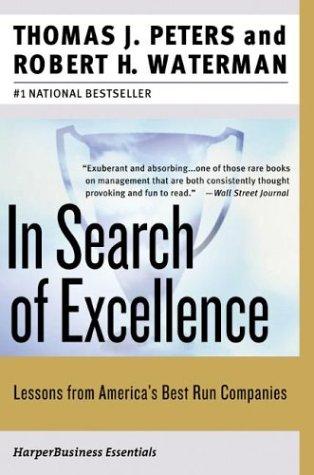
In Search of Excellence
by Tom Peters & Robert Waterman · 1982
The book that launched modern management-book publishing, built from McKinsey research into 43 'excellent' American companies, some of which later collapsed.
Worth reading? In Search of Excellence more or less created the modern business-book genre, and its eight principles (bias for action, staying close to the customer, autonomy and entrepreneurship among them) were genuinely influential. Its weak spot is well documented: several of the 43 companies held up as excellence exemplars ran into serious trouble within years of the book's release, which became a famous case study in survivorship bias. Read it for the history and the principles that held up, and pair the excitement with real skepticism about the case studies -- Good to Great, built with more rigorous methodology, is the better-aged successor.
| Full Title | In Search of Excellence: Lessons from America's Best-Run Companies |
|---|---|
| Author | Tom Peters & Robert Waterman |
| Published | 1982 |
| Category | Business & Money |
| Favorite quote | “Excellent firms don't believe in excellence -- only in constant improvement and constant change.” |
The Verdict
This is a foundational text in the modern business-book genre almost by accident of timing – it sold millions of copies and set the template that Good to Great, Built to Last, and dozens of others followed. Read it as management history and for the principles that genuinely held up (bias for action, staying close to the customer), but treat the specific company case studies as a cautionary tale about survivorship bias, not a blueprint.
you want the historical foundation of modern management writing and the eight principles that shaped a generation of corporate strategy
you want a track record that held up, a notable share of the book's 43 'excellent' companies (including several tech and retail names) struggled or failed within a decade of publication
Book Summary
Peters and Waterman studied 43 companies they identified as excellent by financial performance and reputation, and distilled eight common attributes: a bias for action, staying close to the customer, fostering autonomy and entrepreneurship within the company, driving productivity through people rather than just systems, being hands-on and value-driven, sticking to what the company knows, keeping structure simple with lean staff, and maintaining simultaneous loose-tight properties (strong central values, high operational autonomy).
The book's most famous flaw became a management-research case study in itself: many of the 43 "excellent" companies underperformed or fell into serious difficulty within a decade, exposing how the study selected on already-successful companies at a single point in time rather than tracking what actually sustains excellence over the long run -- a methodological warning that shaped how later business books, including Good to Great, tried to correct for survivorship bias.
Top 7 Lessons from In Search of Excellence
- A 'bias for action' -- doing and adjusting over exhaustive planning -- beats analysis paralysis in most operating environments.
- Staying genuinely close to the customer surfaces problems and opportunities that internal metrics miss.
- Autonomy and entrepreneurship within a large company sustain innovation better than top-down control alone.
- Productivity gains come more reliably from engaged people than from systems and processes alone.
- Stick to what the company actually knows how to do well -- unrelated diversification is a common failure mode.
- Keep organizational structure lean and simple, even as the company scales.
- Be skeptical of any 'excellence' study built from a snapshot in time -- sustained excellence is much harder to prove than a single successful moment.
Top 4 Quotes from In Search of Excellence
"Excellent firms don't believe in excellence -- only in constant improvement and constant change."
Tom Peters & Robert Waterman, In Search of Excellence
"The excellent companies are, above all, brilliant on the basics."
Tom Peters & Robert Waterman, In Search of Excellence
"Creativity is thinking up new things. Innovation is doing new things."
Tom Peters & Robert Waterman, In Search of Excellence
"Every excellent company we studied is clear on what it stands for, and takes the process of value shaping seriously."
Tom Peters & Robert Waterman, In Search of Excellence
Frequently Asked Questions
Is In Search of Excellence worth reading?
Worth reading for its historical influence and the eight principles that held up, but read the case studies with real skepticism -- several of the 43 'excellent' companies struggled badly within a decade of publication.
What companies did In Search of Excellence study?
43 large American companies identified as excellent based on financial performance and reputation in the early 1980s, including names in tech, retail, and consumer goods -- several of which later underperformed or failed.
Why is In Search of Excellence criticized?
Its central methodological flaw is survivorship bias -- it studied companies that looked excellent at one moment without tracking whether that excellence was sustainable, and a notable number of the profiled companies later struggled.
What's a better-aged alternative to In Search of Excellence?
Good to Great, published two decades later, was built with a more rigorous comparison methodology specifically designed to address the kind of survivorship bias that undermined In Search of Excellence.
Ready to read it?
Get In Search of Excellence on Amazon