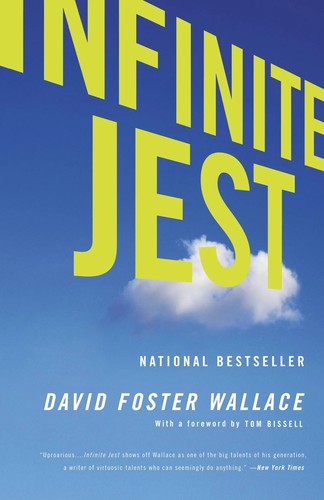
Infinite Jest
by David Foster Wallace · 1996
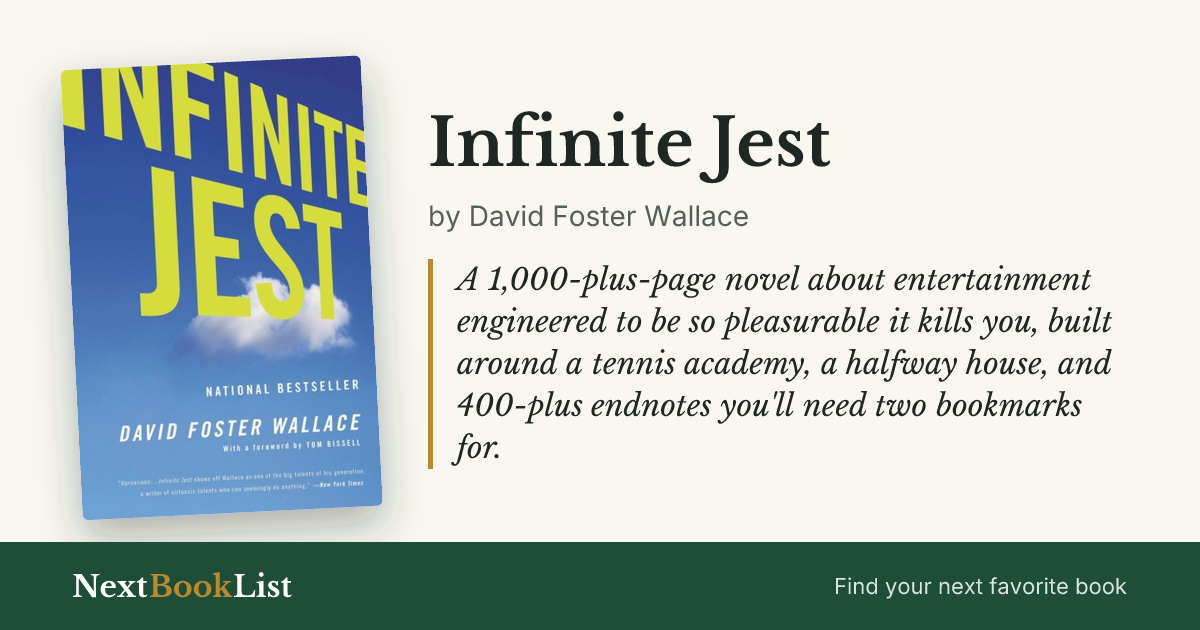
A 1,000-plus-page novel about entertainment engineered to be so pleasurable it kills you, built around a tennis academy, a halfway house, and 400-plus endnotes you'll need two bookmarks for.
Worth reading? Infinite Jest is the book people namedrop and don't finish, and that reputation is mostly earned -- it's long, structurally difficult, and the endnote-flipping breaks any reading rhythm on purpose. But nothing else captures American entertainment-addiction anxiety this thoroughly, not even Neil Postman's more focused Amusing Ourselves to Death. If you want proof Wallace can write short before committing to this, read his essay collection Consider the Lobster first.
| Author | David Foster Wallace |
|---|---|
| Published | 1996 |
| Publisher | Back Bay Books |
| Category | Fiction |
| Favorite quote | “The truth will set you free. But not until it is finished with you.” |
The Verdict
Wallace built a 1,000-plus-page argument that entertainment engineered for maximum pleasure is a kind of poison, then made his own novel maximally difficult to read, as if daring you to prove him wrong. It mostly works. The tennis-academy sections are the funniest writing about competitive ambition you’ll find anywhere, and the Ennet House sections are the most clear-eyed writing about addiction recovery in American fiction.
Nobody should start here as their first Wallace book – that’s what Consider the Lobster is for. But if you’ve read the essays and want the real commitment, this is still the one everyone’s talking about for a reason.
you want the defining postmodern American novel about addiction, entertainment, and loneliness, and you're willing to commit real time -- and two bookmarks -- to get there
you want tight plotting, a clean ending, or a book you can read in airport-lounge chunks -- Wallace deliberately withholds resolution and makes the reading experience itself an act of labor
Book Summary
The novel braids three settings into one story: the Enfield Tennis Academy, where junior prodigies train under grinding, quasi-military discipline; Ennet House, a halfway house for recovering addicts at the bottom of the same hill; and a Quebecois separatist cell hunting a film cartridge so entertaining that anyone who watches it loses all will to do anything else, including eat or sleep.
Addiction is the book's real subject, and Wallace treats tennis ambition, substance abuse, and entertainment consumption as three versions of the same compulsive structure. The novel argues that a culture built entirely around ironic detachment and frictionless pleasure is its own kind of addiction -- one that looks like freedom and functions like a cage.
Wallace deliberately makes the book's form mirror its content: the constant interruption of endnotes, the fractured chronology, and the sheer size all force the reader into the same kind of effortful, occasionally miserable discipline the book's characters need to get sober or get good at tennis. There is no shortcut through it, which is the point.
Top 10 Lessons from Infinite Jest
- The novel centers on a film cartridge so entertaining it's lethal -- anyone who watches it loses all will to do anything else.
- Enfield Tennis Academy trains junior tennis prodigies under grinding, quasi-military discipline that structurally mirrors addiction.
- Ennet House Drug and Alcohol Recovery House sits at the bottom of the same hill as the academy, pairing addiction and elite ambition as mirror obsessions.
- Quebecois separatist wheelchair assassins hunt the master copy of the lethal entertainment as a weapon against the U.S.
- Wallace structures time by corporate-sponsored calendar years (the Year of the Depend Adult Undergarment, among others), satirizing hyper-commercialization.
- Hal Incandenza's arc traces a brilliant mind's slow linguistic and emotional collapse, visible from the opening scene onward.
- Don Gately, a recovering addict working at Ennet House, becomes the novel's real moral center despite starting as a minor character.
- AA meetings are rendered with total sincerity, not irony -- Wallace treats recovery cliches as genuinely load-bearing.
- The novel argues that irony and detachment, taken as a cultural default, become their own kind of addiction and numbness.
- Footnotes and endnotes fracture the reading experience deliberately, forcing a physical labor that mimics the book's themes of interruption and compulsion.
Top 4 Quotes from Infinite Jest
"The truth will set you free. But not until it is finished with you."
David Foster Wallace, Infinite Jest
"Everybody is identical in their secret unspoken belief that way deep down they are different from everyone else."
David Foster Wallace, Infinite Jest
"You will become way less concerned with what other people think of you when you realize how seldom they do."
David Foster Wallace, Infinite Jest
"The thing about people who are truly and malignantly crazy: their real genius is for making the people around them think they themselves are crazy."
David Foster Wallace, Infinite Jest
Frequently Asked Questions
Is Infinite Jest worth reading?
Yes, if you actually finish it -- it's the most thorough fictional treatment of American entertainment addiction ever written. Skip it if you want a book you'll actually complete on a first try; a lot of people don't.
What is Infinite Jest about?
A film so entertaining it incapacitates anyone who watches it, orbited by a tennis academy, a halfway house for recovering addicts, and Quebecois separatists hunting the master copy.
Is Infinite Jest hard to read?
Yes -- it's over 1,000 pages with 400-plus endnotes (some containing their own footnotes), fractured chronology, and dense prose. It rewards patience more than any other novel on this site.
Who should read Infinite Jest?
Readers who want the defining postmodern novel about addiction and entertainment and are willing to commit serious time. Skip it if you want tight plotting or a fast read.
Ready to read it?
Get Infinite Jest on Amazon