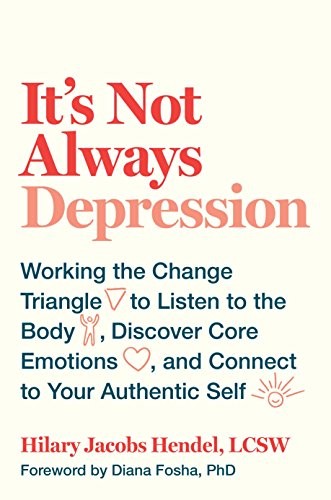
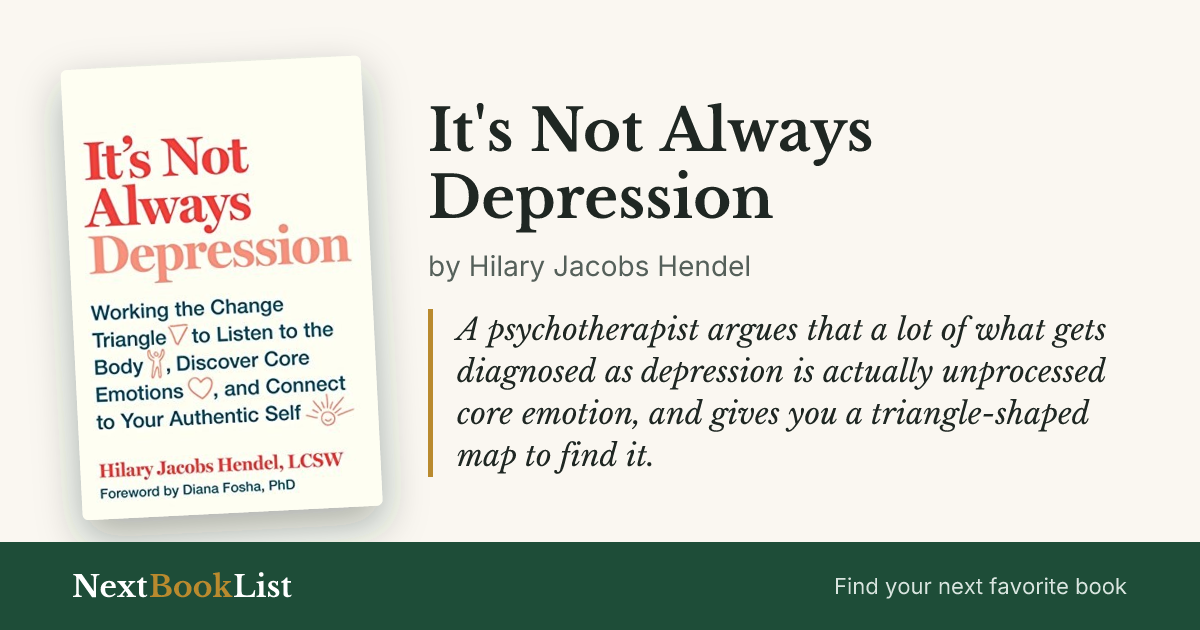
It's Not Always Depression
by Hilary Jacobs Hendel · 2018
A psychotherapist argues that a lot of what gets diagnosed as depression is actually unprocessed core emotion, and gives you a triangle-shaped map to find it.
Worth reading? The Change Triangle is a genuinely useful diagnostic tool, clearer and more actionable than most emotional-awareness books, and more clinically grounded than pop psychology because Hendel is working from AEDP therapy, not a personal theory. It doesn't replace The Body Keeps the Score for trauma specifically, but it's a better everyday tool for figuring out why you feel flat, anxious, or numb when nothing is technically wrong.
| Full Title | It's Not Always Depression: Working the Change Triangle to Listen to the Body, Discover Core Emotions, and Connect to Your Authentic Self |
|---|---|
| Author | Hilary Jacobs Hendel |
| Published | 2018 |
| Publisher | Random House |
| Category | Self-Improvement & Psychology |
| Favorite quote | “Healing is not just a desired outcome of treatment, it is a potential that is there from the start. We are wired to heal, to right ourselves, to grow and transform.” |
The Verdict
The Change Triangle earns its place because it’s a diagnostic tool, not just a comforting idea. Next time you’re inexplicably flat or anxious, you can actually locate where you are on it: what’s the defense, what’s the inhibitory emotion, what’s underneath. That’s more useful than being told to process your feelings without being told how.
It works best alongside therapy, not instead of it. Hendel is a working psychotherapist writing from clinical practice, and the book reads like a very good intake session, not a cure. If your low mood is severe or persistent, treat this as a companion to professional care, not a substitute.
you suspect your low mood is more about avoided feelings (anger, grief, fear) than a chemical default, and want a concrete framework instead of a vague 'sit with your feelings' suggestion
you're dealing with clinical depression that needs medical treatment -- this book is a useful add-on to therapy or medication, not a replacement for either
Book Summary
Hendel's Change Triangle has three points: core emotions (anger, sadness, fear, disgust, joy, excitement, sexual excitement) at the bottom, inhibitory emotions (shame, guilt, anxiety) that block them, and defenses (avoidance, numbing, intellectualizing, people-pleasing) that keep the whole system from surfacing. Her claim is that a lot of what looks like depression is actually the buildup of blocked core emotion, not a standalone mood disorder.
The therapeutic move is to notice the defense, name the inhibitory emotion underneath it, and work down to the core emotion so it can be fully felt and released, rather than managed, medicated, or argued with. Fully processed core emotion is short-lived; it's the blocking of it that creates chronic distress.
On the other side of the triangle is what she calls the openhearted state -- calm, curious, connected, compassionate, confident, courageous, clear -- which she presents as evidence the emotional work succeeded, not a permanent personality trait you either have or don't.
Top 9 Lessons from It's Not Always Depression
- A lot of what presents as depression is actually chronic avoidance of core emotions like anger, sadness, or fear.
- The Change Triangle has three parts: defenses, inhibitory emotions (shame, guilt, anxiety), and core emotions underneath both.
- Core emotions, when fully felt, are naturally short-lived -- it's blocking them that creates lingering distress.
- Shame and guilt often aren't the 'real' feeling -- they're inhibitors covering something more primary like anger or grief.
- Common defenses include intellectualizing, people-pleasing, numbing, and staying endlessly busy.
- The goal state after working the triangle is 'openhearted': calm, curious, connected, compassionate, confident, courageous, clear.
- Naming a feeling in the body -- where it sits, what it physically feels like -- is a core technique, not an afterthought.
- The method is drawn from AEDP (Accelerated Experiential Dynamic Psychotherapy), giving it a clinical basis rather than a purely anecdotal one.
- Healing is framed as something the nervous system is wired to do already, given the chance, not something forced from scratch.
Top 4 Quotes from It's Not Always Depression
"Healing is not just a desired outcome of treatment, it is a potential that is there from the start. We are wired to heal, to right ourselves, to grow and transform."
Hilary Jacobs Hendel, It's Not Always Depression
"When we judge others for what and how much they feel, it says more about our capacity to handle the emotions of others."
Hilary Jacobs Hendel, It's Not Always Depression
"When we are not aware of what we care about and why, we lose the ability to create the life we want and to feel our best no matter the circumstances life presents."
Hilary Jacobs Hendel, It's Not Always Depression
"Shame causes us to stay small, to shrink down."
Hilary Jacobs Hendel, It's Not Always Depression
Frequently Asked Questions
Is It's Not Always Depression worth reading?
Yes, if you want a concrete framework for locating what's underneath a flat or anxious mood. It's a strong companion to therapy, not a replacement for treating clinical depression.
What is the Change Triangle?
A three-part model -- defenses, inhibitory emotions (shame, guilt, anxiety), and core emotions (anger, sadness, fear, joy, and others) -- used to trace a low or numb mood back to the feeling underneath it.
Is this book a substitute for therapy or medication?
No. Hendel presents it as a tool to use alongside professional care, especially for anyone dealing with clinical depression rather than situational low mood.
Who should read It's Not Always Depression?
Anyone who suspects their low mood is really avoided anger, grief, or fear and wants a specific framework rather than generic advice to 'process your feelings.'
Ready to read it?
Get It's Not Always Depression on Amazon