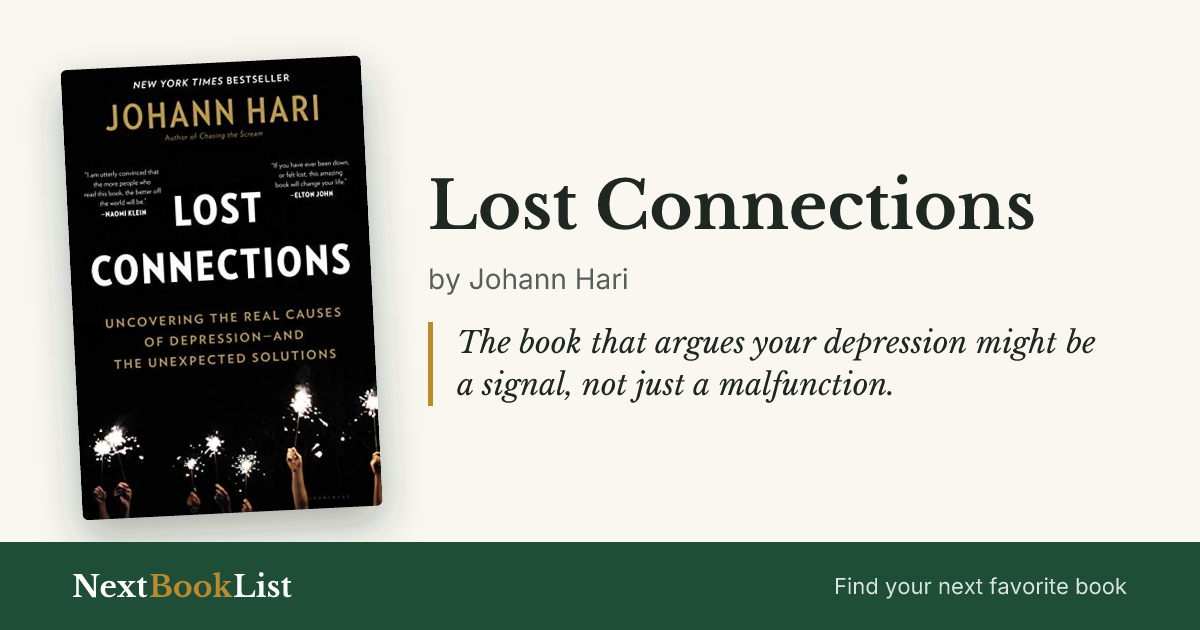
Lost Connections
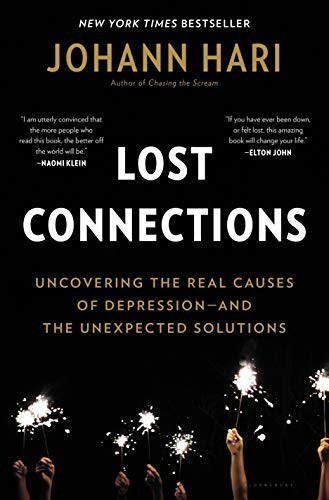
by Johann Hari · 2018
The book that argues your depression might be a signal, not just a malfunction.
Worth reading? Lost Connections is the more actionable read next to Andrew Solomon's The Noonday Demon. Solomon's book is an exhaustive, beautifully written encyclopedia of depression; Hari's is a reported argument with a thesis -- that disconnection (from meaningful work, other people, status, nature, a hopeful future) is doing more damage than we admit, and that treating only brain chemistry misses most of the picture. Skip it if you're currently in crisis -- this is a book to read when you're stable enough to think about causes, not a substitute for a therapist or a psychiatrist. Hari is also upfront that he's not anti-medication, just against treating medication as the whole answer, so don't read this as a case against treatment you're currently relying on.
| Full Title | Lost Connections: Uncovering the Real Causes of Depression – and the Unexpected Solutions |
|---|---|
| Author | Johann Hari |
| Published | 2018 |
| Publisher | Bloomsbury Publishing |
| Category | Self-Improvement & Psychology |
| Favorite quote | “You are not a machine with broken parts. You are an animal whose needs are not being met.” |
The Verdict
Johann Hari spent years interviewing the scientists behind the chemical-imbalance theory of depression, and came back with an uncomfortable finding: it’s not the whole story. Lost Connections argues that disconnection from work, people, and purpose is doing more damage than we’re willing to name. It’s a hard book to read passively – it asks what’s actually missing from your life, not just what’s wrong with your brain.
you've been told your depression is just a chemical imbalance and it never fully explained your experience
you're in crisis right now and need clinical treatment, not a book reframing the causes of depression
Book Summary
The dominant story about depression -- that it's caused by a chemical imbalance in your brain -- is incomplete, and Hari spent years interviewing scientists who study the social and psychological causes that story leaves out. He's careful to say biology matters, but argues it's not the whole story, and treating it as the whole story leaves people without real solutions.
Depression and anxiety often track with disconnection: from meaningful work, from other people, from status and respect, from the natural world, from a secure future, and from childhood trauma that was never resolved. Hari calls these "lost connections," and argues that reconnecting -- not just medicating -- is where real, lasting relief tends to come from.
Solutions that work address the disconnection directly: rebuilding community, finding meaningful work, addressing loneliness, and in some cases restructuring the conditions (like unstable work or isolating cities) that caused the problem in the first place. This is a bigger ask than a pill, which is exactly Hari's point -- the real fix is often social, not just chemical.
Top 9 Lessons from Lost Connections
- The chemical-imbalance story of depression is incomplete, not necessarily wrong.
- Depression often tracks with disconnection -- from work, people, status, nature, or the future.
- Meaningless work is a documented risk factor for depression, not just an inconvenience.
- Loneliness is a measurable driver of depression, not a vague complaint.
- Unresolved childhood trauma shows up in adult depression more often than people admit.
- Treating only the biological symptom can leave the actual cause untouched.
- Reconnecting to community and meaning produces relief that medication alone often can't.
- Depression can be a rational response to an irrational way of living, not just a malfunction.
- Fixing the environment -- unstable work, isolating cities -- matters as much as fixing the individual.
Top 3 Quotes from Lost Connections
"You are not a machine with broken parts. You are an animal whose needs are not being met."
Johann Hari, Lost Connections
"If you are depressed and anxious, you are not weak, and you are not crazy. You are a human being with unmet needs."
Johann Hari, Lost Connections
"Depression is in fact a form of grief -- for our own lives not being as we want them to be."
Johann Hari, Lost Connections
Frequently Asked Questions
Is Lost Connections worth reading?
Yes, especially if the standard chemical-imbalance explanation of your depression never felt complete. It's a reported argument, not a memoir, and it treats the social causes of depression seriously.
What is the main idea of Lost Connections?
Depression and anxiety are driven by disconnection -- from meaningful work, people, status, nature, and a secure future -- not just brain chemistry, and reconnecting is often where real relief comes from.
Is Lost Connections against antidepressants?
No. Hari says he's not anti-medication, just against treating it as the only answer. Read it as an argument for addressing causes alongside treatment, not instead of it.
Who should read Lost Connections?
Anyone who's felt like the chemical-imbalance explanation of their depression left something out. Skip it if you're in an acute crisis -- talk to a clinician first.
Ready to read it?
Get Lost Connections on Amazon