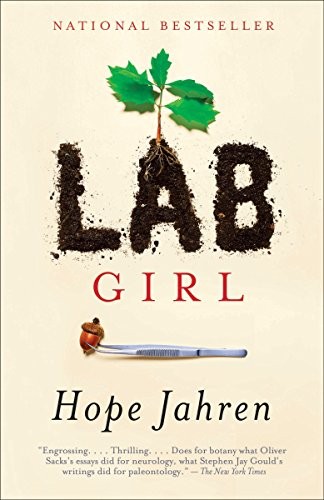
Lab Girl
by Hope Jahren · 2016
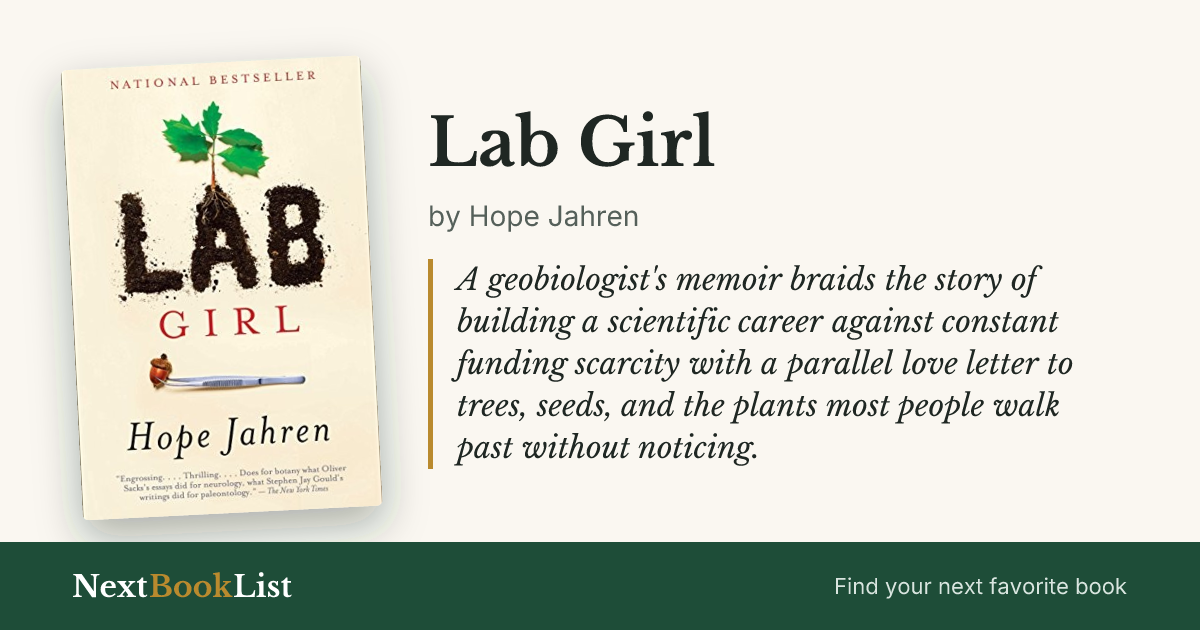
A geobiologist's memoir braids the story of building a scientific career against constant funding scarcity with a parallel love letter to trees, seeds, and the plants most people walk past without noticing.
Worth reading? Lab Girl works because Jahren refuses to romanticize either half of her story. The science career is shown as chronic underfunding, unstable jobs, and grinding lab work, not a triumphant montage. The plant chapters, interspersed between memoir sections, do double duty as genuine botany writing and quiet commentary on resilience, growth, and starting over. It earns its comparisons to Wild and H Is for Hawk without copying either.
| Full Title | Lab Girl |
|---|---|
| Author | Hope Jahren |
| Published | 2016 |
| Publisher | Knopf |
| Category | Science & Nature |
| Favorite quote | “A flower is really just a leaf that has learned how to fall in love.” |
The Verdict
The plant essays could have felt like padding between memoir chapters. They don’t, because Jahren writes them with the same specificity and stubbornness she brings to her own story – a seed waiting decades to germinate reads less like a metaphor she’s forcing and more like something she genuinely noticed first, then realized applied to her own life.
What sets this apart from the shelf of “scientist writes a memoir” books is the honesty about money. Jahren doesn’t gloss the grant-chasing, the borrowed equipment, the years of unstable positions. That’s the actual texture of a science career for most people who have one, and it’s rarely on the page this directly.
Read it if you want a memoir about resilience and obsessive partnership that treats plant science as more than decoration. Skip it if you’re looking for a conventional, chapter-by-chapter popular botany book – the science here serves the memoir, not the other way around.
you want a memoir about what doing real science actually costs -- financially, emotionally -- alongside genuinely moving writing about plant life
you want a straightforward popular-science book about botany -- this is a memoir first, with the plant science woven in as metaphor and interlude, not the main subject
Book Summary
Jahren structures the book as alternating chapters: her own life story (childhood in her father's physics lab, an unconventional path through grad school, building and rebuilding labs across several university jobs) interleaved with short standalone essays about plant biology -- seeds, roots, leaves -- that mirror the memoir's themes without stating the parallel outright.
The financial reality of academic science is a constant undertone: grant-writing as a survival skill, equipment bought with personal money, and a career built on relentless improvisation rather than institutional generosity, especially once she and her research partner Bill become a package deal that universities have to accommodate.
Her long working partnership with Bill, a itinerant lab manager who moves with her from job to job, becomes the book's emotional core -- a decades-long collaboration built on mutual obsession with the work rather than romance, treated with as much care as any relationship in the book.
Top 8 Lessons from Lab Girl
- Academic science, even at the level of a career scientist with a permanent position, runs on chronic underfunding and improvisation, not the steady institutional support outsiders assume exists.
- A seed's ability to wait, sometimes for decades, for the right conditions to germinate mirrors the book's larger theme of patience and delayed reward.
- Long-term working partnerships (Jahren and her lab manager Bill) can be as central to a life's meaning as romantic or family relationships, and deserve to be written about with the same weight.
- Building a lab from scratch multiple times across job changes is a hidden, rarely discussed cost of an academic science career.
- Plants' apparent passivity hides intense competitive strategy -- for light, water, and space -- that Jahren repeatedly uses to reframe what looks like stillness as active struggle.
- Mental health struggles (Jahren writes candidly about bipolar disorder) can coexist with, and sometimes fuel, a demanding scientific career, rather than being incompatible with it.
- Trees and roots invest in structures (deep root systems, stored resources) built for a future they can't fully predict, a discipline Jahren ties back to how she approaches funding and lab-building.
- Being taken seriously as a woman in a male-dominated scientific field required Jahren to repeatedly prove competence that male colleagues were simply assumed to have.
Top 4 Quotes from Lab Girl
"A flower is really just a leaf that has learned how to fall in love."
Hope Jahren, Lab Girl
"Green plants are the only things in the universe that can make food out of nonliving ingredients."
Hope Jahren, Lab Girl
"Trees and rocks are not so different from each other as one might think."
Hope Jahren, Lab Girl
"Every acorn on the ground is just as viable as any other, and each one is trying to become a tree."
Hope Jahren, Lab Girl
Frequently Asked Questions
Is Lab Girl worth reading?
Yes -- it's a rare honest look at what an academic science career actually costs, paired with genuinely good writing about plants, without leaning too hard on either half.
What is Lab Girl about?
Geobiologist Hope Jahren's memoir of building a scientific career job by job, underfunded lab by underfunded lab, alongside her decades-long partnership with lab manager Bill, interwoven with essays on plant biology.
Is Lab Girl a science book or a memoir?
Primarily a memoir -- the plant biology chapters are real science writing but function as short standalone essays between the personal story, not the book's main subject.
Does Lab Girl require a science background?
No -- Jahren writes the plant chapters for a general audience, and the memoir chapters need no scientific background at all.
How does Lab Girl compare to other science memoirs like H Is for Hawk?
Similar in structure (personal story braided with nature writing) but Lab Girl is more explicitly about the mechanics and economics of a scientific career, not just grief processed through nature.
Ready to read it?
Get Lab Girl on Amazon